Frustration in adolescent dogs

Adolescence Isnโ€™t Disobedience: Understanding the 7-Month-Old Spaniel Brain

I recently responded to a post about a 7-month-old Cocker Spaniel who was โ€œpulling like a trainโ€ and they were asking for a harness that โ€œstops pullingโ€. Other phrases that kept coming up were ones I hear all the time:

โ€œHeโ€™s suddenly forgotten everything.โ€
โ€œHis attention span is like a gnatโ€™s.โ€
โ€œHeโ€™s pushing boundaries and meeting force with force.โ€

Welcome to canine adolescence.

This phase can feel like all your hard work has unravelled overnight, but what youโ€™re seeing isnโ€™t stubbornness, dominance, or your dog โ€œbeing naughtyโ€. Itโ€™s biology.


The Teenage Dog Brain (or: Why Your Dog Canโ€™t Put the Brakes On)

A 7-month-old dog is roughly equivalent to a 14-year-old human teenager.

Their body is developing rapidly, hormones are surging, and crucially โ€” their frontal cortex hasnโ€™t caught up yet.

The frontal cortex is the part of the brain responsible for:

  • Impulse control
  • Emotional regulation
  • Decision-making
  • The ability to pause and think before acting

In dogs, this area doesnโ€™t fully mature until around 18 months of age.

So when we expect a teenage dog to โ€œjust make better choicesโ€, weโ€™re asking them to use a part of the brain that quite literally isnโ€™t finished yet.


Be the Swan ๐Ÿฆข (Even When Youโ€™re Screaming Inside)

I often tell clients to be like a swan.

On the surface: calm, graceful, unbothered.
Underneath: paddling like mad, thinking โ€œfor goodness sakeโ€, and feeling frustrated.

Feeling frustration is normal. Itโ€™s human. Itโ€™s part of our emotional repertoire.

But dogs donโ€™t need us to win against them โ€” they need us to be smarter than their nervous system.

Meeting force with force during adolescence often escalates behaviour, because the dog simply doesnโ€™t have the neurological capacity to regulate themselves yet.


What Adolescent Stress Actually Looks Like

During this phase, dogs become more easily frustrated, and stress shows up in ways that often confuse owners.

You might see:

  • Scratching in the middle of play
  • Yawning when nothing seems tiring
  • Shaking off when theyโ€™re not wet
  • Avoiding things they were previously fine with
  • Lunging or barking at familiar sights
  • Sudden โ€œout of contextโ€ behaviours

These are stress displacement behaviours โ€” signs that the dogโ€™s nervous system is struggling to cope.

When pressure continues, dogs may opt for space-increasing behaviours, such as:

  • Pawing at you to make you stop
  • Mouthing or grabbing clothing
  • Snapping to create distance

This isnโ€™t aggression โ€” itโ€™s communication.


Redirect, Donโ€™t Confront

Instead of challenging the behaviour head-on, I prefer redirection using cues the dog already understands well.

One of my favourites is:

โ€œWhatโ€™s this?โ€

It taps into curiosity and makes the dog come towards you to see what theyโ€™re missing out on.

If you can teach:

  • โ€œUp upโ€ โ†’ you can teach โ€œOffโ€
  • โ€œCome and seeโ€ โ†’ instead of pushing away

Always ask yourself:

What is the opposite of the behaviour I donโ€™t want?

Examples:

  • Jumping up โ†’ a solid sit on a mat
  • Mouthing โ†’ stopping and picking up a toy
  • Recall issues โ†’ working very close for a long time to build value in staying with you

Distance is earned. Adolescents need to relearn proximity.


Puberty = Instincts Switching On

Puberty typically hits between 7โ€“9 months, and this is when a dogโ€™s breed-specific behaviours really start to emerge.

Under pressure or frustration, dogs revert to what they were selectively bred to do.

For example:

  • Spaniels like to hold and possess
  • Retrievers like to carry things in their mouths
  • Guardian breeds may grab and pull down

These behaviours often increase when:

  • The dog is frustrated
  • The dog doesnโ€™t know whatโ€™s being asked
  • Training lacks clarity
  • Tasks change too quickly

Dogs donโ€™t default to calm thinking under stress โ€” they default to instinct.


Why Frustration Tips Over So Fast (Especially on Lead)

Frustration builds pressure in the nervous system, and pressure needs an outlet.

This is why:

  • Dogs are often more reactive on lead than off
  • Tension on the lead escalates behaviour
  • Lack of movement increases emotional overflow

Under pressure, behaviour can escalate quickly into:

  • Barking
  • Lunging
  • Snapping

Not because the dog is โ€œbadโ€, but because their coping capacity has been exceeded.


A Note on Harness Battles

If getting equipment on and off has become a battle, you have two options:

1. Change the Equipment

Some dogs struggle with harnesses that go over the head.
step-in or Velcro harness can remove that stress entirely.

2. Go Back a Step

Slow the whole process down.

  • Break it into smaller steps
  • Reinforce calm behaviour
  • Reduce the โ€œfaffโ€

Sometimes removing the equipment altogether for a short reset helps, because the dog has learned to predict:

โ€œSomething uncomfortable or stressful is about to happen.โ€

If in doubt:

  • Change the cue
  • Change the equipment
  • Start again from scratch

There is no failure in resetting โ€” only information.


The Takeaway

Adolescence isnโ€™t a training problem.
Itโ€™s a developmental phase.

Your dog isnโ€™t giving you a hard time โ€” theyโ€™re having a hard time.

With clarity, patience, and an understanding of whatโ€™s happening inside that teenage brain, this phase doesnโ€™t have to be something you โ€œget throughโ€.

It can be something you guide them through โ€” calmly, consistently, and with empathy.

And yesโ€ฆ sometimes while paddling furiously under the surface ๐Ÿฆข

If you appreciated this post feel free to check out my previous post Help My Puppy Wonโ€™t Settle At Night here๐Ÿ‘ˆ

Before you go you might want to check out my 12 Days Of Woofmas by adding your email to my newsletter sign up page Here to get access to 12 days of canine science right into your inbox there will also be 12 videos to accompany those emails on a private section of this website as well as daily tasks to complete via email – so if you want to keep yourself busy over the Christmas period feel free to sign up now ๐Ÿ‘

Love from your friendly neighbourhood dog trainer and behaviourist.

S x

https://about-town-pets.com/newsletter-sign-up/

Help! My New Puppy Wonโ€™t Settle at Night

A gentle, gradual guide to peaceful nights in the first few weeks home

Bringing a new puppy home is magicalโ€ฆ and exhausting. One of the most common worries I hear from new puppy parents is:

โ€œMy puppy just wonโ€™t settle at night. Are we setting her up to never be able to sleep alone?โ€

Take a breath โ€” the answer is no.
In fact, a gradual, methodical transition is the very thing that prevents separation-related problems later on.

Your puppy has just come from sleeping in a pile of warm littermates. Suddenly sheโ€™s in a new home, new smells, new routines, and without her usual nighttime company. Reassurance in these early weeks isnโ€™t โ€œspoilingโ€ โ€” itโ€™s meeting a biological need for safety.

Letโ€™s walk through a gentle, practical plan that helps your puppy settle confidently at night, whether youโ€™re using a crate or a playpen.


Step One: Choose Where You Want Your Puppy to Sleep Long-Term

Before you start, decide what your end goal is. Do you want your dog to sleep:

  • In a crate beside your bed?
  • In a crate or pen downstairs?
  • In a specific room like the kitchen or living room?

Thereโ€™s no wrong answer โ€” choose the setup you can maintain long-term.

Tip: Most people find starting with the crate beside the bed much easier. You’re close enough for quick reassurance without allowing rehearsals of prolonged crying.


Option 1: Start Beside the Bed (My Recommended Option)

Begin with the crate or pen right next to the bed, within armโ€™s reach. Your presence helps your puppy regulate her emotions and settle back to sleep after tiny wobbles.

Week-by-week progression:

Week 1 โ€” Right at your bedside
Your hand can reach the crate easily. Reassure with a quiet word or a gentle touch if needed.

Week 2 โ€” End of the bed
Move the crate every 3 days or so, keeping your puppy successful and calm.

Week 3 โ€” Outside the bedroom door โ†’ Hallway โ†’ Bottom of the stairs
Small, steady changes. No big jumps.

Week 4 โ€” Final sleeping spot (e.g., living room or kitchen)
You may need to sleep on the sofa for a night or two depending on your puppyโ€™s confidence. Expect to get up for toilet trips and brief reassurance โ€” totally normal.


Option 2: Start Where the Crate Will Live (Downstairs)

If you prefer to begin downstairs, place the crate in the room you intend to use long-term โ€” kitchen or living room usually works best.

For the first few nights, sleep on the sofa nearby.
As your puppy settles more easily, gradually increase the distance between you and the crate until youโ€™re no longer needed in the room.

This mirrors the same progression as Option 1, just starting in a different location.


Important Caveats (The Things People Forget!)

1. Scoop-and-go is absolutely fine

In the early days, if your puppy wakes and you need to take her out now, pick her up and go quickly to avoid accidents. Youโ€™re not making a habit that will last forever โ€” youโ€™re preventing one.


2. The crate or pen must be big enough

Your puppy needs two zones:

  • A cosy sleep area
  • An area they could move to if they needed to toilet

Puppies genuinely donโ€™t want to soil where they sleep. If the space is too small, crying or accidents increase.


3. Set your puppy up for sleep success

Before bedtime, make sure she has:

  • Been out to toilet
  • Played a short game (nothing too exciting!)
  • Had her final meal or snack

A tired belly and brain settle best.


4. Phase out puppy pads sooner rather than later

Pads often encourage puppies to toilet wherever they smell previous pee spots.
If you use them temporarily, clean the area with an enzymatic cleaner to remove ammonia scents โ€” this prevents โ€œOh, I peed here before!โ€ repeat performances.


Reassurance Is Not a Bad Habit โ€” Itโ€™s Attachment Building

Your puppy is not manipulating you. Sheโ€™s not being โ€œnaughty.โ€
Sheโ€™s simply calling out for the family she knows is somewhere in the house.

Call-and-response crying is normal in the first weeks.

What youโ€™re watching for is intensity:

  • A few minutes of fussing? Normal.
  • More than 20 minutes with rising distress? She needs help.

After a toilet check, offer calm reassurance โ€” a hand on the crate, sitting nearby for a moment, a quiet voice. Once she settles, return to bed.

This is how puppies learn:
โ€œIโ€™m safe. My human comes when I need them. I can go back to sleep.โ€

That confidence becomes the foundation for healthy independence later.


Want Help With Crate Training?

The full gradual crate-training guide is available in my Black Friday Weekend Webinar Bundle which Iโ€™ve extended until midnight tonight for those who want a step by step guide on not only crate training all things home alone training as well as three of my other lost popular webinar topics :

Separation Anxiety Survival Guide

Letโ€™s Learn Loose Lead (prevent pulling)

Restart Recall & Creating A FOMO Recall

Tiny Dog Behaviour – Debunking The Little Dog Syndrome Myth

Plus step by step guides for both crate training and creating an off switch by training a Settle In Real Life – if this sounds right up your street then grab it at its current price of ยฃ35 instead of my normal bundle deal of ยฃ70 Book the last minute webinar bundle here ๐Ÿ‘ˆ


If you need support applying the steps with your puppy , just reach out โ€” thatโ€™s what Iโ€™m here for.

And if you appreciated this post you might want to check out my previous blog post Donโ€™t rush your rescue dog! Which applies to rehoming young dogs also๐Ÿ‘

Love from your friendly neighbourhood dog trainer- S x

Donโ€™t Rush Your Rescue Dog

Thereโ€™s nothing quite like the excitement of bringing home a new dog โ€” especially a rescue dog who has finally found the loving family they deserve. But if your new furry arrival has come from a kennel environment, particularly abroad, they need something far more important than adventures and busy schedules:

โœจ Time to decompress. โœจ

The Decompression Phase (4โ€“6 Weeks Minimum)

We humans want to do all the things right away โ€” walks, visitors, dog park trips, training classes. But for a rescue dog, especially one who has traveled a long way, this period is a huge life change.

Their nervous system needs time to recalibrate after the stress theyโ€™ve experienced.

โœ… Keep outings short and calm
โœ… Allow lots of quiet observation time
โœ… Home is the safe place โ€” help them learn that slowly

For the first few weeks, think less โ€œwalksโ€ and more:

๐Ÿšช Garden sniffing
๐Ÿ‘€ Watching the world safely
๐Ÿ›‹๏ธ Chilling with their new family

Youโ€™re building trust โ€” not a schedule.


Sleep + Chewing = Emotional Regulation

One of the best things you can do right now?

๐Ÿ› Prioritise rest.
๐Ÿฆด Offer healthy things to chew.

Chewing and rest promote calmness and basically tell your dogโ€™s brain,
โ€œYouโ€™re safe here.โ€

Try a cycle like:

โ€ข Short enrichment or training session
โ€ข Snuffle mat, lick mat, or a safe chew afterwards
โ€ข Encourage a nap

Foreign rescue dogs are often overstimulated by all the new sounds and sights โ€” not truly tired. They may need help learning how to settle initially.


Toilet Training Troubles? Check For Giardia

If thereโ€™s a lot of pooping happening (everywhere!) โ€” donโ€™t panic. For dogs coming from kennel environments or a stressful journey, Giardia is extremely common.

๐Ÿ’ฉ Take a stool sample to the vet
๐Ÿงผ Double-clean accidents with an enzymatic cleaner
โš ๏ธ Remember: It’s highly contagious and can reinfect

A stressed gut = a stressed brain, so clearing up tummy issues will help behaviour dramatically.

In some cases, a 24-hour fast (with plenty of hydration), followed by a gentle/bland diet, can help โ€” but always check with your vet first.


Restart Toilet Training โ€” Like You Would A Younger Dog

Once any medical issues are addressed, go back to basics:

โœ… Frequent garden trips (after sleep, play, meals)
โœ… Mark and reward immediately
โœ… Set them up for success from the start

And for now, track food intake until their digestion stabilises โ€” consistent meals mean consistent results.


How Much Exercise Is Right?

You may have heard the 5 minutes per month of age guideline.
Itโ€™s not a rule โ€” itโ€™s a reminder.

New rescue puppies should not be walked for ages on their tiny developing joints. Short, positive exposure is the goal.


Save the big adventures for later once theyโ€™re confident and secure.

I love using 3-day walk cycles for balance:
1๏ธโƒฃ Explore a little
2๏ธโƒฃ Practice calm confidence-building activities
3๏ธโƒฃ Rest and reset

Your relationship is the walk โ€” not the mileage.


The Adolescent Phase Is Comingโ€ฆ

If your female pup isn’t spayed yet, be prepared for:

โ€ข Restlessness
โ€ข Nesting behaviour
โ€ข Possible indoor accidents

Many females come into season around 9โ€“10 months but it can vary โ€” keep an eye out for behavioural changes and speak to your vet about timing.

For male adolescent dogs behaviours spike when hormones set in around 6-9 months old and can continue until 12 months and even 18 months old for larger breeds.


Final Words: Youโ€™re Doing Great โค๏ธ

Your rescue dog doesnโ€™t need perfection โ€” they need patience.

By slowing the pace, supporting their recovery, and listening to their needs, youโ€™re helping them feel safe enough to blossom into the dog they were always meant to be.

Because the real magic happens when a rescue dog realises:

๐Ÿซถ They are home.

โ€ฆโ€ฆlove from your friendly neighbourhood dog trainer and behaviourist.

And if you found this blog post helpful please check out my previous blog post here – Debunking the โ€œLittle Dog Syndromeโ€ Myth

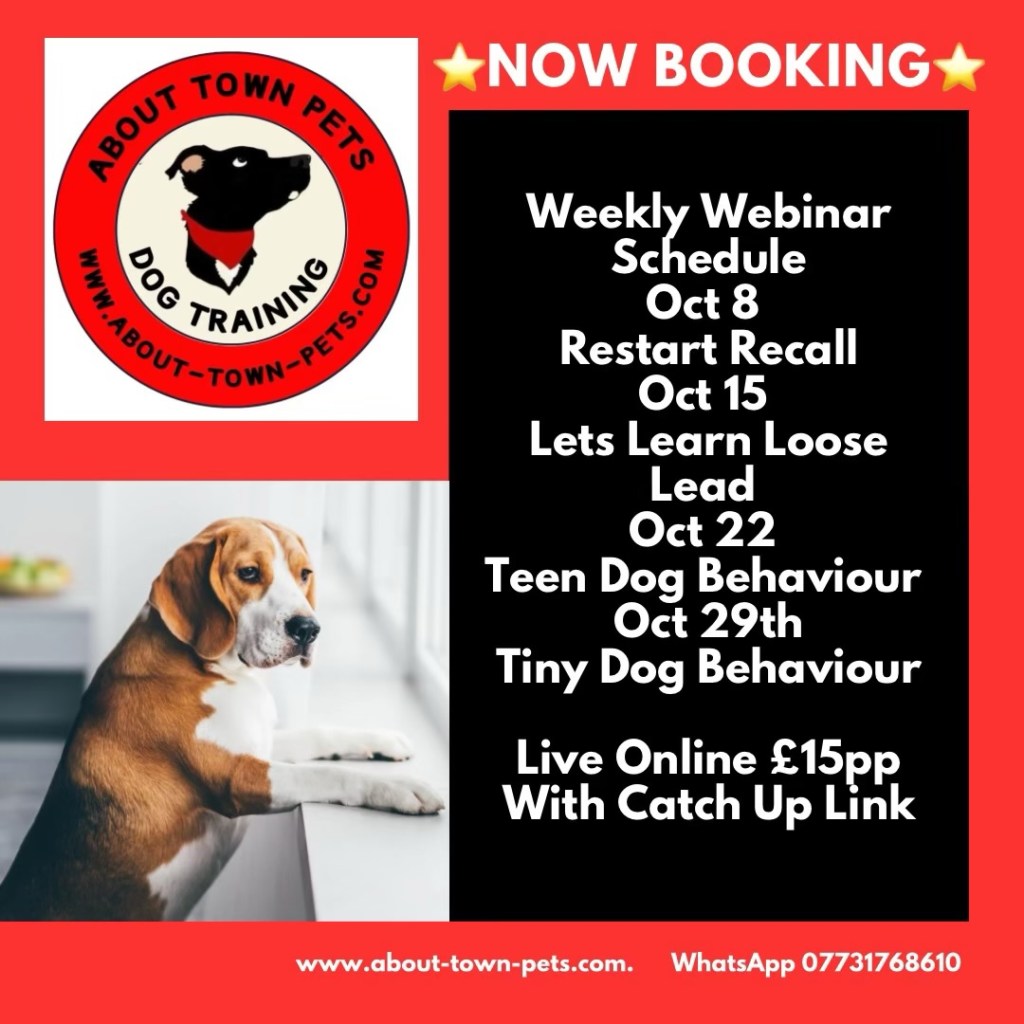
Canโ€™t make an in person session consider checking out my upcoming zoom webinar topics and using this link to book Book Weekly Webinars Here๐Ÿ‘ˆ


And if you would further help and live in the Plymouth or surrounding area please book in by filling in my training and behaviour questionnaire here New 1-2-1 Clients Start Here

Thanks . S

Little Dog Syndrome- What Small Breeds Really Need

Small dogs need big personalities for you to โ€œlistenโ€ to them.

If youโ€™ve ever heard the phrase โ€œlittle dog syndromeโ€, you might picture a tiny dog with big attitudeโ€”yapping, bossing other dogs around, maybe even snappy or reactive. Itโ€™s a phrase many people toss around with a wink. But as with many catchy sayings, the reality is far more nuanced than it seems.

What the phrase implies

The term suggests that small-breed dogs are inherently more problematic: more yappy, more aggressive, more spoiled. It frames size as the root cause of behaviour problems. But the truth: size alone doesnโ€™t determine behaviour. What does matter is why behaviour issues arise โ€” and how we support small dogs (and their owners) differently.

What the science reveals

  • Research shows that smaller dogs do have higher odds of owner-reported fearfulness and aggression than larger dogs โ€” but size is just one of many factors. For example, one large-scale study found that smaller body size correlated with higher risk of fear and aggression, but the authors emphasised that this is a broad, population-level trend, not a destiny for any individual dog.
  • Another key piece: early life and maternal care matter a lot. Puppies whose dams were less stressed, who gave more consistent licking/nursing and contact, develop into calmer, more resilient adults.
  • Behaviour issues in small dogs are frequently driven by pain or medical issues (for example dental disease, joint problems, airway or spine issues) rather than โ€œjust being a small dog with attitude.โ€ When pain is relieved, behaviour often improves.
  • Nutrition and training style matter too: diet can support behaviour improvement (though it isnโ€™t a silver bullet) and training methods that rely on rewards, respect and clear communication outperform punitive methods โ€” especially for smaller dogs.

So whatโ€™s really at play?

Here are the bigger drivers behind what gets labelled โ€œsmall dog syndromeโ€:

  • Higher vigilance: Many small breeds were bred to alert or watch (rather than herd or guard). That means a lower threshold to respond to stimuli (doorbell, stranger, passer-by).
  • Owner handling biases: Small dogs are easier to pick up, more likely to be carried, less likely to be handled like larger dogs (walked as much, trained as much). This can reduce their confidence and increase fear.
  • Overlooking health issues: Because theyโ€™re small, pain or discomfort in the joints, spine, teeth or airway may be overlooked โ€” and an irritable, anxious dog often looks like a behaviour problem.
  • Inadequate training/enrichment: Smaller dogs still need outlets for their breed-instincts, socialisation, movement and mental challenges โ€” these get missed if we think โ€œsmall = easy.โ€
  • Environment and management: Running into strangers, dogs or stimuli at high speed without a plan creates stress; small dogs are more vulnerable to feeling โ€œtrappedโ€ (less body mass, fewer escape options) so reading early signals matters.

What you can do to advocate for your small dog

1. Read the body language early

Look for the subtle-before-the-problem: lip licks, head turn, freezing, shifting weight, crouching or making the body smaller. These arenโ€™t โ€œcuteโ€ โ€” theyโ€™re stress signals. Intervene early: give space, create a barrier (your body, a bench), redirect to a positive behaviour (scatter a few treats, hand-target, escort to safe zone).

2. Check health/pain before punishing behaviour

Especially in small breeds, do a โ€œvet auditโ€ when you see a new or changed behaviour: dental examination (crowded jaws are common); joint check (patella, spine/neck, hips); airway/trachea or breathing issues; signs of neuropathic pain (especially in certain breeds). Pain-driven behaviour is teachable โ€” but only after treating the cause.

3. Tailor training to small-dog size & needs

  • Use a well-fitted Y-front or front-clip harness instead of a tight collar (especially for toy or brachycephalic breeds)
  • Teach โ€œstationโ€ (mat on the floor or low bench) so your small dog has a safe base
  • Practice โ€œhand-target,โ€ โ€œmiddleโ€ (dog between your legs), โ€œscatter-sniffโ€ breaks during walks
  • Use short sessions frequently (2โ€“3 mins several times a day) to suit small body/attention spans
  • Build โ€œconsent handlingโ€ (dog comes to you for grooming/touch rather than you always picking it up) to build resilience and trust

4. Provide enrichment & mental outlets

Small breed owners often think โ€œless space = less need.โ€ But with little dogs especially, enrichment helps reduce reactivity and fear: puzzle feeders, snuffle mats, short high-value walks, nosework, training games, โ€œLook at thatโ€ with new people/dogs at distance.

5. Change the narrative: dismissing โ€œsmall dog = easyโ€

Educate your network: small dogs can do a lot โ€” we just need to support them right. They deserve the same structured socialisation, and predictable training, and patience. The phrase โ€œsmall dog syndromeโ€ stops being an excuse and becomes a stepping-stone to doing better.

6. Create safe walks & encounters

Because small dogs are physically closer to obstacles, less body-mass to buffer stress, teach your clients / owners to anticipate:

  • Use visual scanning: whatโ€™s ahead? Could another dog/child move towards us quickly?
  • If yes: U-turn early or cross the road, give space.
  • If in doubt keep moving – lead reactivity is often an attempt to create space if we take on the role of manager we can always help the dog out and keep moving- knowing your dogs initial safe distance is important.
  • Practice a โ€œgo-toโ€ cue like โ€œfind itโ€ then drop a handful of treats behind a parked car or something else in the environment to help to block the oncoming trigger just until the moment has passed.
  • Use a โ€œsafe spaceโ€ or magic mat at dog-friendly cafรฉs or venues so your dog can climb up, feel elevated and choose to stay. Being sure that everyone understands to โ€œignoreโ€ your dog where needed.

Final word

Your little dog isnโ€™t โ€œjust small.โ€ Itโ€™s a fully capable, complex individual with specific needs. Yesโ€”size adds a few extra risk parameters (fear threshold, vulnerability to pain, owner biases) but it never dictates the future. By understanding the science (maternal care, early life, genetics, health, training), reading the signals early, and advocating smartly, you turn โ€œsmall dog syndromeโ€ from a myth into an opportunity: a chance to say โ€œsmall dogs count tooโ€”and actually, they hold the key to some of the best, most fun, most rewarding dog-human partnerships.โ€

Letโ€™s shift the conversation: small dogs deserve big support.

And if you found this blog helpful you might also like my previous blog post on ๐Ÿ‘‡

How To Tackle Jumping Up

BOOK ZOOM WEBINARS HERE

โ€ฆ love from your friendly neighbourhood dog trainer โ€“ S 

If you want to work with me 1-2-1 please check out my Training & Behaviour Questionnaire Link To Get Started HERE ๐Ÿถ
โ€”

Please consider signing up to my Weekly Newsletter to find out about all upcoming online session and in person sessions available over the next few weeks.

Sign Up Using This Link

Jumping Up -Why It Happens and How To Tackle A Common Issue

If your once well-behaved puppy suddenly seems to forget everything theyโ€™ve learned, youโ€™re not alone. The adolescent phase โ€” usually between 6 to 18 months โ€” can bring a wave of new challenges as your dogโ€™s brain and body mature. Think of it as the teenage phase of their development: hormones, distractions, and big feelings all at once!

One of the most common issues owners face during this stage is jumping up โ€” especially around people. The good news? With management, consistency, and a well-practised alternative behaviour, your dog can absolutely learn better ways to greet.


Why Does It Happen?

Jumping up is natural for dogs. They do it to get attention, greet face-to-face, or release excitement. During adolescence, impulse control dips while energy and social motivation soar โ€” not the best combo! Add in the fact that new people, places, and smells are super stimulating, and itโ€™s easy to see why polite manners can vanish overnight.


Step 1: Manage Before You Train

Use management to prevent unwanted rehearsals of the behaviour. Keep greetings calm and controlled โ€” use a lead or long line, create space, and avoid letting the dog practise jumping.
This isnโ€™t forever! Itโ€™s just until your teen pup is emotionally mature enough to handle more stimulation without losing focus.


Step 2: Train an Alternative Behaviour

Start at a distance where your dog can succeed. Practice a calm, incompatible behaviour such as:

  • An automatic sit
  • A โ€œgo to matโ€ or โ€œplaceโ€ cue
  • A relaxed settle on a bed

Reinforce these generously so they feel just as rewarding as saying hello by jumping.


Step 3: Keep Rewards Low

Always deliver rewards on the floor. This prevents your dog from anticipating treats coming from above โ€” which can encourage more jumping. It is inevitable if everything fun happens at waist height then the dog is much more likely to want to get to the exciting thing more quickly by jumping up as excitement builds so get into the habit of asking your dog to โ€œFind Itโ€ on the floor initially.


Step 4: Repetition Builds Reliability

Consistency is everything. It takes around 3โ€“4 weeks for old habits to fade and new ones to stick.
And remember: one excitable jump can set you back a few practice sessions โ€” so think long-term, not instant results.

A great rule of thumb: train 100 reps for the time youโ€™ll need that 101st in real life. Build the muscle memory before you need it.


Step 5: Check the Motivation

Ask yourself:

  • Is my dog overstimulated by people or the environment?
  • Do they know how to switch off?

Try visiting public places to practise simply watching and settling. Start with 5โ€“10 minutes at a distance, then gradually work closer as your dog learns to stay calm.


Final Thoughts

A well-timed โ€œsitโ€ or โ€œwhatโ€™s this?โ€ is always more effective than shouting โ€œno.โ€ When dogs understand whatโ€™s expected, they feel secure โ€” and calm dogs make better choices.

Adolescence can be challenging, but itโ€™s also an opportunity to deepen your bond through patience, practice, and clear communication.

If youโ€™d like to learn more about why adolescent dogs behave this way and how to support them through it, join my Teen Dog Behaviour Webinar on Wednesday nights โ€” dates for the next rotation of webinar topics can be found below๐Ÿ‘‡ ๐Ÿพ

And if you found this blog helpful you might also like my previous blog post on ๐Ÿ‘‡

7 Tips To Help With Loose Lead Training

โ€ฆ love from your friendly neighbourhood dog trainer – S

If you want to work with me 1-2-1 please check out my Training & Behaviour Questionnaire Link To Get Started HERE ๐Ÿถ

๐Ÿฆฎ Help! My Dog Pulls on the Lead

7 Simple Tips to Get Started with Loose Lead Training

Pulling on the lead is one of the most common frustrations I hear about โ€” and honestly, I get it. No one wants to feel like theyโ€™re being dragged down the road by a furry sled team! The good news? Loose lead walking is totally achievable with a few smart tweaks and some patience. Here are seven tips to help you get started.

Tibetan spaniel type tan brown dog pulling to one side with mouth open and tongue out

1๏ธโƒฃ Rethink Your Walk (and Download My Anatomy of a Walk Graphic)

Before you even clip the lead on, think about how your walks are structured. You can grab my free โ€œAnatomy of a Walkโ€ graphic by signing up for my weekly Whatโ€™s Up Wednesday Newsletter ๐Ÿ‘‰Newsletter Sign Up Here.

Some dogs focus best after a little movement or a breed-specific activity. Ten to fifteen minutes of sniffing, moving, or playing before training can make a huge difference โ€” especially for dogs with the attention span of a gnat ๐Ÿ˜….

I often let dogs have one โ€œfreeโ€ lap to get out that initial excitement (and take care of business) before we start training. Then we move through:

  • A few easy wins to get momentum going,
  • A new or more challenging exercise,
  • And finally something calm like scatter feeding or a snuffle mat to signal the end of the โ€œworkโ€ portion.

You can even practice your loose lead walking on the way back to the car, when your dogโ€™s energy levels are lower โ€” then gradually park a little further away each time.


2๏ธโƒฃ Practice at Home First

Before you hit the pavement, start in a quiet, distraction-free space. Practice the mechanics of luring, shaping, and capturing the behaviours you want. This helps both you and your dog build muscle memory so it feels natural once youโ€™re outside.

Think of it as rehearsing before opening night โ€” the fewer surprises, the better your performance.


White bull breed with one black ear pulls on a green harness

3๏ธโƒฃ Work on Your Lead Handling Skills

Loose lead walking is a bit of an art form. Itโ€™s not just about the dog โ€” itโ€™s about your timing, lure placement, and lead handling. Youโ€™re juggling food, movement, maybe even a clickerโ€ฆ itโ€™s a lot!

Go slow and break it down: practice luring first, then add the lead, then add walking in a straight line. Most loose lead failures happen because we rush stages or because owners give up before new habits stick. Be patient with yourself and your dog โ€” this takes practice.


4๏ธโƒฃ Jackpot Training: Make the โ€œRight Spotโ€ Rewarding

Instead of relying on the stop-start method (which can be pretty unclear for dogs), create a jackpot zone right by your thigh โ€” thatโ€™s the โ€œfirst positionโ€ you want your dog to aim for.

Every time your dog lands in that sweet spot, reward generously. Lots of treats, praise, or quick repetitions. This builds value in the behaviour you want rather than just punishing the pulling.


Adolescent golden retriever pulls to one side

5๏ธโƒฃ Adapt for You and Your Dog

Not every dog โ€” or human โ€” learns the same way.

  • Got a small dog? Try using a spatula or target stick so youโ€™re not bending over.
  • Disabled or mobility-limited? Focus on slower starts, shorter bursts, and consistent pacing.
  • High-energy or busy dog? Use lots of mini-sessions throughout the day instead of one long session.

Realistic expectations make all the difference between steady progress and frustration โ€” for both ends of the lead!


6๏ธโƒฃ Fade Out the Food (But Not Too Fast!)

We want to move away from constant food luring, but donโ€™t ditch it before your dog really understands the job. Gradually ask for more โ€” maybe five or ten steps โ€” before rewarding.

For experienced dogs, you can start mixing in hand touches or verbal praise between treat rewards. Young or busy dogs will need more frequent feedback to stay motivated.

Remember: the goal is clarity, not stinginess.


Beige mixed breed dog with pointed ears walks along a burgundy path

7๏ธโƒฃ Keep It Fun and Consistent

Loose lead walking isnโ€™t learned in a day โ€” itโ€™s built through hundreds of little, positive moments. Keep sessions short, upbeat, and always finish on a win.

If you liked this post, check out my High-Energy Dog Training Series โ€” a three-part guide to shorter, smarter training sessions (you can find parts one, two, and three Part 1Part 2, and Part 3).


๐Ÿ’ป Want to Learn More?

I regularly run Letโ€™s Learn Loose Lead webinars online โ€” Book a weekly webinar here โ€” and also offer 4-week in-person loose lead courses in Plymouth Book lets learn loose lead in person here

If you need extra support, I offer 1-2-1 training and behaviour sessions both locally and online โ€” specialising in separation anxiety and lead reactivity.


๐Ÿพ Love from your friendly neighbourhood trainer,
Sara

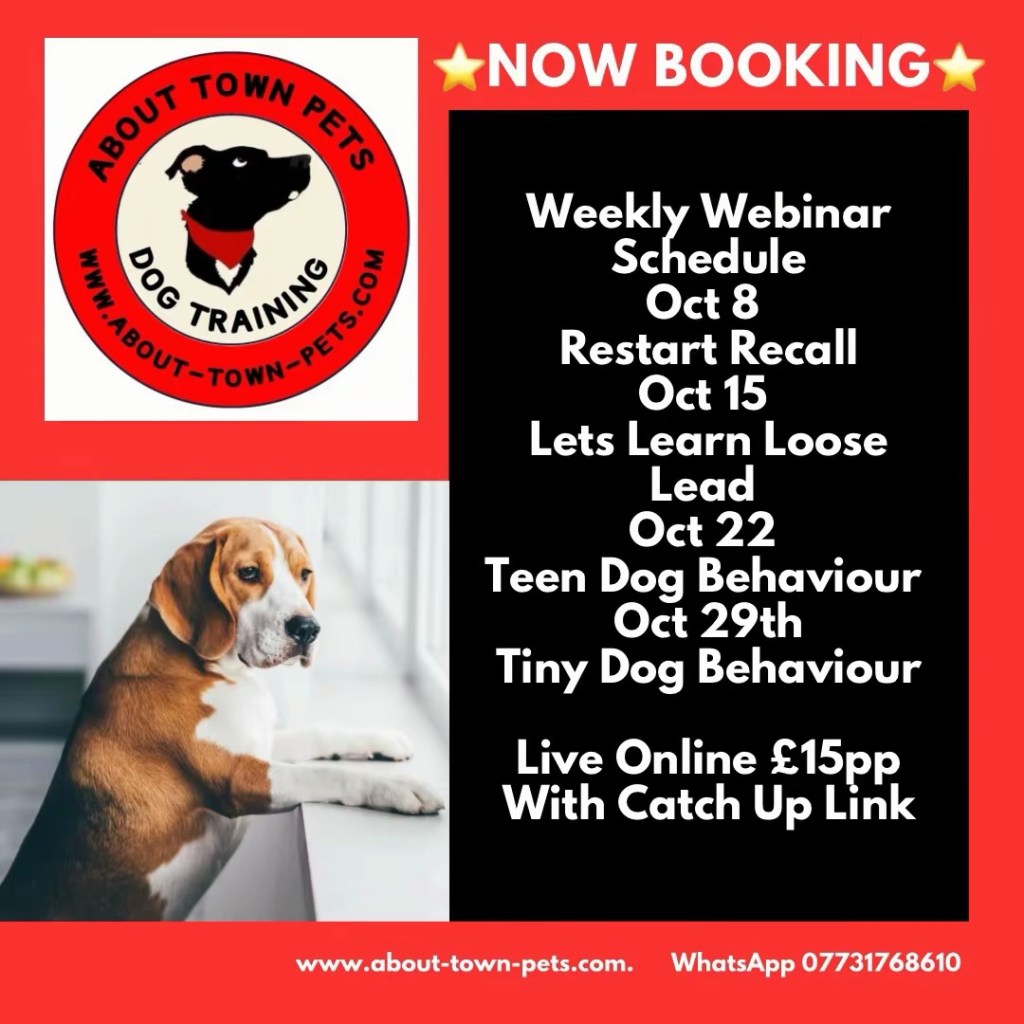
Schedule for upcoming weekly webinars via zoom for About Town Pets
Get in contact if you would like to work online or in person ๐Ÿ‘†

Six Recall Tips For New Dog Owners

From someone who has walked over 30,000 dogs off lead in public๐Ÿ˜‡

Training your dog to come back when called doesnโ€™t have to be stressful or frustrating. With the right approach โ€” a mix of patience, consistency, and positive reinforcement โ€” recall training can become one of the most rewarding parts of your relationship together.

Whether youโ€™re working with a new puppy or an adult dog whoโ€™s forgotten what โ€œcomeโ€ means, these tips will help you build confidence, connection, and reliabilityโ€ฆ and make your off-lead adventures a whole lot more enjoyable.


1๏ธโƒฃ Condition Your Recall Cue Until Itโ€™s Second Nature

Begin Malibuโ€™s Running through a meadow

Before you even think about dropping the lead, your recall cue (that special word or whistle) needs to be so well-conditioned that your dog responds without thinking.

You want it to feel like a reflex โ€” something your dog does automatically because itโ€™s been so rewarding in the past.

That means thousands of happy, positive repetitions. Play recall games at home, reward generously, and make it fun. Most people stop conditioning too early, but this is where all your future success comes from.

๐Ÿ’ก Related reading: 9 Ways to Turn You & Your Dog into Super Learners


2๏ธโƒฃ Donโ€™t Let Go of the Long Line Too Early

The long line is your best friend in recall training. It keeps your dog safe while giving them a sense of freedom, and it gives you the chance to reward successful recalls without risking a โ€œzoomiesโ€ moment.

The biggest mistake I see is people dropping the line too soon โ€” usually because things are going well! Keep it on until your dogโ€™s recall feels reliable and predictable.

Itโ€™s not about holding them back; itโ€™s about setting them up to succeed.


3๏ธโƒฃ Start Small and Build Distance Gradually

Intense tri coloured border collie running at speed across a field

Dreaming of that picture-perfect recall across a wide-open field? It all starts close to home โ€” literally.

I like to begin with recall games within just 6โ€“10 feet of me. Reward every time your dog turns and runs back towards you. Once theyโ€™re flying to you with excitement at that distance, then start to build space.

Think of it as climbing a ladder: you canโ€™t skip the lower rungs and expect to stay balanced at the top!


4๏ธโƒฃ Use the 25% Rule

Hereโ€™s a simple guideline I use with all my clients: when your recall success rate is 75% or higher, youโ€™re ready to start testing off lead.

If that rate dips below 75%, gather up the long line again and return to an easier stage. Training progress isnโ€™t about perfection; itโ€™s about building confidence โ€” for both of you.

5๏ธโƒฃ Practice in Different Environments

Your dogโ€™s recall might be flawless in the garden but vanish the second you step into a park full of smells and squirrels โ€” and thatโ€™s completely normal!

Dogs donโ€™t generalise the way we do. So when you change locations, lower the difficulty slightly, make it fun again, and rebuild success in that new setting.

The more variety you build in early, the stronger (and more reliable) your recall will become over time.


6๏ธโƒฃ Find a โ€œRecall Bestieโ€

Black and white dog in a black harness runs through long grass with his mouth open

This is one of my favourite tips! Dogs learn a lot simply by watching other dogs.

If you know a dog with brilliant recall, plan some joint walks. When you call both dogs, your friendโ€™s dog will dash straight back โ€” and yours will often follow.

Itโ€™s a brilliant example of social learning in action and one of the easiest ways to get more recall โ€œrepsโ€ without pressure.


๐Ÿ’ญ Final Thoughts

Building a great recall isnโ€™t about being the loudest person in the park โ€” itโ€™s about creating such a strong, positive association that your dog wants to come back to you.

Take your time, keep sessions short and upbeat, and celebrate every small success. Each recall builds trust, strengthens communication, and makes your bond even stronger.

Peach close runs whilst loooking to the right with mouth open and orange lead attached to a purple collar

๐Ÿ“ฃ Ready to Take It Further?

๐Ÿ• Join me this Wednesday 8th October for my Live Webinar Via Zoom โ€œRestart Recallโ€ at 7pm


Weโ€™ll cover practical exercises, common pitfalls, and live demonstrations that you can use straight away with your dog.

Weekly Webinar Schedule Of Topics For The Four Weeks – Use the link below to book๐Ÿ‘‡

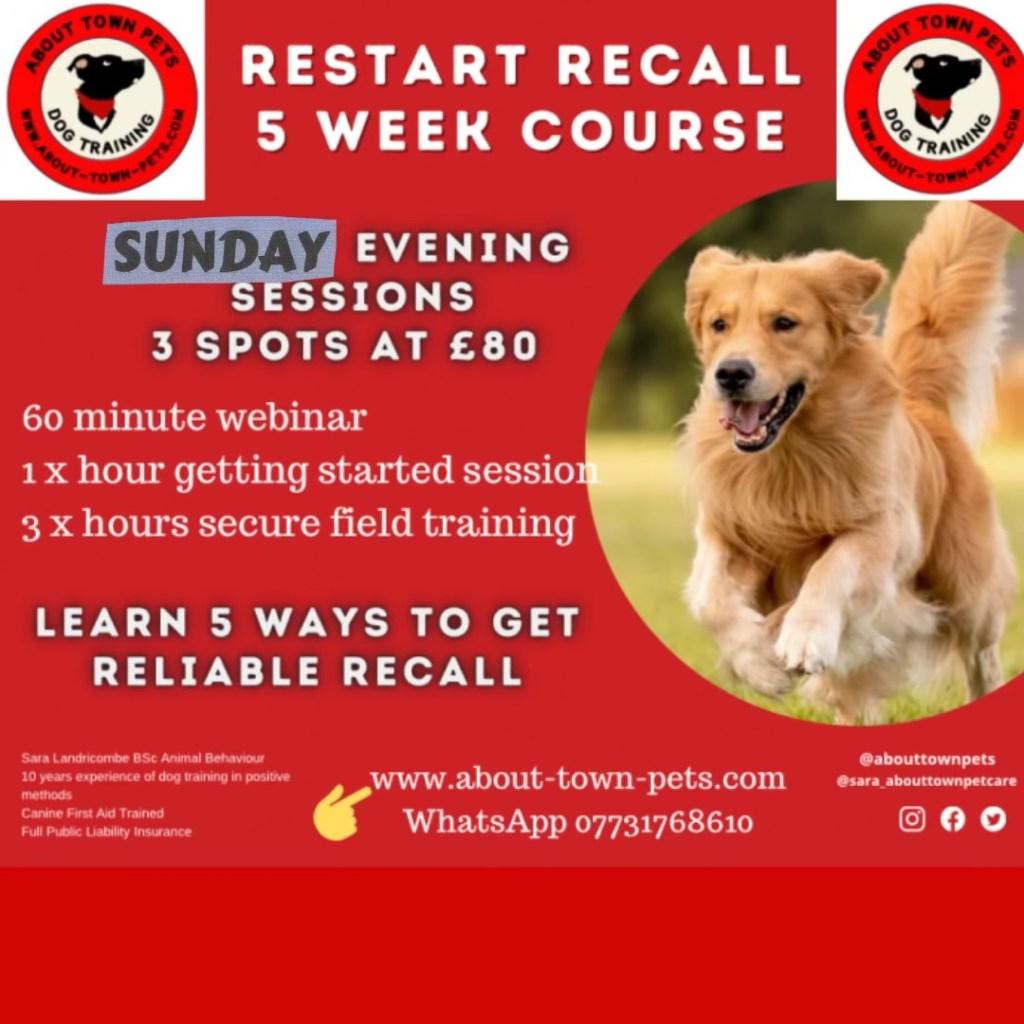
๐ŸŽ‰ And donโ€™t forget โ€” only 14 days left to book your place on my 5-Week Restart Recall Course here in Plymouth! Itโ€™s the perfect opportunity to reset, rebuild, and strengthen your dogโ€™s recall in a fun, supportive environment. Starting Sunday 19th October at 7pm (week one online via zoom – 90 minute webinar) then subsequent 4 weeks will be in person at a secure field in Bickleigh Plymouth at 3pm
Restart Recall Advert Starting Oct 19th at 7pm use the link below to book 5 week course in Plymouth

Love from your friendly neighbourhood dog trainer – Sara

9 Ways To Turn Your Dog Into A Super Learner

How to Create a Dog That Loves Learning: By Becoming A Well Prepared Owner

Training your dog doesn’t have to be a chore. With a little patience, consistency, and a whole lot of positivity, you can turn learning into a fun and rewarding experience for both you and your canine companion. Here’s 9 ways in which you can create a dog that loves learning, in a relaxed and enjoyable way.

1. Start with Easy Wins

Begin with simple commands even before you start to train the obvious stuff like “sit” or “down” in a quiet environment. You can begin to reward your dog for looking up at the sound of his name OR for โ€œChecking Inโ€ doing it so often that it becomes a reflex is a great starting point which. These early successes build your dog’s confidence and set the stage for more complex training. A great example of an easy win is when we try and get our dogs to engage with enrichment activities – shy nervous or easily frustrated dogs and puppies might not actually know what to do to begin with so you can start by point or showing the dog how to do something and mark and reward the moment their nose touches a treat (a simple rolled up tea towel with treats inside is a wonderful easy win). See my previous post about Every Day Enrichment Ideas Here.


2. Embrace Imperfection

Perfection isn’t the goalโ€”progress is. Celebrate small victories and understand that mistakes are part of the learning process. Your dog’s journey is about improvement, not flawlessness. The aim of the game is to get the behaviours you want loosely then you have plenty of time to polish anything up over time and as the dog matures or becomes more engaged with the whole process of training. Even if that means getting a little creative with how you train something (because there are a plethora of ways to train one thing) itโ€™s mostly about confidence building for you both as a team and whether or not you can go away and actually get a little bit done often because imperfect consistency is better than no training at all.

If you really find yourself hitting a brick wall with a certain behaviour donโ€™t hesitate to get in contact or at the very least send your trainer a video of you doing the behaviour and we can tell you what aspect of your training mechanics or reward delivery might need a little more practice.Contact me here ๐Ÿ˜…


3. Train Frequently, Seize Every Opportunity

Incorporate training into daily routines. Whether it’s during walks, meal times, or play sessions, use these moments to reinforce commands and behaviors. A great example of this is to get into the habit of naming everything that is significant on your walk- because if you always say a certain word or give a specific hand gesture at the same points on your walk the dog will get into the habit of predicting your behaviour and over time start to look as though โ€œthey trained themselvesโ€ when actually what is more likely is that you were predictable with your body language and words when out and about with your dog.

For example ; I talk in sound bites to my dogs and give slightly over exaggerated arm signals so that I can see theyโ€™ve seen them – itโ€™s all communication after.

Need to cross the road – always say โ€œWaitโ€ at every curb then โ€œCrossโ€ with an outstretched arm signal that acts not only as the โ€œrelease cueโ€ as it were it also tells my dog what direction we are going.

Need the dog to get up into a crate in the car? I get into the habit of getting dogs to jump โ€œup upโ€ onto and into things on my way as well as โ€œoffโ€ in the opposite direction for when I need them to then generalise that to getting โ€œup upโ€ into the car with a tossed treat luring them into the crate to begin with and again when they need to get out a flat palm to ask to โ€œwaitโ€ and then โ€œoffโ€ when they need to get themselves out.

Remember to think about does this behaviour look like something they already know? If so adapt a previous behaviour so you donโ€™t have to work so hard.


Got a dog that loves to sit as a default behaviour ? use this as the cue to prevent jumping up instead of creating a new cue work with the one you already have ๐Ÿ‘

4. Use Hand Signals First

We are verbal creatures and live to add words to everything (see previous point๐Ÿ˜…) yet dogs however, are highly visual learners. Start with hand signals before adding verbal cues. This approach helps your dog associate actions with commands more easily. This way we donโ€™t even need to worry so much about what words we are using half of the time but Iโ€™d my body language looks similar to something theyโ€™ve done before it is likely I can tell a Spanish dog to sit by simply asking what hand signal they use instead. I mean letโ€™s be honest it must all sound like gobbledygook to our dogs in the beginning anyway.


5. Shape Behavior Gradually

Instead of expecting your dog to perform a complex behavior immediately, break it down into smaller steps. Reward each step toward the desired behavior to encourage progress. For example maybe your dog is struggling with retrieving something or they drop the toy to early. Start with the end result train a dog

1- a chin rest (get the dog used to having your hand under their shin for longer and longer amounts of time)

2- get the dog to hold a toy with a chin rest

3- get the dog to pick up the toy and then release it like previously mentioned

4- start to toss that toy slightly further away

5- add distance to the tossed toy etc etc

And voila you have back chained (reverse engineered as it were) a behaviour by breaking it down into 5 steps instead of wondering why your dog goes to get the toy but drops it before they come all the way back – start closer and work out.


6. Introduce a Marker Cue

A marker cue like “good,” “yep,” or a clicker helps your dog understand exactly what behavior is being rewarded. This clarity speeds up the learning process. But the caveats I want to add here is that you must classically condition your cues to begin with. Thereโ€™s no pint in saying yep good or click if they have no perceived meaning yet – much like telling your dog โ€œnoโ€ if there is no association with it yet. This just means they must hear the word and a reward appears for many many repetitions much like your dog starts to associate their name with your attention or a treat for example. You do it so much that it becomes a reflex. Go and call your dog – if they donโ€™t immediately price their ears up or look up chances are you havenโ€™t done enough classical conditioning yet. Then with good timing your dog can hear your cue โ€œyepโ€ or โ€œgoodโ€ โ€œclickโ€ and know that that means a reward is coming.


7. Add Verbal Cues Later

I know I just told you to make everything because โ€ฆ.why not but you actually NEED to worry about the exact words you use initially. If itโ€™s a new behaviour you might have noticed that there are a couple of steps you need to do first anyway to be sure the dog knows what youโ€™re asking and then when they start to pre-empt a kite or a hand signal you can start to add a word. Focus on the behavior, and introduce verbal cues once your dog consistently performs the action is actually the most efficient way to train. But for the smarty pants dogs who have a learned history with training then I speed it up and do hand signals and naming at almost the same time- but thatโ€™s just me.


8. Practice the Mechanics of Training

Donโ€™t run before you can walk. A lot of mishaps or odd foibles that your dog does are usually because your training โ€œmechanicsโ€ are a bit clunky. So taking a little time to master the foundations of your own muscle memory / how you lure your dog into behaviours/ what your own body language looks like to your dog/ how will I deliver the reward all effects whether or not your dog gets what you are asking. So for example if youโ€™ve never taught loose lead behaviours before definitely donโ€™t start with the lead attached- go home and practiced the techniques shown to you in the garden with the lead OFF before you add in a layer of complexity with the lead inevitably brings, then you need to add in your marker word and treat delivery in the go – all things that need to be practiced individually BEFORE you take it out into the real world where you then have to navigate – other people, distractions, terrains. Etc etc, practicing in this way builds your confidence and ensures you’re prepared for various situations when you need to be in full control of your dog as well.


9. Phase Out Lures Gradually

If you’re using treats or toys to guide your dog’s behavior, slowly reduce their use over time. This helps your dog learn to respond to cues without relying on external rewards. That again comes with a BIG CAVEAT I am never in a massive hurry to phase out lures for young shy or nervous dogs because they need as much repetition and confidence building as possible but as that confidence and reliability grows or in some cases matures, we can start to phase out treats for less valuable reward such as touch, play or praise- eg; quickly go from rewarding every successful attempt of a behaviour to every other / to every third to just once or twice a walk. But Iโ€™m never without some form of reward regardless of how long a dog has learned something for because the world is unpredictable and I cant expect my dog to be perfect in all scenarios so having some โ€œemergency rewardsโ€ never goes a miss.


By following these steps, you can foster a positive learning environment that strengthens the bond between you and your dog. Remember, the key is consistency, patience, and making learning enjoyable for both of you. Love from your friendly neighbourhood dog trainer ๐Ÿถ๐Ÿ‘ S

Iโ€™d you enjoyed this post please check out my previous post on Knowing how long to leave your dog home alone x

How Long Is Too Long? Understanding Your Dogโ€™s Alone Time Needs

A Dog Ownerโ€™s Guide to Balancing Alone Time and Welfare

Letโ€™s talk about something weโ€™ve all probably mused over at one time or another as a dog guardian: how long can you really leave your dog home alone?

Technically, the Animal Welfare Act 2006 suggests that after 4 hours assuming that your dog has also just partaken in some form of enforced crating (think overnight in a crate for an average of 8 hours), it would be time to consider your dogโ€™s welfare. Dogs are social creatures, after all, and leaving them for long stretches without interaction isnโ€™t ideal.

In fact, the PDSA is pushing for an additional welfare guideline to consider dogs’ rights to companionship beyond that 4-hour mark. The science is simple: dogs thrive on interaction, and too much alone time can lead to boredom, anxiety, and even stress-related behaviors.
But how long is too long?

A tan faced beagle is lying down on a grey couch

Context Is Key: A Quick Reality Check

For a little perspective, animals in transit on their way to slaughter (yes, grim but relevant) canโ€™t travel for more than 8 hours without a break for food, water, and in some cases, a quick hose down. So if even livestock in transit get regulated breaks, it makes sense to extend similar consideration to our household pets too doesnโ€™t it?

While some dogsโ€”like seniors, puppies, or those with medical conditionsโ€”may need more tailored routines, the general rule of thumb is to limit alone time to 4-6 hours, with 8 hours being the absolute maximum in most cases.


What Can You Do?

Hereโ€™s where your creativity and resourcefulness come into play. Itโ€™s all about breaking up your dogโ€™s day:

  • Enlist Help: Think family, neighbours, friends, or even a professional dog walker.
  • Pop-In Visits: A quick visit to let them out, give them some love, and maybe toss a frisbee can make all the difference.
  • Gradual Training: If your dog isnโ€™t used to being alone, work up to it gradually with the help of a specialist dog trainer/ behaviourist.

Gradual Alone-Time Training: Step-by-Step

If youโ€™re planning on leaving your dog alone while youโ€™re at work, itโ€™s worth setting them up for success:

  1. Start Small: Begin with short periods out of the house, like 2 hours or even less if your dog has ZERO practice (thirty seconds is all Iโ€™m asking to begin with).
  2. Use a Camera: Set up a pet cam and see what your dog does when youโ€™re gone. (Spoiler: the camera doesnโ€™t lie.)
  3. Extend Slowly: Once your dog is comfortable, try 3 hours, then 4. Adjust based on what you observe. Even 1 minute / 2 minutes in micro bursts might be where you start.

Itโ€™s worth noting that adjusting to a new routine can take timeโ€”sometimes up to 6 weeks. So please be patient!

A shirt faces pug lies down in front of a glass door looking out

Setting Your Dog Up for Success

Hereโ€™s a handy checklist to help your dog settle into their alone time:

  1. Get Them Moving: Make sure your dog gets a good walk before you leave, but avoid high-energy activities like frisbee or fetch, which can leave them tired but overstimulated.
    • Instead, try scent-based activities like scatter feeding or search games to help them decompress on the way home.
  2. Feed Them: A well-fed dog is much more likely to nap afterwards. I often do this AFTER their walk due to issues regarding bloat (I have two deep chested dogs).
  3. Provide a Cozy Space: Create a comfortable โ€œhotel spotโ€ where they can snooze undisturbed whilst you are out. The more appealing and luxury the better.
  4. Offer Enrichment: Puzzle toys, Kongs, or chew toys can keep them entertainedโ€”but introduce these while youโ€™re still home so they donโ€™t associate them with you leaving. Give yourself plenty of time to leave. I use the rule that enrichment for the day goes down 30 minutes before I leave.
  5. Keep the Goodbye Drama-Free: No long farewells. Just calmly set them up and go. By planning these morning routines well we can set our dogs up well.
  6. Lastly – make sure you are actually out of sight and out of their scent range because dogs will settle sooner if they can smell you upstairs or out on the doorstep for example. We need to make it as true to life as possible.

A large Black and Tan shepherd mix breed lies down on the decking with his mouth open whilst wearing a black harness on

The Bottom Line

Your dog doesnโ€™t need 24/7 supervision, but they do deserve thoughtful planning to ensure their welfare. With a mix of routine, training, and enrichment, you can strike a balance that keeps your dog happy and healthyโ€”while giving you peace of mind.

So, whether itโ€™s calling on a neighbour, investing in a pet camera, or adjusting your dogโ€™s routine, small changes can make a big difference and remeber itโ€™s never too late to start home alone training.

Love from your friendly neighbourhood dog trainer Sara.

If you enjoyed this post feel free to check out my previous Home Alone Posts Here ๐Ÿ‘‰ How to start home alone training & Five myths about separation anxiety

If you want to work with me then you can email me here Contact Sara at About Town Pets as I now offer online 1-2-1 dog training in person in an 8 miles radius of Plymouth Uk or online for the rest of the UK USA Canada Europe New Zealand and Australia specialising in the following topics;
Separation Related Distress

Lead Reactivity

Adolescent Dogs (6-18 months old)

Tiny Dog Behaviour (dogs under 7kgs)

City Dogs (adapting training for urban environments)

Or BOOK NOW ๐Ÿ‘‰Home Alone Heroes Package
Please be sure to check out my Facebook page for upcoming webinar topics coming soon About Town Pets On Facebook

Tap on the image above to book now

How To Train An Alternative To Lungeing Forward

Common in herders and hunters

I recently replied to an enquiry looking at how to train a twelve month old Australian Shepherd who was nervous in general around novel stimulus , who lives in a farm environment (riding stable) and didnโ€™t have much experience of the wider world except for trips to the beach occasionally. He lunges forward when asked to meet and greet new people and also circles and barks when anyone tries to leave the premises or the group if they are out walking when off the lead.

Sound familiar ? It should be , itโ€™s a common trait in sheep herding breeds and may also look quite similar (but is not the same thing) in flock guardians and hunting breeds (sighthounds and gundogs like spaniels for example) whilst each dog is an individual and some parts of my advice would be tailored depending on the age sex breed and learned history of an individual – here is my response for a young inexperienced shy/nervous collie. But the techniques and โ€œfoundation trainingโ€ would be very similair for dogs exhibiting these sorts of behaviour. Also if your dog is over 2-3 years old you can gloss over the first section and go straight to the second paragraph. You may recognise some of the things I mention if you think back to when your dog was 12-18 months old. If you find yourself nodding your head and saying โ€œah yes Fido did used to do that a lot when he was X months oldโ€ then Iโ€™m here to tell you why that happens in the next paragraph. Still nodding? Maybe take a quick look at my previous post Help my teenage dog has forgotten everything ๐Ÿ‘ˆ

Letโ€™s get into it.

Firstly welcome to adolescence. Twelve months old is roughly around the time a secondary fear period can kick in coupled with a few other things you have the perfect storm. Take the fact that your pup is also quite an anxious dog by nature then you can see how any previous behaviours such as some form of overarousal around novelty (new people, new places ,too much going on at once) can make those โ€œreactionsโ€ more amplified. It is important that any training during this period is done gently and at a level the dog can cope with. Distance is your friend. Start any training at a distance that he can cope with and work back up to meeting and greeting people and also watching or participating at the edge of classes.

Now you mention his ability to cope for an hour or two -thatโ€™s amazing for a teenage dog. I agree that these are traits shepherding dogs do naturally and without ample opportunity to meet his needs in regards to his pastoral behaviours then when he gets super frustrated tired excited or fearful he will resort back to behaviours he has been selectively bred for (micromanaging his environment or space seeking behaviours if he is very nervous) looking for the body language that his behaviour has tipped over the edge of his ability to cope is your first port of call, training for this scenario is done separately. This is where we start to build the scaffolding or foundations for any future behaviours we may need to chain together in the not so distant future.

Laying The Foundations First

I would put the โ€œeye stalkโ€ part of his behaviour on cue โ€œlookโ€ mark and reward for eventually disengaging an actively reward for an alternative which is looking back at the handler and moving away.

The key is to mark and reward AFTER heโ€™s disengaged. Obviously do this in a calmer environment to get the initial behaviour. With enough repetitions you will get a dog that fulfils the โ€œeye stalkโ€ part of the behaviour without the chase and grab part of the behaviour. You could also fulfil that bit of the behaviour too. Once you have a reliable return from the eye stalk what will the next behaviour be? This is dependent on what suits your dog I often teach a very simple nose touch to hand for nervous dogs as a little confidence booster or if we also wanted to fulfil the chase grab bite sensibly, when he returns perhaps wanting a โ€œkryptoniteโ€ toy throw it past yourself so he has to chase the toy on returning to you this would also get him engaged in an alternative to going forward. Then we could add the last behaviour to the chain and play tug โ€œgrab bite partโ€ this is how agility is trained for example the reward is at the end ususally an amazing fluffy tug toy of some description. And remember to let the dog actually win the toy and keep it.

Make sure this is done on lead to begin with to prevent unwanted rehearsal lungeing forward to start with. Keeping the lead relaxed (this is why distance is crucial to begin) So your behaviour chain looks like this (at a distance) Eye Stalk something in the environment anything moving- cue โ€œLookโ€- wait for it (.you may need to find something that helps get his attention in the first few instances / squeaker his name / anything trained so it has become a reflex) Mark โ€œYesโ€ for disengagement back to you – then throw the toy past you as you move away from the dog – dog orientates towards you- gets quicker or chases you- throw it slightly behind you (add distance to this throw as he gets the hang of it) play tug or allow him to play with the toy – ask for a drop or not – train this seperately/ repeat (at each stage proof the behaviour – so that generalising can take place).

But My Dog Doesnโ€™t Take Food Or Toys When We Are Outside

If the dog isnโ€™t taking food or toys rewards when they normally would in a calmer environment itโ€™s a good indicator that your environment is too over stimulating or stressful – go back a step and further proof the step before moving on / your ability to time your marker cue when he disengages is key – quicker timing faster learning less repetitions needed๐Ÿ˜…

Does Your Dog Really Need To Say Hi To Everyone?

Iโ€™d argue not really, now that we know it could be adding to your dogs โ€œbusvket of stressโ€ , too many unmanaged interactions in this way may result in a dog having to resort to the behaviour weโ€™ve previously looked at as a result of too many triggering things happening in succession. So Iโ€™d give meeting and greeting a break for a month and just do this stuff mentioned instead after all the training and confidence boosting you could do the same when people approach because l can almost guarantee your dog doesnโ€™t want to meet and greet when heโ€™s shy about new people instead work of focus on the handler whilst people throw rewards away from themselves (giving treats from their hands can cause conflict in the dog so best avoided – think I really want that treat but I really donโ€™t want to go near that person usually results in hand grabbing and increased arousal- so best voided) get visitors to calmly throw any reward past the dog so that he moves away from them instead of towards / a much safer option would be to do some antisocial training and by this I simply mean reward everything that looks like focusing on the handler in the presence of new people- not every dog is a social butterfly sometimes the best we can ask for is tolerance but we donโ€™t get tolerance if we constantly force the dog to do stuff they are not yet equipped to deal with.

Things To Add To Your Foundation Work

Once You Have A Reliable Reinforcement History

I would also then be teaching your dog directions with a solid down (as he seems to be very good at this ie has a reliable reinforcement history) Utilise what your dog already knows well, this will save you a lot of time. Letโ€™s say he can still eye stalk well , always returning to the handler for disengaging. I would now start to this progress this behaviour off lead. Eventually with enough repetitions you will get a dog that looks at his triggers and starts to reflexively return to you for โ€œthe grab game or a treat toss behind youโ€ reward delivery is key to getting engagement up. And donโ€™t be in a hurry – we are trying to build a new association for the one previously learned which takes time and patience ๐Ÿ‘

For further guidance on how to train the foundations in this behaviour change take a look at Predation Substitute Training by Simone Mueller who has a wonderful book on Amazon on the subject- Whilst you are there also check out a book called Control Unleashed by Leslie McDevitt And for the engage disengage section look up Grisha Stewarts many free resources on Grisha Stewartโ€™s Behavioural Adjustment Training she too has a very useful book on lead handling and creating behaviour change. I like to use a mixture of all of these techniques).

How To Train High Energy Dogs

Part Three

In the previous blog posts in this series we looked at two ways in which we can set up our adolescent or high energy breeds of dog for success in regards to trying to train them and getting them to a point in which they might actually be able to concentrate on the task you are trying to set them. We looked at PRE-TRAINING Here, whereby we give those dogs something to do BEFORE we even leave the house and also look at implementing a structured walk Here , depending on the dogs personality and temperament type.

Next up Iโ€™m going to give you some little insider tips as to WHERE and HOW I implement all of the things I have mentioned in my previous blog posts. Thereโ€™s even a bonus tip for all of those who have read all the way to the end of this post.

So here are some of my insider tips;

Insider tip #1

Change it up- your dog gets super excited by leaving through a specific door? Or has your walk become a bit of sprint to get to the nearest green space so we can play (insert your dogs favourite game here)? If yes then change it up. Start to exit your house from a different exit, where possible or change the route to the park, better yet- occasionally donโ€™t even go to the park just so a โ€œsniffyโ€ walk. If your PRE-TRAINING phase was good enough you might be able to encourage your to go for a longer more varied route today that doesnโ€™t end in a game at the park. What we are trying to achieve with this is to get your dog to โ€œUNLEARNโ€ what his walk โ€œalwaysโ€ looks like. If he ALWAYS go to the park at the same time every day and itโ€™s this โ€œrushโ€ that you are trying to prevent with loose lead training, then going the same route isnโ€™t going to help your dog to concentrate in the beginning phase when we are training a new behaviour. This is where the next tip might help you.

Insider tip #2

If in doubt , drive- if the thought of being pulled down the road for fifteen minutes does not appeal to you perhaps we need to make the conscious decision to drive somewhere quite and free from distractions. This is what is meant your dog trainer asks you to start training somewhere with low distractions once youโ€™ve graduated from training in the back garden or in the house. Now itโ€™s your turn to find open spaces, private enclosed fields or โ€œsecret spotsโ€ where you can train with less distractions from dogs or people coming up to you and unravelling that days work. I encourage owners who are โ€œloose leadโ€ training to drive to a quite open area to play a game with your dog or go for a walk on a long line and then train on the way back. Making sure to park a bit further away each time, allowing your dog to concentrate on loose lead a bit more each day. I also encourage owners with reactive dogs to go somewhere that looks like โ€œreal lifeโ€ but isnโ€™t. Which leads to my next tip.

Insider tip #3

Real Life Mock Ups – three places I like to train dogs that looks like real life but isnโ€™t as busy. Here are three to start you off.

Enclosed fields are a godsend, but they are not all created equal, especially if you have a reactive dog. Choose one that has a gap between fields so that the dogs can perhaps see each other from afar but canโ€™t actually get to each other, because nothing ruins recall practice like three dogs running up and down the fence line over threshold for forty five minutes.

Cemeteries are an under-utilised little gem that I like to use because more often than not , they require all dogs to be on lead at all times. Itโ€™s a great place to practice your lead handling skills, to practice โ€œlook/look awayโ€ for reactive dogs and provides ample opportunities to use โ€œstreet furnitureโ€ as it were, to your advantage. Getting to close to an oncoming dog? Dart behind a row of tombstones. Need to practice coming up to a junction, use a headstone as a buffer. Want practice loose lead somewhere other than your street , the local cemetery is a great alternative. I know it sounds mad but they are usually quite and often with other likeminded people with dogs in training. Make sure to take your โ€œin trainingโ€ cuff or waistcoat with you so people donโ€™t think your absolutely going crazy. My local cemetery had a wonderful caretaker who loved seeing me train dogs as long as we respected funeral days and picked up after ourselves obviously๐Ÿ‘

Industrial Estates are also your friend , they are usually quieter or even empty on the weekends and are great places to practice with stooge dogs (calm well socialised dogs, that you know personally) from a distance walking up and down as if on a โ€œreal lifeโ€ with the added bonus of having less people traffic and dogs in these areas as well as nice open car parks for nervous dogs to practice meeting and greeting dogs on long lines that are very well managed/handled. I also like to use them to parallel walks with calm and reactive dogs across the street from each other.

So there you have it how to train high energy dogs in three parts.By taking the pressure off yourself and realising that is actually better for all involved. Here is a recap of what I would do if I was trying struggle to get my crazy springer spaniel to practice some loose lead or even work on building up a nervous dogs positive associations with previous triggers.

Pre-train before you leave

Prepare for your walk by changing your exits and possibly changing the routes you take to make them less predictable for excitable or frustrated dogs.

Make walks more predictable for nervous dogs, however.

Choose an appropriate venue to allow your dog to succeed.

Incorporate some structure into the walk with engaging activities followed by calming activities, to prevent overstimulation.

Train on the way back to the car or on the way home.

Continue to find venues that can help your dogs to practice with minimal distractions or where you can build back up to โ€œreal lifeโ€ busier scenarios over time.

Hopefully this has helped you to see what is required and in what order to help you to train you busy, high energy dog. Keep scrolling to read my BONUS TIP below that I think itโ€™s really important you know when dealing with busy working breeds.

If you enjoyed this post please check out my previous posts in the three part blog series on Training High Energy Dogs here. Or you can sign up with your email HERE COMING SOON – – to grab a copy of 101 enrichment ideas for your dog via email. Before you go check out the Bonus Tips Below๐Ÿ‘‡๐Ÿ‘‡

Bonus Tips – For Training High Energy Dogs

Before you go Iโ€™d like to share with you this bonus tip.

Practice three things if you own a high energy dog

Sloppy handling timing and general mechanics of how you distribute rewards to your dog can have a big effect on how quickly or how clearly your dog learns your new skills. So if you get the chance , get a professional in to look at all of those things before embarking on your training with your dog, this is because high energy dogs can also become easily frustrated and often have short attention spans , these are both things that can hinder our success and are not the dogs fault, even though it might look that way. So before you start to think your dog is stubborn or being grumpy please practice these three things-

Lead Handling Skills – more space is better for our busy dogs so being able to literally pick up the slack in a timely and confident manner will help you to manage your dog quickly, knowing how to stop your dog gradually, how to prevent your lead from getting tangled and knowing where the end of the lead is (no extendable leads for the love of god people).

Timing – learning to capture the correct behaviour with a word like โ€œyesโ€ or โ€œgoodโ€ followed by the reward is important because we often miss lots of good attempts because we leave it too long to mark and reward. Get good at looking for the behaviour you want and get in the habit of saying โ€œyesโ€ followed by the next step.

Delivery – otherwise known as your mechanics. How might your body language be affecting what your dog is doing? Are we sloppy with the lead? Do we get tangled up so miss the point at which we could have marked and rewarded some amazing loose lead? Itโ€™s muscle memory. We can only get good at this bit with practice. We will get what we put in. Practice luring your dog into position, practice holding a treat under your thumb so we can get the dog into the right position before marking โ€œyesโ€ and releasing the treat into their mouth. Or do we have a hand grabber? if so get good at rolling treats directly in their eye line so they donโ€™t spend to long โ€œsearchingโ€ for their reward. As you get quicker at all of these things so too will your dog get quicker at picking up what you actually want ๐Ÿ‘

Hope all of this helped. Love from your friendly neighbourhood dog trainer, Sara.x

Ps if you would like to work with me in person or online please feel free to contact me here Contact Sara Here

Training High Energy Dogs – Part Two

Part Two – The Structured Walk

Do you have a dog that is manic for the first 5-10 minutes of your? Dog they pull you down the street? If yes then, make sure you pop over and read PART ONE in this series to see how โ€œPre-walkโ€ training and games can help you before you even leave the house hereHow To Train High Energy Dogs Part 1 – Now letโ€™s look at two types of structured walk you can do after you have set aside fifteen minutes to do something e,she with your dog (see previous post).

The Structured Walk Number One

Letโ€™s remember why we are walking the dog, first and foremost, I would hope everyone would agree, itโ€™s for the dogs benefit. Itโ€™s your dogs walk and yours second. If we keep that at the front of minds we can then also remember that what we might want to do in that walk might not actually be what that dog wants to do on that walk.

What is a structured walk I hear you cry? Itโ€™s a very distinct set of things we are actively trying to encourage at specific times of the walk for a very specific reason. Itโ€™s not very complicated I promise. It will however require a little bit of pre-empting on your part, thatโ€™s all.

There are five questions I want you ask yourself before we start;

1- What type of personality does my dog have (boisterous, confident, shy, nervous, under confident)?

2-Whatโ€™s does my dog love to do (digging, sniffing, movement, praise)?

3-What training do they already know?

4- What can we be working on to ,are this more enjoyable for us both (does my dog know- โ€œYesโ€, โ€œDropโ€, โ€œThis Wayโ€ โ€œLookโ€)?

5- What venue can we walk in to achieve our structured walk today (do I need the car?, is there a quiet open field I can use? Will an extended walk in my local area suffice?).

Thatโ€™s it five things to consider and I will come back to the last point in a minute.

Id your dog number ONE who might really really enjoy sniffing , they get in โ€œtroubleโ€ for constantly

Why these five things?

Firstly knowing our dogs personality type and their likes and dislikes means we can start to see the walk from their perspective. You might think that โ€œaround the blockโ€ walks are boring to you but to your dog who might be shy it could be a way of getting and using their nose in a familiar environment one in which youโ€™ve practiced how we move away from anything that is scary or perhaps we have done a lot of look/look away training on this route so they no longer have to be super vigilant, as an example. On their hand overly confident dogs who need to learn to be calmer might benefit from โ€œsetupโ€ walks in real life places but with very little distractions. They might not be ready for the dog park just yet but perhaps they can cope if they look at the dog park from far away.

Itโ€™s important to know what your specific dog likes to do because we can use that to our advantage to make their walks more interested h and also can help get more engagement when we are out and about trying to train. For example if my dog is a superstar sniffer I would incorporate almost the entire walk to Scent-work so that I could wean them off of high energy activities all together or my crazy spaniel might not get a lot from walking around the block on a lead but might excel of search and find activities in a small pocket of woodlands that may require very little โ€œwalking to the venueโ€. I could let myself off the hook for the dreaded lead walk for this dog and begin training AFTER they let off steam in the woods.

Utilise what they already know. Does my dog know a sold โ€œdropโ€, brilliant letโ€™s play some retrieve games in the woods (proper search and find games). My dog reliably knows โ€œhand touchโ€ awesome, letโ€™s ask him to do that as part of his loose lead training so we can reduce the amount of treats we give him or lastly my dog knows โ€œfind itโ€, brilliant letโ€™s play โ€œFind itโ€ on the way home – work with what youโ€™ve got and add skills in.

Which leads me to – what can we add to make this more enjoyable. Thereโ€™s a lot to be said for basic life skills with your dog, my top ten go to cues I use every single day in multiple groups of dogs are โ€œyesโ€ as a marker word, โ€œThis Wayโ€, โ€œLookโ€ โ€œWalk Onโ€ โ€œWaitโ€ โ€œHereโ€ (for loose lead) โ€œWhatโ€™s Thisโ€ โ€œDropโ€ โ€œComeโ€ & โ€œFind Itโ€. If your dog doesnโ€™t know any of these , get working on them very soon. **

** I would also say number one thing is to learn to handle a lead better and work on your ability to give rewards precisely and in a timely fashion, without getting tangled**

Lastly we need to set our dogs and ourselves up for success. If our dogs find the front door duper exciting try to desensitise it or change the exit you are using. If we have a nervous dog donโ€™t force them to go on busy loud street walks without building up to it and also donโ€™t take reactive dogs to a place that they might see a plethora of people or dogs in high frequency. Also find quieter places for over excited teenage dogs so they can learn to stay calm and donโ€™t expect them to make go decisions in that last five feet or so between meeting new dogs and new people. If in doubt create space by moving on. Be vigilant, look for you exits and entrances , look for street furniture you can use to calm your down down behind whilst people walk past and start thinking about your walks from your dogs perspective and not your own. Sure itโ€™s convenient to go to the nearest green space and throw a ball a hundred times to create a tired dog. I would then say have they been physically and mentally challenged but the time you spent with them? If not then some simple mindful things can be added to get a dog that loves their walks with you and that you enjoy more as a result.

Structured Walk Number Two

We should also remember that with a structured walk we are getting rid of the โ€œstressโ€ having to take our dogs on a super exciting adventure or rushing the walk just to get it out of the way for forty five minutes instead letโ€™s say that forty five minute looked like this-

PRE-TRAINING (15 minutes) – GO SOMEWHERE QUIETER – FOR OUR WALK OR EVEN AROUND THE BLOCK SNIFFY WALK (15 minutes)- TRAIN ON THE WAY BACK TO THE CAR OR FIND IT ACTIVITIES ON THE WAY BACK (15 minutes) – HOME TIME.

You can see with this structure not only have we reduced the actual amount of โ€œwalkingโ€ we have had to down to thirty minutes instead but we have actually added more engaging activities.

The pre training has gotten that start of the walk energy out, going somewhere in the car or going somewhere predictable helps keep your dogs arousal levels to a minimum as much as possible and also sets you both up to have a less stressful walk. This part of the walk is the actual excersise part of the walk and can include sniffing to engage a different part of their brain so they can potentially be physically and mental tired to the point that they are more likely to concentrate (even in short bursts) on your training activity to have planned. The training/ Find It part of the walk calms their brain down from the previous high energy activity. Itโ€™s why I donโ€™t encourage constant high energy games such as fetch or a ball flinger, not only does it injure knees and joints galore you are essentially creating a dopamine addict, who, without some sort of structure on his way back from the walk will sometimes go home and still be โ€œwiredโ€ from walk because he hasnโ€™t had chance to come down the other side of his high. I would offer that we do this with a handful of find it games & retrieve games to engage his nose, as calm licking or chewing can help bring those hormones back down below an unsafe threshold. *

*Please not I am not saying you should never through a ball for your dog again, but I am saying donโ€™t spend the whole โ€œwalkโ€ throwing a ball flinger or a frisbee until the dog is flat out tired. I am saying throw it a few handful of times and put it away in favour of a few different activities instead.

So structured walk one is for dogs that are not reactive in any way and are perhaps just a high energy working dog who often can fall into the habit of pulling, lead grabbing or needs lots of stimulation to prevent boredom. These dogs benefit from ; PRETRAINING/A FUN WALK WITH MINIMAL DISTRACTIONS AND LIKELY ONE-TO-ONE ATTENTION from the handler (no getting distracted with these dogs please a as they thrive from quick timing and lead handling skills. These dogs are quick learners and so much you be. THEN TRAINING IS MOTIVATING AND REINFORCING & LASTLY ANY FORM OF SNIFFING OR SCENT-WORK TO HELP THEM CALM DOWN.

Structured walk number two – is for those more nervous dogs that need you go slower or who struggle in new environments. I would like you to structure your walks so that they become SAFE & PREDICTABLE. By all means we want to build up to what these dogs can do and cope with over time but to get them there quicker we want to make them feel that this walk is safe because we do this then this then this. Step by step. Your walk might start with a confidence boost at home in the for, of training or an easy find task for fifteen minutes then if lead walking is scary then simply start with โ€œlook/look awayโ€ sorts of training on your front lawn or in the driveway. We want these dogs to just look at the world around them – they will naturally be hyper vigilant and look at everything in their environment anyway. Let them take it all in. You will likely not get far with these dogs in terms of distance but thatโ€™s ok too. These walks are about building confidence for the dog and your ability to handle them in โ€œscary situationsโ€. Graduate out into the street of to a preferred quite spot where they can sniff and explore at their own pace for fifteen to twenty minutes and then dog some training on the way back if they are feeling up to it. Donโ€™t drag these dogs around allow them to stop if they hear a loud vehicle passing but or a boisterous child on the other side of the road, encourage โ€œLook/Look awayโ€ on their own. They will walk on when they are ready. Actively encourage sniffing on the way home to let off some of their โ€œmental steamโ€. You will find these dogs are mentally exhausted and you could add another game when you get home again when they feel safe to aid in getting them physically tired as well. Ending your time with a nice licki Mat or something similar. These walks look like this,

PRE-TRAINING (15 minutes)/ ENGAGE DISENGAGE WORK NEAR THE HOME AND PREDICTABLE WALK(10-15 minutes)/SNIFFING AND FIND IT ON THE WAY HOME (10-15 minutes) – PLUS AT HOME GAME /LICKI OR SNUFFLE MAT TO FINISH.

As you can see there could be so much more to the way in which you walk your dog. I want everyone to enjoy dog walks again. Instead of hiding your dog away from the world because they are too excitable or too reactive etc etc, letโ€™s start to implement completely doable activities for your specific dog so that you can start to enjoy walks again with your best friend. Dogs are constantly learning so letโ€™s help them to go out in the world again with structure that is on purpose for our high energy dogs that find themselves expected to be โ€œpetsโ€ without having their own needs met first.

If you enjoyed this post please keep on eye out for the third and final part in this series of How To Train High Energy Dogs – next time I will be looking at places or venues we can utilise that will actually help our high energy dogs to work up to more distraction environments in regards to getting and keep their focus whilst on a walk. In the mean time please check out my previous post Pre Training High Energy Dogs here.

Love from your friendly neighbourhood dog trainer Sara. X

Ps if you would like to work with me in person or online please feel free to contact me here Contact Sara Here

Training High Energy Dogs

Part One

High energy dogs come in all shapes and sizes and they range from busy spaniel puppies with no off switch to highly frustrated teenage dogs who just have to chase every thing that moves in their environment.

It can be difficult to know where to start with regards to training them, for specific scenarios, especially if you have a dog that pulls the minute you step foot out of the front door, or a dog who is overtly stimulated by things in their environment when out and about.

I want to offer you part one of โ€œhow to train high energy dogsโ€ of which I call โ€œPRE-TRAININGโ€, imaginative I know right?

Red Duck Tolling Retriever holds a green frisbee in its mouth

All dogs get excited and pull for a variety of reasons during the first 5-10 minutes of any walk. If you are trying to train your dog at this moment you are likely setting both you and your companion up to fail. Now this is where the โ€œPre-trainingโ€ comes in.

The first question before we start pre-training – to ask yourself – Does your dog know how to drop? If the answer is yes then continue on to Pre-training, if not then itโ€™s time to train a reliable โ€œdropโ€ (this is another โ€œHow Toโ€ post for another day).

Once you have this in the bag then you can use this new found skill to create a pre-training protocol, whereby you choose a breed specific game that you can play for about 15 minutes before you need to go out for your walk/ training session. Whatever you dog really enjoys * It could be Scent work and Find It games in the garden for spaniels and hounds. Games of tug with sight hounds terriers and bull breeds or retrieving games for gun dogs. Perhaps your dog is a sucker for a frisbee or more training games like many of the herding breeds.

Be on the look out for over arousal in your dog and always bring them back down from hyper games with licking sniffing or chewing activities.

This extra 15 minutes of activity will help to get rid of that โ€œfizzinessโ€ you experience with them at the beginning of a walk.

*Every dog is different but taking the time to find out what they were bred to do, also what motivates them will serve you well when deciding how to structure this pre-training, perhaps your dog loves movement, scent ,holding something in their mouth, hunting or even working out a task on their own (spaniels and terriers excel at this). I guarantee it will be a joy to simply watch your dog carefully to find these things out.

By doing this you will find that your dog is already engaged with you and more likely to be โ€œin the moodโ€ for training and will be able to either concentrate/focus more on any engagement work you now want to do with your dog (loose lead or engage/disengage) for example.

Doing so will also make the first section of your walk much more bearable even if itโ€™s so that you can get to your dog to an area more suitable for training. It could even be a calmer car journey if you need to get them into the car to go somewhere more suitable to continue your training efforts.

In part two we will look at the two types of structured walks that I recommend that can further set both you and your dog up to succeed in your training efforts especially with regards to high energy dogs. Sometimes we just need to change the context for our dogs and come up with protocols that meet them halfway when we ask so much of them everyday.

Springer spaniel holds onto a tennis ball

Keep an eye out for part 2 of โ€œ How to train high energy dogsโ€ and in the meantime if you would like to work with me donโ€™t hesitate to contact me here About Town Pets

โ€ฆ..love from your friendly neighbourhood dog trainer Sara โค๏ธ

Ps if you enjoyed this post you might like my previous post on Help my dog is lead reactive

Help My Dog Is Lead Reactive

How to start helping your lead reactive dog by changing his emotions

Beagle on a blue lead lunges to the right

You are not alone , this is a very common occurrence nowadays especially as we have to keep our dogs on a lead in order to keep them under control in public places.

If I want you to take three things away from this post today itโ€™s that:

1- Reactive dogs are not bad dogs

2- Reactive dogs are likely having to resort to this form of communication because their more subtle attempts of appeasement or displacement have gone unnoticed

3- There is NOT a one size fits all approach to these behaviours (every dog is different has their own learned history of events / genetic background/ age / sexual status etc) all need to be taken into account

4- There IS however some underlying emotional state that is going unnoticed or being misinterpreted perhaps.

So letโ€™s beginโ€ฆ..

So youโ€™ve filled in a training and behaviour history questionnaire and we have assessed perhaps likely causes and rule outs and the reactions are not so severe that they require medical intervention and you are waiting to start some training with an experienced and ethical dog trainer or behaviourist. Whilst some simple changes to your dogs lifestyle including diet and enrichment might help – controlled training scenarios and possibly behaviour modification is likely whatโ€™s needed at this point.

I am assuming here that you know that letting people or dogs greet your dog for the first time on a taught lead is not ideal and that letting your dogs run up to other dogs in general, but especially ones on leads is actually making their behaviours worse as most do not care for rushed face to face greetings – itโ€™s bad manners if youโ€™re a dog and the reacting dog is sometimes angry about the intrusion into his space.

A white bull breed dog on a green harness looks happy and pulls forward to the left

What well adjusted social dogs actually prefer is a behaviour Iโ€™ve heard being called โ€œArcingโ€ where they approach each other from the side whilst giving each other somewhat of a wide berth (this can be seen when you see two dogs go round and round in circle trying to sniff each others butts) and then when they sniffed a butt they quickly go on their merry way – now if we then add a lead we are preventing that free access to the bottom sniff and walking away (weโ€™ve all seen this in the local park when dogs get tangled –

TIP – if safe to do so drop the lead and once theyโ€™ve finished their little butt sniffing circle quickly pick said lead back up, gather it up and move on- this is one of the copious reasons I do not like flexi/extendable leads- I digress – can you now see how by adding a taught lead to this scenario we would be taking away that dogs ability to choose a quick exit ? This will often lead to frustration in a dog that really wants to go and say Hi or anxiety in dogs that just want to move away – this spills over into a reaction because nobodyโ€™s making this rude obnoxious new comer get out of the way. How can you help your dog with this? I hear you cry -simply ask yourself a series of questionsโ€ฆ..

Is your lead long enough? AND do you know how to handle a 6ft lead appropriately ? I ask you this because the lead creates tension if itโ€™s too short – whilst keeping a dog on a short tight lead might feel to you like you have more control in a given situation (and in an emergency situation definitely do this to get past another dog for example) but it is not however , helping that dog feel like he has a choice or conveying calm in the face of something potentially exciting, frustrating or scary (from your dogs perspective).

Red and white spaniel on a black harness lunges and howls

There is a definite way to handle a longer lead in relaxed manner but also having control of that lead should you need to move your dog forward or away from a scenario. You also should attempt to create enough distance so that your dog isnโ€™t having to get to the point that he feels that he has to lunge and therefore make that lead tight- learning your dogs โ€œsafe zoneโ€ is critical to starting any training . Which leads (no pun intended๐Ÿ˜…) me to โ€ฆ..

Do you know the distance at which your dog does not react?

This could be the point at which your dog is comfortable enough to simply look over at another dog or person or thing WITHOUT showing signs of worry stress frustration or becoming excitable. This is likely to be the point at which you will be able to get your dog to think straight again by offering some responses to training or even more relaxed body language. It is here we would start our training process and build back up to these places that were previously stressful or too overwhelming for your dog AT THE MOMENT – all is it lost we just need to remember what we THINK our dogs want might not actually be what they WANT at that time.

This is where some of you will shout โ€œmy my dog is not food/toy/praise orientatedโ€ or insert whatever types of โ€œrewardโ€ you have tried before and Iโ€™d say thatโ€™s ok – all dogs are food motivated at some point – they eat food to live donโ€™t they? So try some of my counter points here

Go back to basics with reward / food based training we might not have been consistent enough, engaging enough with our treat delivery or our timing might be off – increase the VALUE of the reward so boring kibbles might not cut it – but salmon paste might – my dog goes mad for pieces of broccoli ๐Ÿ˜…try out different types of reward ๐Ÿ‘

Is the environment we are in MORE rewarding than me on the lead at this moment – try a less distracting more barren environment to get the basics down (industrial estates on Sunday) are a good idea for practice ๐Ÿ‘

Can you make treat delivery more exciting ? And think about the breed of dog you have โ€ฆ.. do you have a scent hound – treat delivery can be on the floor or scattered in long grass (remember to allow enough time for your dog to โ€œfindโ€ the treat before doing another rep – donโ€™t rushโ€ Do you have a husky who likes to pretend they are hunting? Throw the treat in the air to find or catch (this is a great tip for Lurchers for example or collies) Do you have a spaniel that just has to keep moving ? Incorporate treat or reward delivery at pace and roll it away from you whilst they are on a long line. Can you see how these methods would make a reluctant dog more engaged in you ?

Young golden retriever pulls whilst walking in a Sandy path

Every dog is different and itโ€™s up to us to make decisions for our dog to keep their best interests at heart- got a happy go lucky Labrador who wants to say hi to everyone ? Letโ€™s set him up with lots of polite meeting and greeting BEFORE he goes bounding up to potential lead reactive dogs and setting them back and also earning him the title of โ€œBilly No Matesโ€ as the other older dogs will not want to hang out with this big overly friendly dude again and potentially give him a few unpleasant experiences where older dogs might nip at his face to get him to go away (FYI we shouldnโ€™t be expecting other dogs to do our jobs for us) Itโ€™s our responsibility to not set anyone elseโ€™s dog back just because we havenโ€™t taught our dog polite greetings or recall- they are our responsibility nobody elseโ€™s. If this does happen apologise profusely and keep training.

Perhaps you have a 6 year old pug who has a questionable background and lunges out of fear or under exposure when they were young to a variety of people and other dogs – those dogs will benefit from general confidence training and their โ€œSafe Zoneโ€ might start from the moment you leave the house because going somewhere busy or overstimulating will cause reactions the minute you leave the home – in this case we would build up to going anywhere at all – this is because this dog has been exhibiting the behaviour for a long time they will have a very well trodden pathway which has created a habit that has gone unaddressed over time – but now we know how to look for the signs of stress and the distance at which it can handle short bursts of training. We can now start to prevent that dog from getting overwhelmed and begin the unlearning (is that a word?) that dog now doesnโ€™t have to go towards the thinggs it doesnโ€™t like – we can actually teach it to engage calmly and make a quick retreat- this dog can do more calming behaviours on walks at a distance from things and then start to work at distance again from the scary things as start to learn they now have a CHOICE and we can begin to build a NEW association with the previously scary things.

Frustration Fear Or Out Of Practice?

Lead reactions are not all created equally. A dog with tight stiff forward body language is different to a dog who barks and tries to run away. A dog that might look loose and happy might simply be barking out of excitement and not any malice but at the same time growling coupled with a bristling wagging tail is a courtesy which usually precedes a lead lunge and a snap because they are actually anxious- so by working with an experienced dog behaviourist you will be able to see if you have a shy nervous and potentially under confident nervous dog as opposed to a highly frustrated dog who doesnโ€™t actually know how to greet properly and their reactions are manifestations of not being allowed to do the thing they want to do (there is lots more to this and I am generalising to a quicker post) but you can see how they are different things that might โ€œlookโ€ like a aggressive reaction but there is more going on underneath.

A Rottweiler pulls to the end of a lead with owner in the background

What can you do first and foremost to help your dog before you start working with an experienced dog trainer then?

Start to recognise dog body language and once you see it you wonโ€™t be able to unsee it again. Dogs do a lot of things before a growl or a lunge and a snap or a bite but are we really looking ? If your dog misses a few of these steps and goes straight to โ€œexplosive reactionsโ€ or constant reactions like constant barking for example then itโ€™s likely the previous steps havenโ€™t worked for them in the past so they now have a โ€œdefault reactionโ€ or habit, that looks like – see something I donโ€™t want to be near me – get in there first with an explosive reaction – resulting in something moving away equals awesome it worked Iโ€™ll do that again next time๐Ÿ‘ It can be tempting to then start to not react to the dog and ignore the behaviour and allow the dog to keep going until they stop but this can lead to further frustration sometimes with more and more explosive responses before โ€œextinction โ€œ takes place so our best bet is to make the dog more comfortable at a distance with someone who has take the time and effort to build up a secure relationship with the dog and work on changing their feelings and association with previously response inducing thing. There is also lots of hormone and neurotransmitter things going on behind the scenes here and a skilled behaviourist will know this about your dog but thatโ€™s for another day๐Ÿ˜…

What to look for – stiff forward โ€œstuckโ€ body language where there back feet stay planted but they move forward with their front paws – ears back – whale eyes (seeing the whites of their eyes) hackles up – lip licking – turning their head to the side to diffuse tension – odd displacement behaviours out of context eg: scratching or yawning – whacking off after an altercation – seeing something and going to wee on something nearby straight away – grabbing the lead – scanning and being hyper vigilant – if these things are happening – move your dog away to a safer distance and simply let them observe – reward dogs then checking with you and generally being attentive and focusing on you instead .

If your dogs reactions are quite severe and they have been reacting for a long time – please consider reducing walks in areas where they are likely to encounter the thing they are reactive to just so we can start to reduce the amount of time your dog spends โ€œrehearsingโ€ the behaviour – do this by planning your walks more appropriately.

A jack Russel on a black harness pulls and barks at the end of the lead

– Do you really have to take your dogs to the shops? Could they go out again later when itโ€™s quieter or earlier in the morning when less people are around ? Could you plan a couple of sessions in a secure field so your dog feels better and can be off lead letting off steam? Can we learn to manage our walks with turn arounds, crossing the street and using objects in the environment as a barrier to keep our dogs calmer whilst they begin to learn an alternative ? There are LOTS of techniques we can utilise and practice BEFORE a dog reacts.

Also worth noting is that it can be tempting to not want to walk your dog because it has become overwhelming or it is โ€œembarrassingโ€ to walk them when they are reactive- I would argue that reactive dogs cannot improve if we do not have a controlled plan in place – they need to work up to learning how to behave in public and they need gradual exposure to the things that they react to otherwise they will become out of practice and antisocial and then we cant blame them if their behaviour escalates due to under exposure. Caveat – this does not mean flooding the dog and hoping he gets over it โŒ

Lot of things to think about – donโ€™t worry about being judged – get help sooner rather than later – it has always baffles me that people only ask for help when the problem has become unmanageable instead of being proactive and preventative but is just be really happy if you simply started to get appropriate help and support now. Start as you mean to go on and no dog is too old to train to be more resilient so letโ€™s get started ๐Ÿ‘

โ€ฆโ€ฆ love from your friendly neighbourhood dog trainer Sara โค๏ธ

Ps if you enjoyed this post you might like my previous post on Behind The Scenes As A Dog Trainer & Behaviourist

If you would like to work with me please Contact Me Here Letโ€™s Train Together

Just A Quick Question – A Behind The Scenes Look At What A Trainer Or Behaviouristโ€™s Process Looks Like

When working with a behaviourist you are not just getting a dog trainer who can teach you how to do a new behaviour you should also be getting someone who can delve into their Rolodex type mind to come up with solutions for more complex issues as well as the more simple ones. Each scenario should be approached with the hierarchy of humane procedures.

This is a slightly simplified version of what goes on, but this is the general idea for why we ask you to fill in a list of very specific questions on our behaviour history question forms. A lot of information can be gleaned from the dogs breed age and sexual status (neutered or not) and medical history but we are also looking for the following things in every case:

1. Is the dog healthy? I’ve heard different numbers but over half of aggression cases are medical issues according to the experts. Get a general physical done and some tests. Seemingly average looking complaints (such as compacted anal glands, pain, intestinal issues or females in season) can cause obscure behaviours which may not need any behavioural intervention at all just management and veterinary intervention.

Is the dog being fed enough & a quality food? Just because we use food doesn’t mean we want them starving. Also is the dog eating everything and anything and still not putting on weight ? (This last one can be true for dogs with specific forms of diabetes so again not behavioural but medical rule outs are needed as standard). We are not in cohoots with the vet and we are not trying to get you to pay out for the vets when not needed , we ask because about fifty percent of the time there IS a medical underlying issue that has gone unnoticed and knowing these things can speed up your training experience if we need to do that as well.

Are they getting enough mental and physical exercise? More confidence training, more engagement with family members #BeMoreFun and more stimulating walks (dependent on the dogs age personality and ability) more enrichment activities will likely solve lesser problems in the first instance -solve those first, always.

If the dog is excitable how can we introduce more calming activities ? ( just as we need to be exciting to train a young dog recall we also have to note that that same method wonโ€™t help us when training calmer behaviours).

2. Can we change the environment so it’s not an issue? Management is always our next port of call so that whilst the dog is learning we manage them safely whilst they learn an alternative – this management can then be phased out over time when the dog has become more โ€œtrustworthyโ€ For example we might phase out the use of a crate over time when toilet training or mouthing has subsided and upgrade the dog to having more space over time, not as a privilege but because growing dogs need more space and itโ€™s up to us to train them or give them stimulation so they can be trusted in their new space.

Does this lead reactive dog need to be on lead or can he enjoy enrichment in other ways that doesnt involve being tied to a person or for safety reasons, a food resource guarding dog must ALWAYS be given space and left alone when eating to prevent escalation before we can start to train and educate owners on what the risks are and how to manage this scenario.

3. Next up- Positive reinforcement training. Pick something the dog already does that we like and reinforce it. Even better choose something simple that is incompatible with the issue (got a dog that jumps up? Train a default sit or settle on a mat and repeat repeat repeat- Dog isn’t eating food? Go back to step one. All dogs are motivated by food itโ€™s usually the environment is too stimulating for them to WANT to take the food in that instance (be it negatively – anxiety or positively – excitable behaviours).

The dog normally eats but isn’t now? Change the environment. We are probably flooding them which means they are too over aroused to think clearly – reinforcing calmer behaviours regularly helps here or at a distance too. Going back to basics even if itโ€™s for a refresher in an older dog who is out of practice will help everyone get on the same page.

4. Like mentioned above we would then look at reinforcing alternate behaviors. Jumping isn’t reinforced but standing is. Pulling isn’t reinforced but walking near handler is and this is done with good timing, clear hand signals (no need for man handling in any case) with good frequency (donโ€™t be stingy with reinforcement) and with good mechanics (delivery of the treat matters, can the dog see its reinforcement , are you reinforcing after the dog does something ie: in the case of counter conditioning – donโ€™t be tempted to put your hand in your pocket too soon๐Ÿ˜…) and all of this is done with lots of repetition – you get what you put in and the simpler the approach the better as it helps owners stick at the training too๐Ÿ˜‰

Lastly If you have done these things and they aren’t working, it’s time to call in someone else because we missed something. It’s not time to use aversives. There is lots and lots of science to back up this claim (a simple google scholar or science direct search is all that is required) these days and the top behaviourists should be aiming to work collectively with knowledgeable vets who also hold a specialism in veterinary behaviour (unfortunately these are few and far between at the moment and their case loads have months and months waiting lists) – again another topic for another day.

Your trainer or behaviourist should not be trying to โ€œmuddle onโ€ if they donโ€™t know how to progress when a dogs behaviour has plateaued they should be asking for a second opinion or help with the task or if itโ€™s a complicated case should be happy to refer on.

So as you can see there are no quick fixes even for relatively simple issues and when you ask for a response to your very unique or specific question you can start to see why it might be problematic for me to generalise to โ€œevery dog that does A needs to be trained to do Bโ€

We can give you an educated guess based on what weโ€™ve seen before and what science has proven the probability of it to be true but every dog is an individual with learned history and specific breeding and upbringing so they may have learned things even us as owners are unaware of.

So I hope the takeaway here is that your qualified experienced dog trainers and behaviourists are doing all of this puzzle solving in the background and trying to come up with a manageable, easily digestible plan that you can implement at home without lots of supervision .

When we hear โ€œIโ€™ve tried this XYZ and been to lots of different trainersโ€ regardless of methods itโ€™s not really a dog trainer issue at this point itโ€™s the individuals ability to go at the dogs pace , not expect a quick fix and putting in the repetitions with GOOD technique to get a dog to the point itโ€™s issues are โ€œresolvedโ€ and whether a dogs issues are truly solved or rehabilitated is also a topic for another day.

Keep up the good work and keep training the best you can and stayed informed ๐Ÿ‘

Love from your friendly neighbourhood dog trainer โค๏ธxx

Ps if you enjoyed this article feel free to check my previous article on The Puppy Blues & Why itโ€™s Totally Normal

Letโ€™s Talk About The Puppy Blues – Itโ€™s Exhausting & Totally Normal

Inspired by a recent post in a puppy group that I frequent on Facebook and by the looks on any of my puppy club members faces when they get to class – I thought it would worthwhile to mention that โ€œThe Puppy Bluesโ€ Phase of puppy ownership is completely normal and I guarantee that the majority of other small puppy owners are feeling the same way or have done over the past 6 months. I know this because itโ€™s a constant topic online and amongst my own puppy class members who tend to bond over stories of their own puppy blues- itโ€™s exhausting having a puppy but please remember this too shall pass- if you ever make it to a formal puppy class you will notice that it slightly resembles an AA meeting but for young puppy owners. They recall tales of hands that are beaten and bruised by puppy gnashers and bleary eyed first time owners recall how they havenโ€™t really slept for the past three weeks whilst everyone else in the group nods and agrees itโ€™s true in some form or another for them all.

Terrier puppy against a blue checkered background sits amongst fluff pulled from the inside of a cushion – presuming that this is โ€œnaughtyโ€ behaviour

Itโ€™s real โ€œThe Puppy Bluesโ€ they tend to set in when it dawns on you that this going to be harder and take longer than you thought but Iโ€™m here to tell you that its gets easier and weโ€™ve all been there I promise.

Dogs transitions vary with age breed and their personality but as a rule I say stick to a 3 day protocol anything you implement please allow three days for your pup to get used to it – chopping and changing will not help you – donโ€™t be afraid to pop your pup in a crate or play pen in your room so you are at arms length for the first few nights – I promise you are not going to ruin your dog – itโ€™s just come from 8 weeks of mum and siblings on tap and physical comfort at all times so bare this in mind when we are in a hurry to get puppy into a routine

Cavapoo puppy sits amongst toilet roll which strewn around him

Being at arms length allows your puppy to feel safe if he cryโ€™s but allows him to settle when he can- further tips and advice can found on my previous post- here

Then you can start to move the crate/pen etc every three days to the next spot (I assume here that you eventually want your puppy to sleep downstairs) so every 3 days move the crate/pen to the end of the room then just outside the door then downstairs then in the room that you want them in – be prepared to reassure puppy and go back a step if they are really getting very worked up – unfortunately with some dog s(breed and personality have a lot to say in this) letting your dog self soothe as a blanket piece of advice may mean 1/ your create a dog with separation anxiety or 2/ you ruin any crate training you are working on (crate training requires gradual exposure and all positive experiences happen in the crate with the door open and closed) this canโ€™t happen if he starts to associate the crate with scary bedtimes

Also be prepared to go out (physically scoop up your pup if you have too to begin with) on the hour every hour until you have mastered toilet training because puppies cry not only for attention but because they often donโ€™t want to soil their bedding

A good rule here is let them out/physically take them out after eating sleeping playing – they have tiny bodies and tiny bladders for the next 6 months

A beagle puppy stands on his back legs to greet someone on the other side of his playpen

If you prepared well you would be writing off the next 6 weeks a bit like new parents donโ€™t see the light of day for about 6-12 months new puppy owners are likely going to need about 6 weeks minimum to get that pup into some sort of routine and so much training and visiting happens during this time not to mention that your pup is likely not going to be allowed out for the first 3 weeks that have them at home due to the gaps required between their first and second and potentially third vaccinations (unless your puppies breeder was an absolute gem and got your pup vaccinated whilst they were still with them)

โญ๏ธSide Bar – Breeders you get extra superstar status if you – as standard- keep the puppies for an extra 2 weeks with mum and do some beginners handling socialisation and rudimentary toilet training in those first 4/5 weeks with mum – I would be grabbing your hand off for details to pass onto potential new puppy clients๐Ÿ˜

I digressโ€ฆ. that happens here and even when pup is eventually allowed out your going to be working on toilet training socialisation and potentially going to puppy classes (I highly recommend that you do๐Ÿ˜) even if youโ€™ve had lots of dogs in the past – techniques have changed and thereโ€™s about a hundred different ways to train simple things so you are most definite going to pick up tricks and tips) even if itโ€™s how to mark and rewards quickly and efficiently, how to use the three predominant ways of getting initial behaviours and how to look out for puppy body language you may not have noticed before) and SO MUCH more, I know that I want people to learn as much I can teach them with my limited 6 hours that I spend with them because I believe itโ€™s a โ€œhit the ground runningโ€ scenario and your window of opportunity is definitely slim – of course you can train older dogs thereโ€™s no time limit on training, but your puppy is small and manageable and like a sponge up until about 6 months old so I highly recommend training FOR a scenario rather than when you are IN a scenario.

Adorable tan coloured cavalier King Charles spaniel puppy lies down on a white bed

This means that thereโ€™s no point in panicking and hoping your puppy will recall away from another dog in the park instead you should anticipate things that might happen whilst you are out and stay vigilant knowing that you can distract and recall your pup for example BEFORE itโ€™s too late and your puppies attention is lost and you have to scramble to go and get them back – you can manage and mitigate in a scenario but hopefully youโ€™ve put in some solid foundations in the garden in the house or in low distractions whilst you build up and try the same training but in the real world scenarios, understanding that a puppy with lots of repetitions under his belt and a solid โ€œWhatโ€™s thisโ€ (whatโ€™s this gets attention and is followed by a high reward) encourages quick responses so you can put them back on areas or move them around or turn in a different direction until the distracting thing has moved on or you get an opportunity to greet the other dog whilst yours is under control (letโ€™s practice polite quick greetings and move on) unfortunately I see too often owners scramble to recall or grab treats from pouches knowing full well that their dog should really be on a long line but thatโ€™s an inconvenience so I will just wing it and hope for the best – unfortunately hoping for the best and getting lucky isnโ€™t best practice – train frequently and repeat is a better course of action – practicing at every opportunity is so much more fun for your dog anyway and you will end up with a dog that constantly keeps an eye on you instead of a wayward pup.

So really the point of the post is to persevere because everyone has to go through this phase albeit with a new puppy a teenage dog (see my post on this topic – which will ultimately end up being a secondary puppy blues phase for you) or a newly rescued dog – I will also note here that if it really doesnโ€™t seem to be getting any better for you past the 6 – 8 week mark of puppy ownership I would highly recommend you get in contact with a professional training to help you work through potential training plateaus that might be occurring or something else that might need intervention for you or your pup- Iโ€™m not promoting that you struggle just that you allow enough time for your pup to cope before you get some intervention.

If you would like to work with me – please donโ€™t hesitate to contact me HERE

Sara @ About Town Pets ๐Ÿถ๐Ÿพ

Ps If you appreciated this post you might also like my previous blog post on Tips & Training Advice For Dogs With Suspected Separation Anxiety

And Also This One- Learn About My Number One Training Tip

Leaving Your Anxious Dog Alone: Tips for Successful โ€œHome Aloneโ€ Training

Ive had quite a few enquiries lately about suspected Separation Distress in young dogs these last few weeks so thought it best that I create something that might help those who are waiting to work with me in person ๐Ÿถ๐Ÿ‘

If you have a dog who is anxious or destructive when you leave the house, they may be experiencing some form of separation distress- to work out the extent of the issue I highly advise a through vet exam if this is something brand new (behaviour wise) for an older dog and would also like a full history before we work together – Work with me here but whilst you wait – find my tips below.

Fortunately, there are effective techniques you can use to help your dog cope with being alone. In this article, we’ll cover six helpful strategies for separation anxiety training.

Foundation Training: Encouraging Calm Behaviours

Before you start working on separation anxiety training, it’s important to establish a foundation of calm behaviors. This means teaching your dog to relax and settle down on cue. You can use positive reinforcement techniques, such as treats and praise, to encourage your dog to sit or lie down and stay calm. Practice this behavior frequently, gradually increasing the duration of the stay. My favourite technique is to use โ€œThe Magic Matโ€ where this behaviour can be transferred to different parts of the house to encourage settling on a mat and eventually (if required) it can be transferred to settling in a crate with the door open etc I briefly mention how to train this HERE๐Ÿ‘

Ditch the Crate: Confinement May Be Hindering Your Results

Many dog owners assume that crating their pet is the best solution for separation anxiety. However, for some dogs, being confined to a small space can actually increase anxiety levels. If you suspect that your dog is not comfortable in their crate, consider trying other confinement methods, such as a gated area or a playpen. Be sure to provide plenty of toys and distractions to keep your pup occupied. These will help to create a space where you dog can learn to take themselves off for โ€œmicro absences โ€œ even when you are in – they need to be ok with being away from you – this is great for those who this they dealing with a dog with a base line of around 5-10 seconds ๐Ÿ˜…Donโ€™t panic it does get better. * A caviat to this I would say that toys can become a predictor of you leaving so only help keep them under threshold for the time it takes to complete the task – extended periods of home alone training will be required AS WELL provided toys and enrichment ๐Ÿ‘ which leads me to the point belowโ€ฆโ€ฆ

Work Out the Triggers That Are Predicting Your Departure to Your Dog

Dogs have been selectively bred for thousands to work cohesively with their guardians this also means they are experts in watching our body language and seemingly โ€œknowโ€ when we are about to leave before we are even aware of what we are doing . They quickly learn to recognize the cues that signal that you’re about to leave the house. This can include putting on your shoes or picking up your keys. To help your dog feel less anxious, try to desensitize them to these triggers. For example, put on your shoes but don’t leave the house, or jingle your keys but don’t go anywhere- multiple times a day . Over time, your dog will learn that these cues don’t always mean you’re leaving for an extended period of time. You can also be a little bit more prepared I like going on about this topic here – and make sure you leave in a calm manner and have those triggering abject steady by the front door so you can make your โ€œactual departureโ€ as calm as possible.

Leave Frequently and Return While the Dog Is Calm

One effective way to help your dog get used to your departures is to practice leaving frequently for short periods of time. This can help your dog learn that you will always come back. Start by leaving for just a few minutes at a time, and gradually increase the duration of your absences. When you return, if you have a dog who frantically greets you on return (thereโ€™s a high chance you will because this comes as part of the by products of having Separation Anxiety)be sure to greet them a little (as we donโ€™t want that frustration tipping over the edge ) and then walk all the way through your house and asking for a behaviour that might make their greeting calmer ie: Toss a treat a few times and ask them to โ€œFind itโ€ or get out the previously mentioned Magic Mat and ask them to simple wait on it – mark with the word โ€œYesโ€ and reward this calmer version of your dog (praise with a soothing tone we are aiming for calmer reactions after all). This reinforces the idea that calmer behaviour is rewarded. I mention the basics of โ€œYesโ€ training here

Training So Frequently That It Becomes “No Big Deal”

To help your dog feel more comfortable with your departures, you want to train in short yet frequent amounts so that they almost get โ€œboredโ€ of reacting. They get scared because being alone is unpredictable so try to make leaving the house a non-event. Don’t make a big fuss over saying goodbye, make sure that the new predictable keeping under their threshold of stress is the new norm and try not to make a big deal about departures and returns. This helps your dog understand that being alone is now a normal more predictable part of their routine.

Gradually Build Up the Time You Are Outside Out of View

Finally, as your dog becomes more comfortable with your departures, you can start gradually increasing the time you spend out of view. Again, start with short periods of time and gradually build up to longer absences. Be sure to continue rewarding calm behavior, and make sure your dog has plenty of toys and distractions to keep them occupied but make sure you you PLAN ahead give your dog plenty of time to use those toys – ideally half an hour after a walk or being fed they can do these activities (licking sniffing and chewing all promote calm behaviour) so if they are sufficiently calm before you leave instead of a rushed placement of toy and running out the door will make you look even more unpredictable than before. Everything needs to be well rehearsed and predictable because itโ€™s the only training you have to rely on where you cannot be present to do it – this why whilst you work on gradually building these events up in small increments you MUST find ways to keep your dog from tipping over into severe stress – Get a dog walker , send your dog to doggy day care on the days you have to be out of the house, call in as many friends and family you can to take a day each WHATEVER it takes so that your training can take hold and the sacrifice of your time for perhaps 3-6 9 months is worth it so that your dog can have a lifetime of not being anxious.

With patience and persistence, you can help your furry friend overcome separation anxiety or at least increase the amount of time they can cope with being alone and feel more comfortable when you’re away. By following these strategies for separation anxiety training, you’ll be on your way to a happier, more relaxed pup. I know exactly what you are going through as the guardian of two dogs with Separation Anxiety myself – please remember that what they are experiencing is not your fault or their and it is a phobia just like Iโ€™m afraid of heights itโ€™s a phobia itโ€™s not rational but itโ€™s still valid and itโ€™s up to the learner (in this case your dog) how quickly or slowly we gradually expose them to the scary thing – in this case being home alone – sometimes younger dogs sail through the training – some need a title longer to realise everything is going to be ok – thatโ€™s ok whichever way we get there – If you would like more help with your anxious dog please donโ€™t hesitate to contact me as I can offer this training online as well as in person within 30 miles of Plymouth UK – You can books 1-2-1 session here

Sara @ About Town Pets ๐Ÿถ

Ps if you liked todays post please be sure to check this post on Training A Teenage Dog Who Has Forgotten Everything ๐Ÿ‘

My Number One Tip For Any Training Scenarioโ€ฆ

Be Prepared

If this conjures up thoughts of a very popular song from the original Lion King movie – then so be it ๐Ÿ˜…

It doesnโ€™t matter if youโ€™re training puppies to stop mouthing or setting up controlled scenarios to help practice something (ie: barking at the door or keeping calm for reactive dogs) if your not prepared, your dog is less likely to succeed at every given opportunity.

Husky mixed breed looks up at handler in the sit position – good training requires practice

I NEVER leave the house without at least some treats in my pockets – even when Iโ€™m not training, I am prepared to train if the need should arise. My dogs, for example have been learning to settle at cafes at least twice a week, as well as learning to settle in our new campervan. At 5 and 10 years old they still need reminders of whatโ€™s expected and practicing regularly is the best way to do this. They may need help in the form of food reward to keep them motivated and keeping their attentions , especially if said cafe gets quite loud and full of people – our dogs can do this well usually, because theyโ€™ve practiced a lot previously, but I canโ€™t assume they will be perfect on the day, so I bring things I know will help them concentrate and mitigate against distractions. multiple greetings from people , constant movement of people backward and forward , food and drink coming and going – itโ€™s a lot but thatโ€™s why we are here right? ๐Ÿ˜…-

These things used to be an issue for Ollie (settling with distractions) he thought all food was for him and would bark until someone gave him something, he has since practiced A LOT and knows that EVENTUALLY he gets something if he waits it out – the only time he might bark is if he needs to go out for a wee so I donโ€™t really want to extinguish ALL barking ALL OF THE TIME, it is sometimes a good thing but it would be dog specific ๐Ÿ‘

A Jack Russell Lies Down on a mat holding its own lead – practicing duration of a hold is what makes training this behaviour successful

I digressโ€ฆ.. that happens hereโ€ฆโ€ฆ now imagine that I didnโ€™t take any treats or poo bags and didnโ€™t bring a mat for my lurcher to chill out on (he has bad arthritis these days) the visits would not be as relaxed or as well planned as they could be. Scout would constantly figet because he was uncomfortable -leading to him excessively using his arthritic knee more than he should and Ollie would get very frustrated with me very quickly because after waiting a long time for his reward (weโ€™ve worked on duration and delayed rewards) he would stop offering this waiting behaviour and most likely start his frustrated barking in public again – itโ€™s not really worth the hassle and all of this can be avoided by simply was being a little bit prepared with a sensible lead some treats in my pocket and piece of vet bed for Scout – it is the difference between a chilled out lunch on a Sunday afternoon and having to rush and get a quick takeaway coffee and a walk in the rain because they wonโ€™t settle ๐Ÿ˜…๐Ÿ˜…

By simply being more prepared you are both setting yourselves up for success. Success that you can train your dog efficiently (hands free with a Halti lead around your waist means your hands are free to deposit a treat or you reward at the exact right time – because timing is everything๐Ÿ˜‰) or having treats or a toy stashed systematically at points (Iโ€™d advise you out these out of reach from your dog ๐Ÿ˜…) so that when you come through the door you are ready with a toy for your frustrated greeters or if you want to practice alone time you prep pre-made toys and frozen kong enrichment toys, for example, all ready to just take out of the fridge when you need to leave and place in a crate or safe space for your pup or dog.

Another example from my dogs perspective is that just before I leave everyday for work , to settle them down BEFORE I leave I make sure they have a small kong with peanut butter or a Whimzees chew toy so that the chewing licking and sniffing actions of using these toys is medicine of a calm and more chilled out dog before I leave – we do it so often that they waiting just after I put on my shoes and put on my walking belt. Now if I didnโ€™t prep that they wouldnโ€™t be sufficiently calm before I left the house . Iโ€™ve donโ€™t this a lot too – if I rush out of the door because Iโ€™ve missed the post man or I have to pop out to the car – this unprepared rush is different and unrehearsed and the dogs will definitely bark and be up at the window because of it BUT if I RESET them and I give them the chews and toy 10 minutes later I put on my shoes and bag and leave calmly they wonโ€™t bark and wonโ€™t jump up at the window because we are rehearsing the calm exit strategy that they have done lots of times before and can settle a lot quicker ๐Ÿ˜…

A Cavapoo looks up at their handler for a reward after taking a picture

So it sounds likes a stupidly simple piece of advice but if you want to succeed with your dogs training goals itโ€™s the most important one of all. If youโ€™re prepared youโ€™re more likely to train than if you were unprepared and that means more practice and more repetitions of any desirable behaviours and thatโ€™s what successful dog training is all about.

Sara @ About Town Pets ๐Ÿถ

Ps : if you liked this article you may also like my previous blog post With Tips & Advice For Training Tennage Dogs – Here ๐Ÿ•

Or you may also want to check out my most popular blog article about 8 Enrichment Ideas For Your Dog ๐ŸฅŽ

Help My Teenage Dog Has Forgotten Everything!

Adolescent bulldog is running on the grass making a crazy face with mouth open

โญ๏ธTuesday Tips – The FAQ Series

Most dog owners with a pet aged 6 months or over will often say the same thing to me. That during the onset of your puppies adolescence phase (anywhere from 6-12 months old depending on the breed and their size) that their dog seems to have forgotten everything that theyโ€™ve ever taught them. Also there is usually mention of the fact that their dog seems to turn their ears off and needs extra persuasion during this time to follow through with behaviours that have been previously well practiced and trained๐Ÿ˜…

Fear Not – You Are Not Alone In This ๐Ÿฆฎ

This is so common that I offer follow on classes purely for this age range of puppy- It is often due to the fact that your dogs growth spurts will happen around 5 months old (perhaps earlier for smaller dogs) & during this period your dog may begin to start and stop in walks (especially if they walk on a harness). Which can look like โ€œstubbornnessโ€ but is actually more likely to be that they are a bit more touch sensitive because of growing bodies. Their adolescent hormones will also start to kick in around 6-9 months old (again dependent on the rate at which that breed matures) This will mean that their focus and attention will be elsewhere as their environment , movement and sounds will be more distracting (more so than usual ๐Ÿ˜…)

Brown and white spaniel is running with ears flying and mouth open and tongue out

During this phase there is 50 percent more testosterone or Oestrogen in their little bodies as well as flooding into their brains making learning and memory very difficult during this time. This influx of hormones can contribute to concentration difficulties as well as bringing mood swings just like teenage humans- I am happy to report that these hormones do wain over the next 6 months or so, as does, the maturity of the dog – (smaller dogs mature earlier but goofy personalities will still prevail dependent on the breed) – if you can get over the 12-18 months hump, I can almost guarantee that their hormones levels will level out and you will get your โ€œsensibleโ€ dog back but it is extra important to double down on training during this challenging period, making sure that you do so with very high value reward (Iโ€™m talking peanut butter, liver pate, baby food tubes, cooked chicken) these extra repetitions and refresher training sessions will help make training stick once they come out the other side of their โ€œhormone rollercoasterโ€.

So KEEP GOING & DOUBLE UP on your reward frequency (how liberal you are being with the AMOUNT of reinforcement you are giving – because thereโ€™s no such thing as too much rewarding at this stage) PRACTICE in small increments and try to make a conscious effort to do double the amount of training you have already been doing (& by this I mean LITTLE BUT VERY OFTEN) be mindful of how long your dog can go before he needs a break in training – little tests help reset the โ€œlearningโ€ part of their brains and look for frustrated behaviours such as fatigue in the form of panting , impatience ,getting overaroused by the activities you are asking your dog to do and really you will be onto a winner – the massive PLUS side to all the extra training means that you will have built up a great bond with your dog and your training habits will likely stay put , well in the dogs adult phase . You will be giving your dog a head start on the next phase of training which involves the 3 Ds (training through DISTRACTIONS over DISTANCE & for longer DURATIONS๐Ÿ‘โ€ฆ.But thatโ€™s a post for another day๐Ÿ˜…

Two young beagles that look related are running side by side with mouths open grabbing and playing with each other

Common Complaints During The Teenage Phase Include;

๐ŸพNot listening when called (because girl/boy dogs can be smelt up to a mile away๐Ÿ˜…) -if recall is non existent (go back a step to recall on a long line with super duper high value rewards – think liver pate peanut butter tuna in a squeeze tube etc.

๐ŸพMarking their โ€œterritoryโ€, (did you know that simply smelling the ammonia of another dogโ€™s pee will illicit the cocking or squatting behaviour/ dogs live in a world of scent that we have no way of knowing anything about.

* Not knowing when to calm down (double down on your โ€œSettleโ€ or โ€œMagic Matโ€) everything good happens in the May including calm sits or downs on the mat – again build up the duration over time making sure your dog is kept focused for short periods of time and given regular breaks between mini sessions of training – settle training is also best practices after your dog has had some exercise, tired from a play session , after eating or after all of these things Iโ€™ve mentioned.

๐ŸพOverexcited mouthing or nipping – time to get that tug toy out and start to practice a drop or leave it so it becomes very reliable – if you have a dog that gets a bit frustrated at you taking the toy away make sure to roll a treat away from them as you pick up the toy and put it away OR have a second toy ready the moment they drop the first so the game continues – you can add up duration to combat frustration tolerance gradually over timeโ€ฆโ€ฆETC ETC so many questions so little time ๐Ÿ˜…

A brown shaggy dog that looks like an Italian Spinone is looking up and to its right with a wet face and mouth open and tongue out in the grass

โญ๏ธLet me know what you are currently finding challenging with your teenage dog?

Sara @About Town Pets ๐Ÿถ

โœ…Want To Work With Me On A 1-2-1 Basis Tap Here To Work With Me Now

Ps if you enjoyed this quick FAQ post you may also enjoy my post about Help- My Dog Is A Fussy Eater ๐Ÿถ

How To Help Nervous or Shy Puppies in Class

A common mistake I see being made by new puppy owners is that they think that their new little bundle of fluffiness will automatically love all dogs and all humans and be as enthusiastic as they are about life in general ๐Ÿ˜ฌโŒ

Unfortunately this couldnโ€™t be further from the truth for some puppies. Dog guardians are often forgetting a vital piece in their puzzle – and thatโ€™s no matter how many times you unbeknowingly place your puppy into a new situation ,that it doesnโ€™t want to be a part of , you wonโ€™t be automatically creating well socialised dog – what you might be doing instead is creating a pessimistic puppy not an optimistic one.

Tan & Black Puppy lies down with his head resting on a docking area

– Let me explain – whilst my advice IS to expose your puppy to new and novel situations in the first 6-8 weeks of ownership ,gradually, in a calm and positive way (gradual exposure) – my advice ISNT to begin exposing your puppy to everything as much as possible because your nervous pup will just get over it with time. Can you see the difference?

In the first instance I would like you to take your puppies personality (they are all different) into consideration – does he lip lick or turn his head away at the prospect of new things? Does he show instances of โ€œSticky feetโ€ (wants to look or explore but keeps his back feet firmly on the floor for a quick getaway)? Does he hide under your legs or pull to get away from loud cars as they drive by? If yes then you have an under confident puppy or one who is potentially shy or nervous – I would expose these puppies even more calmly and gradually to things than your more forward puppy but the socialisation goals would be the same but timescale might take a little bit longer thatโ€™s all.

In the second instance mentioned above, we would be exposing our puppy for exposure sake- blindly not noticing the subtle body language cues puppies give off when they are nervous and what it can eventually lead to something called โ€œfloodingโ€ – in this instance your dog becomes so overwhelmed by the scary things that they just shut down (which can โ€œlookโ€ like theyโ€™ve โ€œgotten over itโ€) but they actually donโ€™t know what else to do for lack of escape routes or distance and reassurance from their handler. Chances are if we continue down this road with overly exposing puppies to things too quickly or too much your pup isnt going to want to interact again at the next opportunity – WHY? because they need GRADUAL EXPOSURE and SAFETY to figure out if the new anxiety inducing thing being presented is worth the risk.โœ…๐Ÿถ

Cream coloured puppy with colourful harness lies down amongst the grass and leaves

This is where you come in -as the mammal with a large brain to body size ratio -youโ€™d think weโ€™d be able to work out our puppies likes and dislikes quite quickly. If your dog is a little nervous Nellie, then slow gradual confidence building is needed and regular rewards are required for activities that might have been quite hard work for them – Eg; your pup greets a new person they were otherwise shy of – EXTRA PRAISE & REINFORCEMENT PLEASE in the form of play or treats so that you make the puppy feel confident in their next choice to do so without pulling them towards the scary thing – with enough reward for making those sorts of choices, your pup will be more likely to choose to do that again and come back to their SAFE person (you) if youโ€™ve built up a nice relationship at this point.

Itโ€™s a personality thing – not all puppies are happy go lucky and not all puppies are going to need the softly softly approach BUT letโ€™s just assume all puppies arenโ€™t confident until they are, just to be on the safe side- donโ€™t pull them towards something they donโ€™t want to interact with – instead create space and when they are at a SAFE distance just let them LOOK๐Ÿ‘€ and reward for looking and looking back at you- this simple act letโ€™s them know we can move away from the thing but it doesnโ€™t go away -they also get rewarded for simply looking – you can then move forward at the puppies pace or try again another day.

Bernese mountain dog type puppy is being held in the arms of his guardian

DONT be tempted to rush this part as it can take quite a long time to build confidence in a nervous dog – it only takes one big scary interaction for your dog to unravel all of your training and set you back a week or two to build back up to it again. This is why we ALL must be mindful of our adult dogs interactions with puppies AT ALL TIMES – ESPECIALLY ALREADY SHY OR NERVOUS DOGS- theyโ€™ve got lots of time to become friends but a very narrow window exists in which if a scary thing happens (and this means scary to the dog not you) you are unlikely to be able to unravel this learning without months of behaviour modification in the future ๐Ÿ˜… Honestly, gradual confidence building at key moments is better than full exposure and potential behavioural issues that need ironing out at 18 months old .

DONT assume all puppies want to be your friend – I know itโ€™s tempting – the tiny daschund puppy you met on your walk is so cute you could eat him – but imagine if everyone on that walk picked him up and snuggled his face when he was quite a nervous dog to start with? Not only are we not noticing his cues to leave him alone but you are creating one of the most common behavioural issues for small dogs – explosive reactions. If he continues to not be listened to because he is so small – his behaviours and reactions have to get bigger and bigger for people and other dogs to โ€œnoticeโ€ him and then we end up creating (and I hate this term) โ€œlittle dog syndromeโ€ the tiny dog who barks excessively or has โ€œan attitudeโ€itโ€™s not a syndrome and almost always created by us and is just a by product of little dogs having to resort to big shows of emotions to get listened to and this stress response gets passed on to subsequent puppies and so on and so forth. Letโ€™s just not start this in the first place – get good at being a dog detective – look for shying away and hiding – what he really wants is reassurance from the care giver and you to probably just need to ignore him until heโ€™s READY to interact.

Cream coloured crossbreed puppy lies down on a driveway

The weirdest response to these dogs is the โ€œoffended bystanderโ€ you know those people who think theyโ€™re gods gift to dogs and they should โ€œWANTโ€ to interact with them at all costs and almost get argumentative about your dogs reactions – my response to this is – please step away from my dog please he doesnโ€™t want to be your friend – heโ€™s got enough of those at home ๐Ÿ˜‰๐Ÿ˜… โ€ฆโ€ฆ I digressโ€ฆโ€ฆ

Next up DO consider taking your puppy to class even if you have a barky pup chances are he just needs the confidence to know that nothing bad is going to happen and that I can interact from a distance if I need to – provisions can be made to help a more nervous member of a group class – I like to create a barrier around them until they settle , pop them at the other end of the room at a safe distance and I keep sudden movement and personal interactions to an absolute minimum – heโ€™s not my best friend yet so Iโ€™m not going to force him – purely by watching other dogs with positive outcomes that pup will interact at his own pace – dogs donโ€™t need to be side by side or even off lead to interact the act of rewarding calm behaviours without reactions in that environment is enough work for that dog that day and thatโ€™s an achievement in my book – you can learn the techniques in class and take it all home to your safe space to learn. I wonโ€™t be offended and the other people and pups in the class learn a valuable lesson on how to interact and help their fellow nervous members.

Large black puppy lies with his head on the tile floor

I would AVOID classes with large numbers or outdoors classes where lots of other dogs can be seen and movement detected itโ€™s likely to be a bit much for for nervous pal to begin with – you can definitely work up to this but start with an intimate class indoors or even try online training classes or 1-2-1 in home training – you can still be coached through all the techniques from puppy class but the distractions are minimised and you can gradually work up to training these things in the โ€œReal Worldโ€ with calmer puppies or adults dogs at a distance in the future – Thereโ€™s always a way to adapt your learning for nervous dogs and people -your journey might take a little bit longer or need some provision to help you & your puppy learn at a different rate thatโ€™s all.

I hope this article was helpful and feel free to tag someone who might need to hear this advice or would benefit from learning how to help their nervous pup- I will never exclude a dog from class they may just need an alternative arrangement instead โ™ฅ๏ธ๐Ÿถ

Sara @About Town Pets

Ps if you liked this article you might want to try my other articles such as 8 Super Simple Enrichment Ideas You Can Use Every Day

Or The Very First Things You Can Train Your New Puppy Before Class Starts

8 Super Simple Enrichment Ideas You Can Use Everyday Of The Week

Enrichment is simply activities that you can use to create a varied and different approach to mealtimes or even to simply give your best buddy a treat in a interesting way rather than ALWAYS popping their food in a bowl on the floor OR just giving them a treat stick from your handโ€ฆ.. go on let your dog live a little ๐Ÿ˜

1- The number 1 freebie – โ€œFind Itโ€ – encourage your dog to use use their eyes and their noses by scattering JUST ONE or TWO handfuls of their normal portion on the patio or in the kitchen or on a mat, granted you may have point out every kibble) to start with but once they get the hang of it (2 weeks tops) they will activate their little sniffers and enjoy โ€œfinding their foodโ€ more than just eating it straight from a bowl – I promise

2- Second freebie on the list, โ€œRECYCLE ITโ€ keep your most recent Amazon box or cereal box and put some screwed up paper in it (make sure they donโ€™t eat the paper) and again scatter a handle or two of their designated portion in the box (size appropriate of course) and encourage them to rummage around and โ€œFIND ITโ€.

My own dog Ollie waits patiently for his treats to be placed in his box โค๏ธ
Ollie is getting really stuck into his game of Find It in a recycled parcel box

3- Last freebie on the list is โ€œTHE TEA TOWELโ€ trick – simply roll a couple of kibbles up inside a tea towel and allow your puppy to unravel it (this may or may not take a couple of seconds but you can keep doing it several times to keep the game up – what could be easier?

This image is from sparklesandsunshineblog.com and show a brindle crossbreed dog using a rolled up tea towel with treats rolled up inside to encourage sniffing.

4- The next 2 are DIY projects potentially and requires some prep – THE SNUFFLE BOX Also known as the snuffle bin on Jolson Williams Website Here similar to the diy box except you get a plastic organising basket from your DIY/homeware store and some fleece material cut into strips then place those strips through the gaps to create a box that a little bit more of a challenge and place a few treats or a handful of kibbles in there and get them sniffing – obviously keep an eye on them for trying to chew up the fleece (supervision required for all of these activities- safety first).

This image is from joslinwilliams.com and shows a melee blue collie using a snuffle box/bin made with strips of fleece in a plastic basket

5- DIY SNUFFLE MAT- this is similar to the fancy snuffle mats youโ€™ve all used or seen but you can make a cheaper version – get a holey bath mat (the non slip ones are good with the suckers on the bottom) and the fleece material from before but in shorter strips this time – tie each hole with 3/4 pieces of fleece (a simple crossover tie pulled tight will do no knots required) until you have a nice fleece surface to hide treats and again youโ€™ve made your sniffing activity for your pup.

This image is from dreamalittlebigger.com and show a spaniel lying down on a snuffle mat made from fleece and tied through the gaps of a heavy duty plastic bath or door mat.

6- The next 3 are all brilliant products I recommend you invest in and make sure they donโ€™t start to eat this first one when they are done (these are not affiliated links yet but they may become so in the future) – LICKI MATS- Place the wet portion of your dogs food or a small amount of pate or dog friendly peanut butter onto the mat (these come in heavy duty and with a non slip tray for heavy lickers๐Ÿ˜…) Find them here as the name suggests it slows down food scoffers and encourages licking which helps to settle your dog if theyโ€™ve been doing something else a bit more high energy or simply need to slow their eating habits down – I highly recommend you use Forthglade Puppy or Dog Food Grain Free as the nutrition rating is currently very high. Adult Dog Forthglade Here or the puppy version can be found Here

This image is from prouddogmom.com and shows a terrier chihuahua mixed breed using a Licki Mat.

7-The Kong – there are so many ways this can be utilised to help you out- distraction when in another room – encourages chewing and licking and movement all at the same time – you can put a little bit of dog pate or fat free yoghurt in there and it can take a while to get out – Find A Pack Of 2 Kongs Here -also you can put their own kibbles in there and plug the hole with wet dog food and let them get cracking for part of their breakfast OR if you need it to last longer you could soak the kibble before putting them in and plug the end and then put them in the freezer in a Jiffy bag for teething pups or simply to make them last longer, freezing has multiple advantages. I love them – I think they are one of the best toys ever invented for dogs and are so simple – I digress ๐Ÿ˜…๐Ÿ˜…I also love (bonus product) their wobbler Can be found here -for kibbles or small treats for older dogs or larger puppies to get the hang of too, just make sure you place them in a mat otherwise they go skidding all over shiny surfaces ๐Ÿ˜…

This image is from wearwagrepeat.com and shows2 Kongs and a Toppl product stuffed with lots of lovely dog food to be used as an enrichment activity

8- Lastly if you have a dog that pummels their food too fast -you could do all of the above (I do this for my dog and weโ€™ve managed to get his 3 minute eating frenzy up to 15-20 minutes of active searching etc. Or you could invest in a Puzzle bowl to put their dry portion into. It is recommended you get a raised feeder also especially for taller dogs or deep chested dogs like whippets greyhounds or leggy gundogs (weimeraners and viszlas Iโ€™m looking at you) this simple act could be the difference between a dog that gets bloat (gulping too much air as they eat) or dogs that are too active after eating.

This image from an advert for PetDuro puzzle bowls on Amazon – other brands of puzzle/slow feeders are available ๐Ÿ˜…

I hope all of these ideas have given you some food for thoughtโ€ฆ.. no pun intended ๐Ÿ˜… so you can give something a go every day be it a free DIY or purchased activity. Iโ€™d love to see your enrichment ideas and you can tag me at About Town Pet Care On Instagram to show me. I can never see enough videos of dogs in my day๐Ÿ‘๐Ÿ‘ Check out some more tips below – this post is my very first TikTok Video with some tips on How To Make Your Dogs Mealtimes Fun ๐Ÿ‘‡๐Ÿ‘‡

A video with tips on How To Make Your Dogs Meal Times More Fun – this is how my dogs eat their meals most days โ™ฅ๏ธ – copyright http://www.about-town-pets.com

Sara @ About Town Pets

Ps if you enjoyed this post perhaps check out my previous post on How Often Should I Be Training My Puppy ๐Ÿ‘โค๏ธ

Help My Dog Is A Fussy Eater

โญ๏ธFriday FAQโญ๏ธ

This weeks FAQ turned into a Mini Blog Post is โ€ฆ How Do I Prevent A Fussy Eater?

This was a question from someone who had begun to resort to hand feeding their dog because โ€œIm so worried sheโ€™s starting to starve herselfโ€ – an enquiry for a 7 month old terrier x pug โ€ฆ. So here we go โ€ฆ.๐Ÿถ

Border collie sits on a chair at a table eating dog food from a plate with cutlery next to it

๐ŸถFirst off I promise your dog will not starve themselves – Iโ€™ve dealt with fussy eaters my whole career and the minute they see another dog around food they start to chomp on their food -FOMO is real ๐Ÿ˜… That being said if you try some of the things mentioned and your dog is still reluctant to eat I would get their mouths checked at the vets (you know just to be on the safe side).

If you are finding that your dog wonโ€™t eat their food in one sitting pick up the bowl and put the portion down again later in the day – this prevents grazers (I mean unless you donโ€™t mind a grazer) Grazing is not recommended in my house for example because one of my dogs is a food guarder and they would come to harm if food was left down all the time so our simple solution is to give designated โ€œfeeding timesโ€ so that they know nothing else will come until later. that being said they are not rushed and allowed to eat as much as they like – but itโ€™s never left down (but thatโ€™s just me and my multi dog household).

I think the main issue here is because hand feeding has been reinforced – she has learned that if she waits long enough you will hand feed her which she likes and is rewarding to her so she waits it out again and repeat etc etc ๐Ÿถ Positive reinforcement at its finest – something they like is added to the scenario to make the behaviour more likely to occur again in the future ๐Ÿ˜…๐Ÿ‘

A Jack Russell sits at a table with a checkered makeshift bib and one dog treat is placed on a bowl in front of him

You might want to look at the bowl you are using to feed her – I know it sounds mad but some dogs donโ€™t like the shiny reflection in metal bowls (you will get a water splasher) or the shape of their mouths (ie pugs for example) find it easier from a scoop shaped bowl or a slightly raised feeder – that being said you could make meal times more fun and feed her portion exclusively from kongs and the wet portion on a Licki mat – novelty also helps with fussy eaters – this is what we would for rescue dogs in shelters to create variety if a dog is a solo dog- ๐Ÿ‘ For my own dogs I also mix it up a little with warm water mixed in with their food to make it more palatable and also add variety of food stuffs – for example – this link- will show you what food stuffs can be added to your dogs portion in small quantities without hurting them (literally one handful a day makes a lot of difference to your dogs gut biome).

So thereโ€™s my VERY QUICK advice for helping someone with a dog who has become a โ€œfussy eaterโ€๐Ÿฆด๐Ÿ• Donโ€™t forget if you would like to work with me on a 1-2-1 basis you can do so by messaging me Here on my Facebook Business Page or by using My Contact Form Here & Ai look forward to working with you & your dog soon โค๏ธ๐Ÿ‘ Sara @ About Town Pets

๐ŸถPs if you enjoyed this quick FAQ style content please feel free to check out my previous post on How Often Should I Be Training My Puppy Here โค๏ธ

How Often Should I Be Training My Puppy

Mini Blog- FAQs

In my mini blog series – I will be answering some of the most common FAQs (Frequently Asked Questions) that I am often asked. This week is it โ€ฆ.

How Often Should I Be Training My Puppy?

Yellow Labrador puppy is stretched out on the sofa relaxing and lying down

A little but often and it is dependent on the task ( is it a brand new task that the dog does not know yet?) do this more frequently to begin with in shorter stints so the can begin to get the hang of it and then add a few more minutes of it each day.

Does your dog already know what you are asking but needs improvement?

Try 10-15 minutes a day on an improving skill until itโ€™s well practiced and if itโ€™s well known and can be asked for everyday – add distractions next or train it in a different place for slightly longer each time or add distance a little bit at a time for example โ€œWaitโ€ can go from a couple of steps away to a couple of feet away and you could probably do this for 15 minutes twice a day.

Springer spaniel puppy sits up with attention on handle who has a treat positioned above his head out of shot

But it all comes with a caveat of how motivated to learn is your dog today? If theyโ€™ve had a scary experience that day then they will probably need a while to settle down to get back into learning mode (maybe they heard a loud bang or something similar) donโ€™t train now give -them a day or so to calm down – or a dog high on adrenaline after high octane playing session – wait until they have calmed down and try again later- now – a dog that has had a walk,been fed and been to the toilet, who is in a contented state will probably relish a little bit of extra learning today this is the perfect time to get the treat pouch out๐Ÿ‘

Always end on a high (playing a game is good way to end training to let off some steam after thinking) and stop training if the pup or dog is getting too frustrated or tired ๐Ÿ‘Dog trainers donโ€™t train their dogs for an hour each day (unless the dog is a super learners of course) they work out what needs to be practiced that day and โ€œget repetitions inโ€ where they can – asking for 5 things on a walk asking for 5 things at breakfast asking for 5 things when someone comes to visit (distractions) and 5 things on a second walk and finally having a bit of play session late in the day gives you opportunity to get 25 mini training repetitions in that day without even trying very hard and repeat that every day for a week is 175 reps that week๐Ÿ˜ but if I said make sure you do 175 reps this week youโ€™d likely become overwhelmed and give up easier. Smaller chunks are always better than a long haul session.

Young Yellow Labrador is be trained to sit up on back legs by young girl in the garden who has arms stretched out above the dogs head with a treat to encourage him

Also aim for 5 out of 7 days and donโ€™t allow 2 days in a row to go by without at least practicing something -we want to keep what the pup is learning fresh in their mind ๐Ÿถ

So little but often is my advice for how often should I train my puppy – 5 out of 7 days because we all need a learning break too ๐Ÿ‘โค๏ธ Sara @ About Town Pets

Ps if you are a brand new puppy owner & you liked this post be sure to check out my previous post Surviving The First 7 Days of Puppy Ownership & Beyond

5 Myths About Separation Anxiety In Dogs

So youโ€™re a worried pet parent who thinks your pooch has developed Separation related distress – you are not alone . You may have been told or have begun to think that you are the reason why your dog has started to display these phobia like behaviours- well Iโ€™m hear to bust a few mini myths about how dogs get Separation Anxiety in the first place to hopefully put your mind at ease a little bit more – ๐Ÿ‘‡๐Ÿ‘‡ The following statements are NOT TRUE so please donโ€™t believe anyone who tells you otherwiseโ€ฆ.

โŒCuddling your dog too much can cause separation anxiety – FALSE โ€ฆ.if anything dogs with SA have anxious disposition and need MORE reassurance than normal in worrying scenarios.

โŒLetting your dog sleep in your bed causes separation anxiety- FALSE- itโ€™s the best bed in the house it makes sense he loves it there.

โŒLetting your dog go through the door first- FALSE- wrong again- itโ€™s just super exciting getting to go for a walk with you- these dogs just need to learn a few impulse control games with consistent training not โ€œalpha leadershipโ€ – calm positive reinforcement to sit their bottom on a mat (target training) and learning to settle over time is all that is required – you barely have to say anything at all as hand signals will suffice as well as barely have to touch a dog if treats are involved. ๐Ÿ‘

โŒLetting him eat first will cause separation anxiety – FALsE – and again nope- your dog is not hell bent on household domination- your dog is hungry and probably gets once or twice a day to indulge in his favourite thing -EATING – donโ€™t withhold this from him – Iโ€™d be super cranky if you took my Roast dinner away halfway through eating it – Itโ€™s highly likely if you do it too often Iโ€™d stab you with my fork (metaphor for resource guarding) ๐Ÿ˜…๐Ÿ˜…

โŒThe most common โ€œinternet adviceโ€ is often LET THEM BARK IT OUT – you guessed itโ€ฆalso FALSE – This statement implies that SA will fix itself if you leave it long enough (if it does rectify like this it wasnโ€™t Separation anxiety in the first place. What IS likely to happen is that without predictable gradual training to cope with absence dogs that โ€œbark it outโ€ constantly rehearse going over threshold and subsequently get worse not better (like screaming on rollercoaster- itโ€™s seems to have no function except to โ€œself sootheโ€ until the scary thing stops) in our case itโ€™s barking until your owner gets home.

SHORT SUMMARY- Separation Anxiety is a phobia of being alone usually from a specific person which only happens or increase when that person is out of the house and aside from preventative training as a puppy you are unlikely to have caused this phobia and is usually a result of the genetics of stress being passed on my a parent dog or previous learned history (ie a scary situation has increased the likelihood of this phobia)๐Ÿถ

Starting Home Alone Training now even if your dog doesnโ€™t seem to be exhibiting SA is also advisable for all puppies young dogs and rescue dogs who need to get into a routine before you tended period of time .

If you suspect your dog might be exhibiting separation distress or any similar situation please get in contact i can get you started on your journey to becoming a guilt free home alone hero for your dog today using the link below ๐Ÿ‘‡๐Ÿ‘‡

Help Your Dog To Cope Now

โค๏ธ๐Ÿถ Sara @ About Town Pets

Ps If you enjoyed this post and would like advice on other dog behaviour related topics be sure to check out my blog on Help I Think My Dog Is Resource Guarding

Help I Think My Dog Is Resource Guarding

๐Ÿ‘‰Does your dog show signs of guarding sometimes known as Resource Guarding (anything of high value clothes toys food sofa people or space)- it could just be play OR it could be a slippery slope into defensive growling and eventually a bite (the fear of having its coveted thing taken away at all costs)

๐Ÿ‘‰So hereโ€™s my โ€œQUICK ADVICEโ€ for someone whoโ€™s worried enough to ask for help but hasnโ€™t been assessed by a dog behaviourist yet – Disclaimer – your scenario might not be as bad as you think but always er on the side of caution especially where growling & biting & CHILDREN are concerned

This is my online response so Iโ€™m trying to generalise massively for someone I donโ€™t know but can make SOME assumptions based upon my own experience โ€ฆโ€ฆ.here goes๐Ÿ‘‡๐Ÿ‘‡(this was for a 8 month old goldendoodle pup)

โญ๏ธPotential Resource Guardingโญ๏ธ

๐Ÿ›‘First port of call is to manage your dogs triggers – ie: make every attempt to prevent him from practicing the unwanted behaviour so if you know he grabs socks and books and anything that rolls on the floor (my dog guarded a piece of pasta once ๐Ÿ˜…) you need to make the things inaccessible – I donโ€™t have anything loose downstairs and those things are upstairs behind a baby gate

๐Ÿ›‘You need to set your puppy up to not fail as this breed of dog is highly sensitive to guarding behaviour as they enjoy having things in their mouth (golden retrievers actually have a high incendence of guarding behaviour issues) and itโ€™s OUR response to the guarding that starts to create the problem
If we quickly go to grab and manhandle a puppy with something in its mouth it will probably do one of two things:

1- Get defensive because he always gets manhandled or scolded therefore growling and running away will become the default- if this happens too much and pressure is constantly put on the pup and growls are not listened too it will become a bite and then habitually after many repetitions biting = normal for this dog

2- Or it becomes a game of โ€œkeep awayโ€ depending on the behaviour presented – to your dog itโ€™s much more fun to get so and so to chase them around so heโ€™s much more likely to steal that thing again next time because ANY attention is good attention for puppies sometimes

Tan coloured Staffordshire bull terrier plays tug

๐Ÿ›‘So after management of the environment start โ€œYesโ€ training – think of this as the first building block to create a new behaviour chain for your dog -do something completely different in a different room and if your dog knows โ€œWhatโ€™s Thisโ€ you are already onto a winner too.


๐Ÿ’šWhat you are trying to do is create distance between yourself and the guarded item – itโ€™s the close proximity thatโ€™s is causing true resource guarding – there will be a distance at which you see the body language of your dog go stiff and growling starts – this is your boundary when you see it move away quickly to diffuse the situation- keep your body language light and airy even if you donโ€™t feel it & reassure them by actually following through each time and moving away.

๐Ÿ‘‰Say puppy โ€œ Whatโ€™s thisโ€ and go into another room and start putting HIGH value treats on the floor or scatter feed in the garden and say โ€œYesโ€ every time they โ€œfindโ€ a treat but make sure โ€œWhatโ€™s thisโ€ and following you into the other room is ALWAYS followed by this high value game to begin with as your pup is learning something very difficult (undoing the previous learned behaviours) whilst in the other room a secondary person can retrieve the guarded item and once itโ€™s picked up have a puppy party so that coming to you = treats on the floor and eventually a game of tug for example – you can start to train a solid – DROP once youโ€™ve established this first thing (getting two of the same high value things like two squeaky balls for example) and timing your โ€œYesโ€ = treat the moment the first item leaves their mouth – This is Step 2 in your new behaviour chain.

๐Ÿ‘‰Step 3 is training a solid โ€œDropโ€- To encourage the drop donโ€™t put your hand in their mouth or grab (this triggers resource guarders) WAIT for the moment THEY drop and mark โ€œYesโ€ and treat after
You can make a massive fuss of the second item as puppies get FOMO and will drop to play with whatever you have – keep it up until the DROP (you donโ€™t even need to say drop to begin with just pairing the word โ€œYESโ€ with a treat becomes the predictor.

๐Ÿ‘‰Yes Training is basically clicker training with your voice – a consistent word in the place where you would โ€œClickโ€ this is what I mean by start โ€œYesโ€ training- I mention how to do this in the link below to my previous blog post๐Ÿ‘‡

My Blog Post Mentions Yes Training Here

โ€ผ๏ธNotes: On Food Bowl Guarding โ€ผ๏ธ

๐Ÿ”ดIf you are finding that your dog has begun guarding snarling showing stiff body language and eating faster in the presence of other people or your other pets – PLEASE DO NOT ATTEMPT to force your dog to give you their bowl mid meal (I know SOME uneducated dog trainers on the internet will tell you that you NEED to do this) but you DONT need to do this AT ALL – itโ€™s usually BECAUSE there is this forced bowl retrieval mid meal that resource guarding has started. to occur.

๐Ÿ”ดWhat your dog actually needs is to feel SAFE & SECURE so he doesnโ€™t have to resort to getting tense and fearful every time someone comes close so in the first instance ๐Ÿ‘‰ create a separate place where only the dog is allowed to eat (this could be behind a baby gate or in a separate room and do not bother your dog until they have finished – just this for several days to give your dog more confidence – then do the steps previously mentioned above to create a willing response to coming away from the food bowl naturally.

Brown & Tan Kelpie chews a soft toy

๐Ÿ‘‰Then you can get a second person to pick up the bowl whilst your dog is being rewarded for an alternative thing in a separate room

๐Ÿ‘‰This step might be easier said than done as I had a very smart spaniel who would only come away from the bowl for a VERY HIGH reward (I used chorizo and also I found he was only doing this behaviour INSIDE the house in confined spaces) so I found it useful to train an โ€œoutsideโ€ straight after eating to encourage a game outside in the garden to create natural distance from the bowl with a game of catch ALWAYS after his meal (nothing to strenuous I didnโ€™t want him getting bloat) but he loved catching or โ€œcounting kibblesโ€ or โ€œfinding chorizoโ€ in the garden – these were all little tricks I could use if I ever failed at previous management steps and he got a tea towel for example – I could get him to at least come outside and swap for a game of ball instead of the object or โ€œSwapโ€ for the โ€œcatching kibbleโ€ ๐Ÿ˜…

โค๏ธAll of these things then become your toolkit for dealing with and managing a resource guarder humanely and without fear of escalation whilst you wait for behaviourist to assess the severity of your dogs guarding behaviour

๐Ÿ‘My dog lived a happy 7 years in a home with three other dogs as quite a severe food & toy guarder because we managed him well helped him become more confident with his choices by doing fun confidence building training games. By having these little training protocols up our sleeves whenever the proverbial s**t got real made us much less nervous about managing him & made us realise it was our fault for not managing him properly or it was us who needed to dial down our response to the โ€œstealing or guarding behaviourโ€ as itโ€™s was this overreaction that was fuelling the โ€œANY attention is good attention aspect of his behaviour. You learn quickly when you have a dog steal your mobile phone or the remote because you left it unattended on the sofa๐Ÿ™ˆ๐Ÿ™ˆ)

I hope this article helps someone with pointers and tips on how to be a more confident owner of a dog with resource guarding behaviour- because this is just a small aspect of their personality the other 75 percent is a loving happy active smart fun dog who just needs to be understood to thrive โค๏ธ๐Ÿ•โค๏ธ๐Ÿ•

For an in depth look at the issues and training protocol I recommend this book ๐Ÿ“•

Sara @ About Town Pet Care๐Ÿถ

Ps – if this has helped you and you would like further help please contact me here๐Ÿ‘‡

Surviving The First 7 Days Of New Puppy Ownership & Beyond

So youโ€™re bringing your new puppy home tomorrow and youโ€™re wondering what can I do to make this first week as streamlined as productive as possible right? I bet youโ€™ve just found out your new pup canโ€™t go to puppy classes until itโ€™s had its first two jabs โ€ฆ..and it turns out thereโ€™s about a 3 week window between UK canine vaccinations these days – oops donโ€™t worry not a lot of people know this is the case either – thatโ€™s why your friendly neighbourhood dog trainer is here to lend a hand ๐Ÿ˜๐Ÿ‘

A beginners guide to what to do & what to train your puppy right away

Prologue – Firstly itโ€™s ok for your puppy to sleep with you for the first few nights. Doing this for a few days isnโ€™t going to set the pup up for a lifetime of sleeping in your bed – all of these things mentioned below are to help your dog settle within the first week with as little drama as possible . It can all be gradually phased out – just remember your puppy has spent the last 8-10 weeks Co-sleeping with its siblings and possibly its mother so you are the next best thing . Be it on your chest or at the side of the bed even at arms length so it can be comforted when restless and also so you can quickly whip the puppy out for toilet breaks. Did I mention that in the first few weeks you are going to have to watch puppy like a hawk? Hourly visits to the designated poop station is going to be completely the norm from now on ๐Ÿ˜… Help with toilet training is for another day and will deserve its own blog postโ€ฆ.. but in the meantime for the first few days sleepless nights accidents and getting into some sort of routine will be the order of the day as well as the following thingsโ€ฆโ€ฆ

A guide to the first week of puppy ownership: what to expect and what to train to give your puppy a three week head start before puppy classes.

1- Wherever You Go (where possible) Take The Pup Too

This is the first tick off of your puppy socialisation list โœ… By carrying puppy in your arms so it can simply see their surroundings and the sights and sounds of your daily life together you are already getting some valuable practice in in regards to socialisation. Remember socialisation isnโ€™t simply meeting as many people and other dogs as possible itโ€™s also simply observing sights sounds and travelling with their family . Puppies donโ€™t actually have to touch or greet people & other dogs or even be on the floor for โ€œsocialisationโ€ to occur – we have a small window of opportunity to expose our puppies to tall men tall women children bikes cars buses the shops men in hats wheelchairs etc etc All of which should be done with positive interactions and minimally – Letโ€™s not overwhelm the puppy (Google – Flooding behaviour- a post for another day also) but letโ€™s do 15 minutes a day around the block whilst being carried and stopping at friends houses for gentle meet ups and positive handling. Depending on the breed of dog your puppy is going to mature quickly – you have until roughly 18 weeks old (this is by no means set in stone) but until this point the puppy is developing its environmental experiences after this you are likely going to need to train any fears and phobias that arise with positive training rather than naturalised socialisation (you know – those puppies that are spooked by cars for example have likely never been exposed to them before 18 weeks of age or have had an adverse encounter before or after this point) So letโ€™s be mindful of these things within our 8-10 week window before itโ€™s gone forever ๐Ÿ‘

A guide to planning and training puppies before they can go to puppy classes or go for walks in the real world

2- Start teaching your puppy that when you leave you will always come back

Next up start your home alone training from day 2 of your first week – letโ€™s set your puppy up to know that you leaving isnโ€™t anything too overwhelming or scary as you will always come back – it is also adding mild resilience to slightly stressful situations (you going out of the room can be deemed stressful) *Side note- always keep an eye on your puppies body language whilst doing this training- yawning and prolonged screaming or crying suggests youโ€™ve let it go on too long and may hinder any training youโ€™ve already achieved.

Start training Puppy Peekaboo micro absences (like leaving treats outside the toilet door whilst you go in or behind a baby gate whilst you and get a parcel) literally a minute at a time and do this several times throughout the day. Also provide a space (perhaps a crate with the door open) with a toy on a rope with treats inside but cannot be moved (kong on a rope toys would do well here) to provide a space where the puppy can actively take itself off for a time without you that is a positive experience. I will be going over all of these training protocols in my upcoming evening webinar for new puppy owners (link coming soon).

3- Start โ€œNo Big Dealโ€ Training

This is for those of you who may find that they have a naturally anxious dog or one that becomes nervous if you leave them to go outside for example- the concept of โ€œNo Big Dealโ€ training is that we practice something so often it becomes predictable and therefore No Big Deal. So by braking down things that predict that scary things are going happen we Gradually practice a step by step version until the pup becomes relaxed when you do it OR settles down whilst you are doing it like itโ€™s No Big Deal- An Example- your puppy is getting increasingly anxious every time you go to go through the back door to put the bins out – start by braking it down to HANDLE TOUCHES / OPENING THE DOOR/ TAKING A STEP THROUGH etc etc Simply do each thing 10 times in a row until your puppy gets bored of following you or goes and settles down before moving on to the next step- you may only need to do one or a few of these steps but itโ€™s in steps so that we donโ€™t rush the puppy. ANOTHER SIDE NOTE- make sure you are only attempting these things after your puppy is SAFE- Sleepy All tired out Full & Empty as in been to the toilet . This is so that your pup will be able to concentrate better if they are hungry full of energy or needs a wee there wonโ€™t be much learning going on. By starting now, your puppy will have a 1-3 week head start on being left or simply is acclimatised to exits and entrances from people- before you decide to go back to work too, instead of waiting until your puppy is 6 months old before itโ€™s being left alone for the first time.

Start training โ€œNo Big Dealโ€ Training in the first week to get your puppy acclimatised to your coming and going

4- Start as you mean to go on with Toilet Training

Itโ€™s one of the most common requests for advice in regards to the first few weeks of puppy ownership as you can imagine people want to get to the bottom (no pun intended) before itโ€™s too late but realistically your brand new puppy (if the breeder hasnโ€™t done any training beforehand) can take anywhere up to 12 weeks to get right and still dogs will have accidents right up until 18 months old (I mean meeting new people is sooo exciting right?) so please more than anything BE PATIENT. Then remember to look out for โ€œneeding the looโ€ body language and get them out hourly or after eating or drinking/ after a big playtime (they will forget they need to go if they are having fun) after sleeping -basically hourly for the first few weeks (set a timer if you need to). Donโ€™t – put puppy pads down if you are not going to be around to clean it up straight away & try not to make a big deal about peeing in the house just be more vigilant for the signs next time (sometimes by making a big deal we inadvertently teach our puppy to simply go when your not around or when your back is turned when the puppy feels safe because they havenโ€™t actually learned where they should go yet but only know you get angry and scary for some reason when they go and you are nearby (did we cover that they are very good at making body language associations) and Do –clean any accidents with enzymatic cleaner to get rid of the ammonia smells that encourage puppies to go again in the same place. Also restrict puppies movements if accidents are happening frequently (think movable puppy pen).Be Prepared- have treats by the back door to put in your pocket so you can mark and reward puppy the minute a pee is taking place make sure your enthusiasm doesnโ€™t distract the puppy however as this may lead to them forgetting what they are doing and coming back inside to pee when theyโ€™ve โ€œremembered againโ€ and always be PATIENT its the key when waiting and saying โ€œwee weesโ€ for the 18th time that day ๐Ÿ˜…๐Ÿ‘

Getting into a routine will help towards cracking toilet training early in your puppy training schedule

5- Begin GRADUAL crate training if thatโ€™s what you eventually want your puppy to be ok with

Whatโ€™s your end game? Where will the puppy be left if youโ€™ve got to go out for an hour or two – if itโ€™s in a crate under the stairs start gradually crate training with the door OPEN for now and this is likely to take time to build up to closing the door and being genuinely happy and settled inside – Iโ€™d give the pup at least 7-10 days of everyday practice to be able to be left for a few moments – remembering to go at the puppies pace and making sure all good things happen in the crate with the door open. I WILL ALSO HAVE A PROTOCOL FOR CRATE TRAINING 101 IN MY UPCOMING WEBINAR. If you want your puppy to be left in the kitchen behind a baby gate the training will be the same teaching the puppy to settle in that space WITHOUT you with the baby gate shut is exactly the same procedure minus the crate it would just be in a bigger โ€œPenโ€. For this your puppy will next need to learn to settle โ€ฆโ€ฆ..๐Ÿ‘‡

6- Learning to settle using the โ€œMagic Matโ€.

I canโ€™t stress enough how much I use this little bit of training in almost every aspect of dog training from puppy class to general impulse control work and trick training. Itโ€™s the simplest easiest thing to teach from the beginning after perhaps luring behaviours with treats (see the next point ๐Ÿ˜‰) Itโ€™s amazing what a piece of mat can do for you and your puppy (Side note= most dogs donโ€™t like to sit or lie down on a shiny surface or the cold ground hence why I like to use a piece of โ€œMagic Matโ€) this can be anything – a towel a bath mat a piece of vet bed (I tend to use the latter) but it must ONLY be associated with good things put it down next to you a sprinkle treats on it and sit calmly with them and place treats between the paws to encourage the pup to stay – put kongs and treats and feed their food on it to begin with EVERY time so you begin to build an association MAT = GOOD STUFF HAPPENS once you have begun to do this out it in the crate and feed in there then take it on the move and encourage settling in other rooms (remember your micro absences from step one?) itโ€™s all useful – you can even start to train tricks on itโ€ฆโ€ฆ..๐Ÿ‘‡

Get at least 3 weeks head start on training your puppy with this guide

7- Get a heads up on puppy class and begin โ€œYesโ€ Training – itโ€™s like Clicker training without the click

There is no pressure to do any trick training begin with you could simply just start to get you dog ready for leaving, toilet training and crate training if you wish but learning the mechanics and timing of training without any body pressure on your dog and simply luring with something rewarding (in most cases thatโ€™s small pieces of treats broken up) means you can actually move your puppy throughout your home without even touching them and getting them in the right frame of mind for training before you even step foot into a puppy class will give you a massive heads up before you even start walking your puppy. Simply put , Yes training, is when you use the word โ€œYesโ€ to mark a desired behaviour and then reward your pup. The puppy must simply learn that the word โ€œYesโ€ means reward and repeat repeat repeat this is where a click would be but Iโ€™m lazy and forget to carry one with me but Iโ€™ve always got my voice – Good tip here – simply mark and reward when you see your puppy doing something without you having asked for it it eg= settling on a mat โ€œYesโ€ and toss him a treat do this ten 10 times and your pup should start to work out yes means treat- this then becomes the predictor of a reward once you have cracked this simple step you are ready to start learning some simple tricks.

8- Learn a few tricks

Luring a sit purely using an upward hand motion with a treat – WAIT FOR IT the minute your puppies butt hits the mat say โ€œYesโ€ and give a treat – hold out your hand until your puppy touches your hand with his paw ,when he does say โ€œYesโ€ and reward – youโ€™ve just SHAPED the beginnings of โ€œPAWโ€. Put a treat on your pups nose and lure him in a tight circle say yes the minute he gets back to the start and reward – youโ€™ve begun โ€œspinโ€ all wonderful little things to begin boosting your puppies mood and building a positive little bond between you both – make sure everyone in the home knows how to do this and when to mark and reward with yes – you donโ€™t even need to add a word for sit paw or spin really, that comes in puppy class (mostly hand signals will be just fine for the moment๐Ÿ˜‰)

9- Begin to work your way through a socialisation list

Make a list: what will your puppy need to be ok with ? Do you have a baby? It might need to be ok with loud noises and the washing machine as well as people visiting and the pram moving about- do you have small children – factor in multiple visits to the door and different children coming and possibly handling the pup (teach them how to do this gently and what not to do around the puppy and at feeding times) or will he have to live with a cat or do you have regular visitors with other dogs? Make sure your pup is introduced when able to do so in a gentle and sensible way – also a big issue seems to be getting used to a car – treat it like crate training and all the good things happen in the car in a crate before the car has even gone anywhere – go to the vets when you donโ€™t need to ,this will build up the association with treats and getting on a table and then add in places you will regularly go for a walk – simply sit and watch the world go by whilst you both listen to cars and traffic. Obviously this doesnโ€™t all need to be done in the first week but you can plan over the next 3-8 weeks to see at least one or two examples of everything you may encounter in real life scenarios, remembering to carry your puppy and to not overdo it everyday as you will have a cranky tired puppy to deal with as well as everything else.

10- Lastly start getting your puppy associated with his collar harness and lead

If I had a ยฃ1 for every time someone said to me we need to start walks but he hates his collar and or lead I would haveโ€ฆ..about ยฃ50๐Ÿ˜… Start after a handful of days of being home say โ€œyesโ€ and treat him for going near his harness and collar and do some NO BIG DEAL training with the clip on the collar or Velcro or clasp noise of a harness do it frequently so itโ€™s no big deal by the end of the week put a lead on and treat your puppy then put on a lead and treat so they get used to the feel of it attached but donโ€™t fret too much about this part you have at least three weeks to start this before the big FIRST WALK๐Ÿ‘๐Ÿ‘

Hopefully when you get your puppy home he has a wonderful confident personality – if you do find yourself with a nervous or shy puppy remember all of these things will take double perhaps triple the time to master. Be kind to yourself and your puppy if you find yourself in this category and you may even find that standard puppy classes might not be the correct choice to begin – I will make that my next blog post – so check back for advice on Helping Nervous Puppies Go To Puppy Class. Most of all remember to enjoy those first few weeks at home with your pup as they fly by and take as many pictures as you can everyone is in the same boat to begin with but using these steps you can have a puppy that is three weeks ahead of everyone else in regards to toilet training crate training settling at night trick training and home alone training.

I hope this helps – if you need a puppy cheerleader or more help with 1-2-1 training you can find me at my social link below๐Ÿ‘ Ps check out my blog on 7 Things to consider BEFORE you bring a puppy home below๐Ÿ‘‡๐Ÿ‘‡

7 Things You Should Consider Before Getting A Puppy

The thought of getting a puppy leaves the majority of us ecstatic and mostly feeling like a child waiting to go to Disney world (that last part might just be me) but have you REALLY considered everything before taking the plunge? ๐Ÿถ

Youโ€™ve seen THE ONE and youโ€™ve simply got to have him- now take the next 10 minutes to step back into reality and please consider the following 7 things before you make one of the biggest commitments of your life.

Chocolate Labrador Puppy- Puppies are a big commitment. Professional dog trainers advice – Consider the next 7 things before taking the plunge – About Town Pet Care

1- Consider Your Own Lifestyleโ€ฆโ€ฆโ€ฆ

I know I know youโ€™ve promised yourself you will walk it twice a day rain or shine , play with it every day and take it on hikes at the weekends when itโ€™s big enough – now just give me that husky already! But waitโ€ฆ.. you work 10 hour shifts and live in an apartment and you donโ€™t even own walking boots. Obviously Iโ€™m jesting but I see it so often that people either pick a dog because itโ€™s beautiful or what they THINK they can cope with but reality kicks in the moment you struggle to house train a dog in an apartment or when the bull breed starts mouthing A LOT more than the average dog or simply canโ€™t keep up with the athletic ability of a working breed. I also see what I call โ€œbeing out doggedโ€ for want of a better word especially amongst first time dog owners who pick the working version of the breed of dog and donโ€™t realise the sheer variety even within a specific breed. There is no one size fits all for any breed but obviously donโ€™t buy a Great Dane if you live in an apartment ,donโ€™t buy a Malinois Shepherd even if youโ€™ve owned big dogs all your life and definitely donโ€™t underestimate the amount of difference between working cocker spaniels and show cocker spaniels – I say all of these things purely because I want you to enjoy being a team with your new pal and the best way for you both to get along from day one is to be REALLY honest with yourself with regards to how much effort you want to put in to training said puppy all the way through itโ€™s life as well as the amount of space and time you have to keep him occupied when he becomes a teenager. EVERYONE struggles at least, a bit,during this phase. Ok, maybe you wonโ€™t pick the husky, perhaps a (insert breed here) would be better for my lifestyle, no-one is going to judge you for changing your mind if anything Iโ€™d respect you even more for being sensible soโ€ฆโ€ฆโ€ฆ.what next?

2. Thoroughly research your breederโ€ฆโ€ฆ

I donโ€™t just mean heโ€™s KC registered that will do OR this person lives nearby that will do. Check that your breeder has a licence (in England you have one if you breed more than 3 litters per year) and if not that they are committed to get all the health checks and predisposed conditions for that breed checked. Make sure itโ€™s not a backyard breeder who is breeding as many as they can or are dealing in European imported puppies (Red flags – will include not being able to see the mother with the puppies and or the fathers details, meeting at a motorway fuel station to collect the puppy , also the owner bringing the pup out to you to see it , all indicators that they donโ€™t want you to see where the animals are kept). Donโ€™t be afraid to ask to look around – ask if they will allow the puppy to stay longer with its siblings and mother – ask if the pup will start some training with them before you collect them (handling socialisation crate and toilet training can all start as early as 4 weeks old) any dog breeder worth their weight in gold, should now realise, that they have more of a responsibility to breed dogs which are healthy & have better temperaments not just the ones that are trendy & beautiful .Lastly make sure they have a breeders agreement/contract in place just in case something untoward happens and the puppy needs to rehomed ( Iโ€™ve personally rehomed 6 dogs (to prevent them from going in to kennels) and they are all free to come back to me if ANYTHING happens . Dog shelters are currently at capacity and receiving 40 percent more enquiries due to behaviour issues this is sadly becoming a one way street to behavioural euthanasia so please please please donโ€™t add to the problem where it could have been avoided.

7 common things that are often over looked when considering buying a new puppy

3- Try finding a breeder who will allow your puppy to stay an extra two or three weeksโ€ฆโ€ฆ.

Studies are now showing (I will link studies another day- itโ€™s late and Iโ€™m typing with fury) that due to what is known as the โ€œfear periodโ€ in puppies which occurs right at (depending on the breed) 8 weeks of age, just as puppies are typically encouraged to go to new homes. What is a fear period I hear you cry! Its period of heightened sensitivity to overtly stimulating or aversive experiences. The studies proved that if an aversive thing (as perceived by the puppy) happened at 8 weeks old (a scary hand coming in to touch or roughly handle the puppy- I believe) then the puppies were unable to show any signs of resilience and stayed fearful of people after the fact – the same thing happened to puppies at 10 weeks old and they bounced back and were more resilient to the perceived aversion and went on to be trained how to like people more easily (there is thought to be another period like this at 6 months old but thatโ€™s for another post). So by simply allowing the puppy to wean for longer and eat socially with siblings as well as have more social interactions in a safer environment this extra 2 weeks with the breeder could make all the difference between taking home a fearful puppy and a more confident one.

4- That puppies are not blank slatesโ€ฆโ€ฆ.

Just because you buy a new puppy does not mean that itโ€™s free from temperament or health issues from day 1. Stress can be inherited (again I will link studies another time) so if you buy a puppy from a stressed mother ie: puppy farm scenarios or a nervous first time mother , your puppy will likely feel the affect of that through genetically having these dispositions be passed on to them or through lack of maternal care by a naturally less confident dog (so ask as many questions as you can to the breeder- whatโ€™s mum like with other dogs? Whatโ€™s dad like around children etc etc) Also I personally know of puppies bred and raised exactly the same yet yielding puppies with completely different personalities even within a litter. Mother was a slightly nervous girl and had a very typical Labrador male puppy (not phased gentle happy go lucky dog) and also a moderately nervous female who doesnโ€™t like to be away from her owner and isnโ€™t confident around new people and barks a lot (some might say not typical Labrador behaviour ) but is totally normal to find this variance even within a litter so choose your puppy wisely – Was the litter all females or all male (this is thought to have a hormonal difference on behaviour Or was it the puppy that has been returned? If so why was it returned (you get where Iโ€™m going with this?). As a rule look for Goldilocks dog – not too shy and staying away but not the one whoโ€™s trampling all over the others and being too rough- find the guy whoโ€™s happy to be handled and equally happy playing & not too boisterous – a red flag here is a puppy that is panicking a lot if gently tipped onto their backs – look out for the ones who panick or mouth increasingly in doing so.

5- How much time will there be between getting your puppy & you going back to work? โ€ฆโ€ฆ

I donโ€™t think that this is considered enough. I see all too often people asking on social media – how long does it take for a puppy to settle at night โ€ฆ.itโ€™s been 3 nights now and Iโ€™m exhausted. These tend to be people with unrealistic expectations of a brand new baby animal that has just moved away from his previous cohabitating life (puppies are group sleepers) where he had access to his mother and siblings for comfort almost 24/7 to live in a home where everything is new and is expected to sleep alone in 3 days๐Ÿ™ˆ Alternatively they just havenโ€™t given themselves and their puppy sufficient amount of time to practice everything I mention in my upcoming blog post & webinar – Surviving the first 7 days of puppy ownership- If I were to get another puppy, knowing what I know , I would use the 6 weeks school holidays to take full advantage of several people being home at this critical phase – we would crash course the first two weeks where we would hit the ground running with- settling at night gradually – toilet training- basic crate training gradually- getting ready for micro absences- working up to 15 minutes of home alone training – working through your puppy socialisation list & signing up for online puppy classes – so that my pup can be 2 weeks ahead of his class and we can be being proactive whilst waiting to finish his course of vaccinations (which In the UK is about 3 weeks now & the socialisation window for new experiences is roughly 18 weeks old ๐Ÿ˜…) But even if you donโ€™t have 6 weeks to spare try to use your annual leave as much as you can and call in favours for puppy sitting at least until your pup can successfully go to the toilet without accidents and is big enough for a pet sitter to visit. Try to break up the puppies day every 2-3 hours so plan to come home on lunch breaks , get a pet sitter and ask the neighbour to come in because its difficult for your pup to hold it in when their bladder is the size of a walnut ๐Ÿ˜‰๐Ÿ•

Things to consider BEFORE you get your puppy – from your friendly neighbourhood dog trainer – About Town Pet Care

6- Going to puppy classes or not to go to puppy classes that is the questionโ€ฆ.

I have two points to make on going to puppy classes (disclaimer I offer in person puppy classes as of November 2022 in the Plymouth area) that being said I donโ€™t think FORMAL puppy classes are for every dog but let me explainโ€ฆ.. I wholehearted think that everyone with a confident puppy should go to some form of formal positive training sessions with their puppy – I mean its 6-12 hours of your life that can greatly benefit you as the owner (gives you the building blocks and advice to start training your own puppy quickly and kindly) to save you, hopefully, from having to come back to me in 6 months time with Separation Guarding or Reactivity related issues. I say this because the vast majority of my behaviour cases are currently resource guarding nipping or Separation Related distress based upon leaving it too late to train their dogs (none of them have had any early years training even if it was just online sessions with a reputable trainer) a lot of their issues could have been remedied earlier or noticed quickly by a trainer. The seven most commonly asked training issues are usually covered in the very first 6-12 sessions on offer for puppies under 12 months old (I shall do a post about those soon as well). If you have a naturally nervous shy or boisterous dog who loves to bark formal classes might not be the best idea for them and thatโ€™s really OK not all dogs need to physically be next to others to socialise. You could pick online classes to start with so that you can do a class with your mute button on so that your dog can learn the basics in a calm environment OR I recommend โ€œAnti-Socialโ€ training in my puppy classes where, for example, the nervous nellies (daschunds Iโ€™m looking at you๐Ÿ˜…) can still be in class but kept at a distance where they are more comfortable and might settle better or cope better with the movement – just simply being in the same room can help your dog mimic the other behaviour and also it might just be that little Rover needed a few sessions to get to know that everyone else is ok before joining in ๐Ÿ‘ Alternatively 1-2-1 puppy training sessions are another way to get the most out of your hour with the trainer and learn what your peers are learning without the crowds. Just a few ideas to think aboutโ€ฆ..

7- Lastly, seriously consider whether adopting an older dog might be a better fitโ€ฆ..

What? A puppy trainer just told me to not get a puppy and adopt one instead!! Hear me outโ€ฆ. As the owner of two โ€œfailed puppiesโ€ and having worked in a rescue centre myself in the past I know all too well what the puppy industry fallout looks like. Whilst I want to promote the absolute best pet guardianship possible in the most positive of ways I want to also make it clear that I would personally (unless an absolute emergency ) own a puppy ever again – Itโ€™s easier to take on dogs 18 months and older who have already done puppy classes can go to the toilet on their own and have lovely personalities already. I have also had 3 puppies over the years and itโ€™s hard work- itโ€™s called the Puppy Blues for a reason – you think your puppy isnโ€™t normal and โ€œwhy meโ€ when it comes to relentless biting peeing and barking BUT I am an advocate for RESPONSIBLE dog ownership & want to reduce the like hood of any current puppies from needing to either be rehomed for behavioural issues that could easily be prevented or simply reducing the amount of โ€œon a whimโ€ puppy buyers to reduce the 40 percent increase in intakes in rescue centres of dogs aged 6-18 months old roughly about the same time the โ€œfun periodโ€ ends for puppies and sh*t gets real. So please please please take notice of the points mentioned above and perhaps hold off another year from getting that puppy but by all means go and get yourself a puppy if you truly have the burning desire to do so because as with dogs not everyone is the same sort of owner I get that โค๏ธ Do try your very best,however, to avoid all of the pitfalls I see every week so that we can all live in a world where dogs are angels in real life – I just want you to enjoy your dogs in the best most kind way possible. Xx

Thanks Sara๐Ÿ•โค๏ธ Ps Check back every Tuesday for more training tips and advice and get your fix of daily doggies on my Instagram or more posts at My Facebook Page

http://www.about-town-pets.com

An In Depth Look At Animal Emotions

Recently I signed up for a free Coursera short course on dog emotion and cognition, Find course here, hosted by Duke University. It got me looking into the most recent research on the subject over the last few days. I thought Iโ€™d share what I found with you all, I want to be useful so Iโ€™m sure someone will benefit from this little finding.

One of the first articles listed in the journal of Neuroscience and Biobehavioral Reviews was this review article , (Kremer et al 2020) that took all of of 3 seconds to find on Science Direct. It is a not to be officially published until next month so it is hot off the press.

The study is from the Animal Science department at the Wageningen University in the Netherlands by authors Kremer, Klein-Hokenborg, Reimert, Bolhuis and Webb. It is a synopisis of the field of animal affect. Animal affect is a broad umbrella term for mood and emotion (see Figure 1 below).

Figure 1: the relationship between mood emotion and affect (Kremer et al, 2020)

The study asks – do existing animal science methods assess animal mood, happiness or personality?

The multi process method (which brings together both of the current methodologies for these assessments) is the most promising. It suggests that low arousal positive affects (for example,contentment or relaxation) need further research as it is a lot more difficult to test for these sorts of behaviours without the animal getting too highly aroused. The researchers also believe that better defined methods are needed to unravel negative from positive affects of low arousal ( For example being able to safely differentiate between sad or depressed or content and relaxed) See figure 2 below.

(Adapted from this study)

The study of animal emotion can sometimes be confusing with each branch of study with its own variants on the definitions used for the terminology within the field. This study however tries to be a complete and up to date overview of the field of animal emotion with its functions and processes explained.

As the interest into emotional lives of non-human animals continues to grow so too does the growing concern for the welfare of captive and domesticated animals (Cornish eat al, 2016). Certain animals show characteristics that influence concern for their welfare, with those species considered more intelligent being afforded more concern. With regards to our food production animals almost being given an โ€œout of sight out of mindโ€ sort of mentality , there is compelling evidence that the general public have a very poor understanding of farm animal welfare.

By Roy Buri – Did you know pigs are thought the most intelligent of all of domesticated animals?

It is with further studies into animal emotion that we can, perhaps, change the public awareness surrounding an animals consciousness and emotional capabilities so that we may be able to further improve standards of welfare and ethics for the more overlooked species and therefore all animals both locally and internationally.

Animal emotions studies have emerged in various fields of science including zoology, neuroscience and even psychopharmacology. I am particularly interested in animal intelligence, emotions and personality.

There are already a multitude of reviews on animal emotions, many of which study researchers using neural, behavioural and physiological indicators to measure animal emotions, these measures are used to characterise how animals responded to situations that induce discrete emotional states as well as affective characteristics such as positivity Vs negativity and arousal (likened to being excited).

The review also includes thorough definitions of emotions, moods and affects, the function of these affects and the frameworks used to study these affects. It also delves into the cognitive components of emotions as well as the physiological affects.

In summary this article review, dated for next month, is very thorough and provides an in-depth incite so that you can gain a good working knowledge of the methods being used to determine animal emotions. It is also open access so everyone can benefit from it. It includes a wealth of cited current (I use data from the last 10 years only unless looking into historical methods etc) scientific papers and articles so that you can continue expanding your understanding of topic of animal cognition and emotion. Itโ€™s a lot of reading but highly worth it.

Happy weekend everyone

Sara

By Ivan Ovgood