Help I Think My Dog Is Resource Guarding

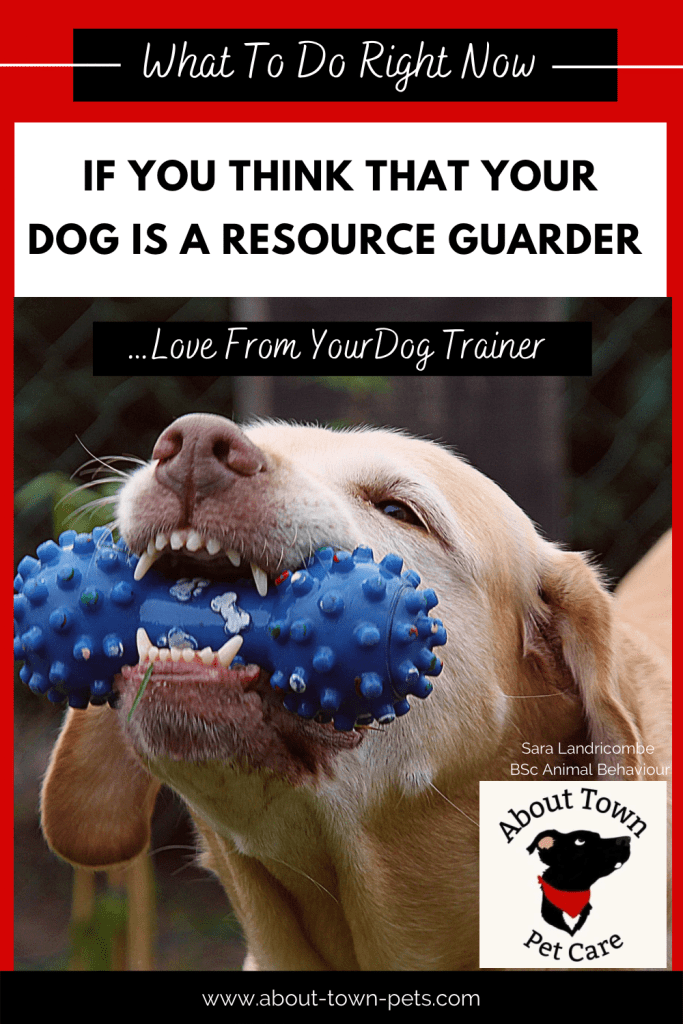
👉Does your dog show signs of guarding sometimes known as Resource Guarding (anything of high value clothes toys food sofa people or space)- it could just be play OR it could be a slippery slope into defensive growling and eventually a bite (the fear of having its coveted thing taken away at all costs)

👉So here’s my “QUICK ADVICE” for someone who’s worried enough to ask for help but hasn’t been assessed by a dog behaviourist yet – Disclaimer – your scenario might not be as bad as you think but always er on the side of caution especially where growling & biting & CHILDREN are concerned

This is my online response so I’m trying to generalise massively for someone I don’t know but can make SOME assumptions based upon my own experience …….here goes👇👇(this was for a 8 month old goldendoodle pup)

⭐️Potential Resource Guarding⭐️

🛑First port of call is to manage your dogs triggers – ie: make every attempt to prevent him from practicing the unwanted behaviour so if you know he grabs socks and books and anything that rolls on the floor (my dog guarded a piece of pasta once 😅) you need to make the things inaccessible – I don’t have anything loose downstairs and those things are upstairs behind a baby gate

🛑You need to set your puppy up to not fail as this breed of dog is highly sensitive to guarding behaviour as they enjoy having things in their mouth (golden retrievers actually have a high incendence of guarding behaviour issues) and it’s OUR response to the guarding that starts to create the problem
If we quickly go to grab and manhandle a puppy with something in its mouth it will probably do one of two things:

1- Get defensive because he always gets manhandled or scolded therefore growling and running away will become the default- if this happens too much and pressure is constantly put on the pup and growls are not listened too it will become a bite and then habitually after many repetitions biting = normal for this dog

2- Or it becomes a game of “keep away” depending on the behaviour presented – to your dog it’s much more fun to get so and so to chase them around so he’s much more likely to steal that thing again next time because ANY attention is good attention for puppies sometimes

Tan coloured Staffordshire bull terrier plays tug

🛑So after management of the environment start “Yes” training – think of this as the first building block to create a new behaviour chain for your dog -do something completely different in a different room and if your dog knows “What’s This” you are already onto a winner too.


💚What you are trying to do is create distance between yourself and the guarded item – it’s the close proximity that’s is causing true resource guarding – there will be a distance at which you see the body language of your dog go stiff and growling starts – this is your boundary when you see it move away quickly to diffuse the situation- keep your body language light and airy even if you don’t feel it & reassure them by actually following through each time and moving away.

👉Say puppy “ What’s this” and go into another room and start putting HIGH value treats on the floor or scatter feed in the garden and say “Yes” every time they “find” a treat but make sure “What’s this” and following you into the other room is ALWAYS followed by this high value game to begin with as your pup is learning something very difficult (undoing the previous learned behaviours) whilst in the other room a secondary person can retrieve the guarded item and once it’s picked up have a puppy party so that coming to you = treats on the floor and eventually a game of tug for example – you can start to train a solid – DROP once you’ve established this first thing (getting two of the same high value things like two squeaky balls for example) and timing your “Yes” = treat the moment the first item leaves their mouth – This is Step 2 in your new behaviour chain.

👉Step 3 is training a solid “Drop”- To encourage the drop don’t put your hand in their mouth or grab (this triggers resource guarders) WAIT for the moment THEY drop and mark “Yes” and treat after
You can make a massive fuss of the second item as puppies get FOMO and will drop to play with whatever you have – keep it up until the DROP (you don’t even need to say drop to begin with just pairing the word “YES” with a treat becomes the predictor.

👉Yes Training is basically clicker training with your voice – a consistent word in the place where you would “Click” this is what I mean by start “Yes” training- I mention how to do this in the link below to my previous blog post👇

My Blog Post Mentions Yes Training Here

‼️Notes: On Food Bowl Guarding ‼️

🔴If you are finding that your dog has begun guarding snarling showing stiff body language and eating faster in the presence of other people or your other pets – PLEASE DO NOT ATTEMPT to force your dog to give you their bowl mid meal (I know SOME uneducated dog trainers on the internet will tell you that you NEED to do this) but you DONT need to do this AT ALL – it’s usually BECAUSE there is this forced bowl retrieval mid meal that resource guarding has started. to occur.

🔴What your dog actually needs is to feel SAFE & SECURE so he doesn’t have to resort to getting tense and fearful every time someone comes close so in the first instance 👉 create a separate place where only the dog is allowed to eat (this could be behind a baby gate or in a separate room and do not bother your dog until they have finished – just this for several days to give your dog more confidence – then do the steps previously mentioned above to create a willing response to coming away from the food bowl naturally.

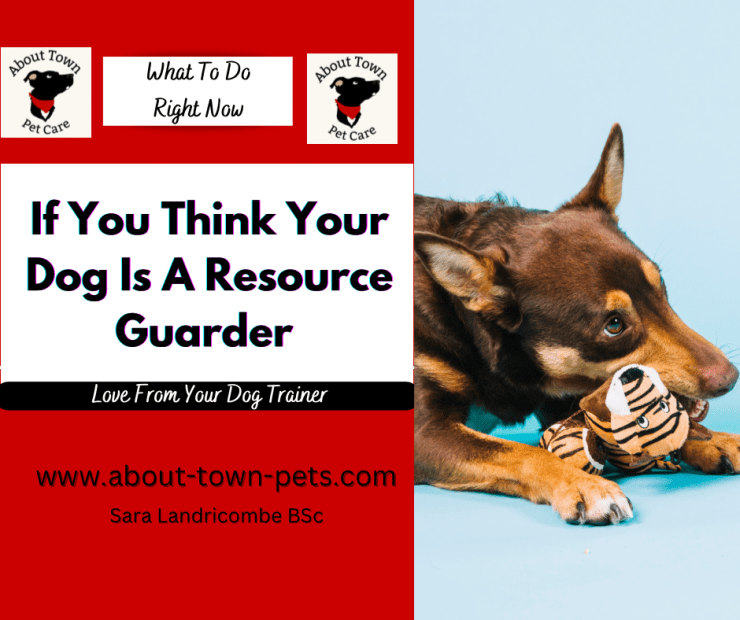
Brown & Tan Kelpie chews a soft toy

👉Then you can get a second person to pick up the bowl whilst your dog is being rewarded for an alternative thing in a separate room

👉This step might be easier said than done as I had a very smart spaniel who would only come away from the bowl for a VERY HIGH reward (I used chorizo and also I found he was only doing this behaviour INSIDE the house in confined spaces) so I found it useful to train an “outside” straight after eating to encourage a game outside in the garden to create natural distance from the bowl with a game of catch ALWAYS after his meal (nothing to strenuous I didn’t want him getting bloat) but he loved catching or “counting kibbles” or “finding chorizo” in the garden – these were all little tricks I could use if I ever failed at previous management steps and he got a tea towel for example – I could get him to at least come outside and swap for a game of ball instead of the object or “Swap” for the “catching kibble” 😅

❤️All of these things then become your toolkit for dealing with and managing a resource guarder humanely and without fear of escalation whilst you wait for behaviourist to assess the severity of your dogs guarding behaviour

👍My dog lived a happy 7 years in a home with three other dogs as quite a severe food & toy guarder because we managed him well helped him become more confident with his choices by doing fun confidence building training games. By having these little training protocols up our sleeves whenever the proverbial s**t got real made us much less nervous about managing him & made us realise it was our fault for not managing him properly or it was us who needed to dial down our response to the “stealing or guarding behaviour” as it’s was this overreaction that was fuelling the “ANY attention is good attention aspect of his behaviour. You learn quickly when you have a dog steal your mobile phone or the remote because you left it unattended on the sofa🙈🙈)

I hope this article helps someone with pointers and tips on how to be a more confident owner of a dog with resource guarding behaviour- because this is just a small aspect of their personality the other 75 percent is a loving happy active smart fun dog who just needs to be understood to thrive ❤️🐕❤️🐕

For an in depth look at the issues and training protocol I recommend this book 📕

Sara @ About Town Pet Care🐶

Ps – if this has helped you and you would like further help please contact me here👇

Surviving The First 7 Days Of New Puppy Ownership & Beyond

So you’re bringing your new puppy home tomorrow and you’re wondering what can I do to make this first week as streamlined as productive as possible right? I bet you’ve just found out your new pup can’t go to puppy classes until it’s had its first two jabs …..and it turns out there’s about a 3 week window between UK canine vaccinations these days – oops don’t worry not a lot of people know this is the case either – that’s why your friendly neighbourhood dog trainer is here to lend a hand 😍👍

A beginners guide to what to do & what to train your puppy right away

Prologue – Firstly it’s ok for your puppy to sleep with you for the first few nights. Doing this for a few days isn’t going to set the pup up for a lifetime of sleeping in your bed – all of these things mentioned below are to help your dog settle within the first week with as little drama as possible . It can all be gradually phased out – just remember your puppy has spent the last 8-10 weeks Co-sleeping with its siblings and possibly its mother so you are the next best thing . Be it on your chest or at the side of the bed even at arms length so it can be comforted when restless and also so you can quickly whip the puppy out for toilet breaks. Did I mention that in the first few weeks you are going to have to watch puppy like a hawk? Hourly visits to the designated poop station is going to be completely the norm from now on 😅 Help with toilet training is for another day and will deserve its own blog post….. but in the meantime for the first few days sleepless nights accidents and getting into some sort of routine will be the order of the day as well as the following things……

A guide to the first week of puppy ownership: what to expect and what to train to give your puppy a three week head start before puppy classes.

1- Wherever You Go (where possible) Take The Pup Too

This is the first tick off of your puppy socialisation list ✅ By carrying puppy in your arms so it can simply see their surroundings and the sights and sounds of your daily life together you are already getting some valuable practice in in regards to socialisation. Remember socialisation isn’t simply meeting as many people and other dogs as possible it’s also simply observing sights sounds and travelling with their family . Puppies don’t actually have to touch or greet people & other dogs or even be on the floor for “socialisation” to occur – we have a small window of opportunity to expose our puppies to tall men tall women children bikes cars buses the shops men in hats wheelchairs etc etc All of which should be done with positive interactions and minimally – Let’s not overwhelm the puppy (Google – Flooding behaviour- a post for another day also) but let’s do 15 minutes a day around the block whilst being carried and stopping at friends houses for gentle meet ups and positive handling. Depending on the breed of dog your puppy is going to mature quickly – you have until roughly 18 weeks old (this is by no means set in stone) but until this point the puppy is developing its environmental experiences after this you are likely going to need to train any fears and phobias that arise with positive training rather than naturalised socialisation (you know – those puppies that are spooked by cars for example have likely never been exposed to them before 18 weeks of age or have had an adverse encounter before or after this point) So let’s be mindful of these things within our 8-10 week window before it’s gone forever 👍

A guide to planning and training puppies before they can go to puppy classes or go for walks in the real world

2- Start teaching your puppy that when you leave you will always come back

Next up start your home alone training from day 2 of your first week – let’s set your puppy up to know that you leaving isn’t anything too overwhelming or scary as you will always come back – it is also adding mild resilience to slightly stressful situations (you going out of the room can be deemed stressful) *Side note- always keep an eye on your puppies body language whilst doing this training- yawning and prolonged screaming or crying suggests you’ve let it go on too long and may hinder any training you’ve already achieved.

Start training Puppy Peekaboo micro absences (like leaving treats outside the toilet door whilst you go in or behind a baby gate whilst you and get a parcel) literally a minute at a time and do this several times throughout the day. Also provide a space (perhaps a crate with the door open) with a toy on a rope with treats inside but cannot be moved (kong on a rope toys would do well here) to provide a space where the puppy can actively take itself off for a time without you that is a positive experience. I will be going over all of these training protocols in my upcoming evening webinar for new puppy owners (link coming soon).

3- Start “No Big Deal” Training

This is for those of you who may find that they have a naturally anxious dog or one that becomes nervous if you leave them to go outside for example- the concept of “No Big Deal” training is that we practice something so often it becomes predictable and therefore No Big Deal. So by braking down things that predict that scary things are going happen we Gradually practice a step by step version until the pup becomes relaxed when you do it OR settles down whilst you are doing it like it’s No Big Deal- An Example- your puppy is getting increasingly anxious every time you go to go through the back door to put the bins out – start by braking it down to HANDLE TOUCHES / OPENING THE DOOR/ TAKING A STEP THROUGH etc etc Simply do each thing 10 times in a row until your puppy gets bored of following you or goes and settles down before moving on to the next step- you may only need to do one or a few of these steps but it’s in steps so that we don’t rush the puppy. ANOTHER SIDE NOTE- make sure you are only attempting these things after your puppy is SAFE- Sleepy All tired out Full & Empty as in been to the toilet . This is so that your pup will be able to concentrate better if they are hungry full of energy or needs a wee there won’t be much learning going on. By starting now, your puppy will have a 1-3 week head start on being left or simply is acclimatised to exits and entrances from people- before you decide to go back to work too, instead of waiting until your puppy is 6 months old before it’s being left alone for the first time.

Start training “No Big Deal” Training in the first week to get your puppy acclimatised to your coming and going

4- Start as you mean to go on with Toilet Training

It’s one of the most common requests for advice in regards to the first few weeks of puppy ownership as you can imagine people want to get to the bottom (no pun intended) before it’s too late but realistically your brand new puppy (if the breeder hasn’t done any training beforehand) can take anywhere up to 12 weeks to get right and still dogs will have accidents right up until 18 months old (I mean meeting new people is sooo exciting right?) so please more than anything BE PATIENT. Then remember to look out for “needing the loo” body language and get them out hourly or after eating or drinking/ after a big playtime (they will forget they need to go if they are having fun) after sleeping -basically hourly for the first few weeks (set a timer if you need to). Don’t – put puppy pads down if you are not going to be around to clean it up straight away & try not to make a big deal about peeing in the house just be more vigilant for the signs next time (sometimes by making a big deal we inadvertently teach our puppy to simply go when your not around or when your back is turned when the puppy feels safe because they haven’t actually learned where they should go yet but only know you get angry and scary for some reason when they go and you are nearby (did we cover that they are very good at making body language associations) and Do –clean any accidents with enzymatic cleaner to get rid of the ammonia smells that encourage puppies to go again in the same place. Also restrict puppies movements if accidents are happening frequently (think movable puppy pen).Be Prepared- have treats by the back door to put in your pocket so you can mark and reward puppy the minute a pee is taking place make sure your enthusiasm doesn’t distract the puppy however as this may lead to them forgetting what they are doing and coming back inside to pee when they’ve “remembered again” and always be PATIENT its the key when waiting and saying “wee wees” for the 18th time that day 😅👍

Getting into a routine will help towards cracking toilet training early in your puppy training schedule

5- Begin GRADUAL crate training if that’s what you eventually want your puppy to be ok with

What’s your end game? Where will the puppy be left if you’ve got to go out for an hour or two – if it’s in a crate under the stairs start gradually crate training with the door OPEN for now and this is likely to take time to build up to closing the door and being genuinely happy and settled inside – I’d give the pup at least 7-10 days of everyday practice to be able to be left for a few moments – remembering to go at the puppies pace and making sure all good things happen in the crate with the door open. I WILL ALSO HAVE A PROTOCOL FOR CRATE TRAINING 101 IN MY UPCOMING WEBINAR. If you want your puppy to be left in the kitchen behind a baby gate the training will be the same teaching the puppy to settle in that space WITHOUT you with the baby gate shut is exactly the same procedure minus the crate it would just be in a bigger “Pen”. For this your puppy will next need to learn to settle ……..👇

6- Learning to settle using the “Magic Mat”.

I can’t stress enough how much I use this little bit of training in almost every aspect of dog training from puppy class to general impulse control work and trick training. It’s the simplest easiest thing to teach from the beginning after perhaps luring behaviours with treats (see the next point 😉) It’s amazing what a piece of mat can do for you and your puppy (Side note= most dogs don’t like to sit or lie down on a shiny surface or the cold ground hence why I like to use a piece of “Magic Mat”) this can be anything – a towel a bath mat a piece of vet bed (I tend to use the latter) but it must ONLY be associated with good things put it down next to you a sprinkle treats on it and sit calmly with them and place treats between the paws to encourage the pup to stay – put kongs and treats and feed their food on it to begin with EVERY time so you begin to build an association MAT = GOOD STUFF HAPPENS once you have begun to do this out it in the crate and feed in there then take it on the move and encourage settling in other rooms (remember your micro absences from step one?) it’s all useful – you can even start to train tricks on it……..👇

Get at least 3 weeks head start on training your puppy with this guide

7- Get a heads up on puppy class and begin “Yes” Training – it’s like Clicker training without the click

There is no pressure to do any trick training begin with you could simply just start to get you dog ready for leaving, toilet training and crate training if you wish but learning the mechanics and timing of training without any body pressure on your dog and simply luring with something rewarding (in most cases that’s small pieces of treats broken up) means you can actually move your puppy throughout your home without even touching them and getting them in the right frame of mind for training before you even step foot into a puppy class will give you a massive heads up before you even start walking your puppy. Simply put , Yes training, is when you use the word “Yes” to mark a desired behaviour and then reward your pup. The puppy must simply learn that the word “Yes” means reward and repeat repeat repeat this is where a click would be but I’m lazy and forget to carry one with me but I’ve always got my voice – Good tip here – simply mark and reward when you see your puppy doing something without you having asked for it it eg= settling on a mat “Yes” and toss him a treat do this ten 10 times and your pup should start to work out yes means treat- this then becomes the predictor of a reward once you have cracked this simple step you are ready to start learning some simple tricks.

8- Learn a few tricks

Luring a sit purely using an upward hand motion with a treat – WAIT FOR IT the minute your puppies butt hits the mat say “Yes” and give a treat – hold out your hand until your puppy touches your hand with his paw ,when he does say “Yes” and reward – you’ve just SHAPED the beginnings of “PAW”. Put a treat on your pups nose and lure him in a tight circle say yes the minute he gets back to the start and reward – you’ve begun “spin” all wonderful little things to begin boosting your puppies mood and building a positive little bond between you both – make sure everyone in the home knows how to do this and when to mark and reward with yes – you don’t even need to add a word for sit paw or spin really, that comes in puppy class (mostly hand signals will be just fine for the moment😉)

9- Begin to work your way through a socialisation list

Make a list: what will your puppy need to be ok with ? Do you have a baby? It might need to be ok with loud noises and the washing machine as well as people visiting and the pram moving about- do you have small children – factor in multiple visits to the door and different children coming and possibly handling the pup (teach them how to do this gently and what not to do around the puppy and at feeding times) or will he have to live with a cat or do you have regular visitors with other dogs? Make sure your pup is introduced when able to do so in a gentle and sensible way – also a big issue seems to be getting used to a car – treat it like crate training and all the good things happen in the car in a crate before the car has even gone anywhere – go to the vets when you don’t need to ,this will build up the association with treats and getting on a table and then add in places you will regularly go for a walk – simply sit and watch the world go by whilst you both listen to cars and traffic. Obviously this doesn’t all need to be done in the first week but you can plan over the next 3-8 weeks to see at least one or two examples of everything you may encounter in real life scenarios, remembering to carry your puppy and to not overdo it everyday as you will have a cranky tired puppy to deal with as well as everything else.

10- Lastly start getting your puppy associated with his collar harness and lead

If I had a £1 for every time someone said to me we need to start walks but he hates his collar and or lead I would have…..about £50😅 Start after a handful of days of being home say “yes” and treat him for going near his harness and collar and do some NO BIG DEAL training with the clip on the collar or Velcro or clasp noise of a harness do it frequently so it’s no big deal by the end of the week put a lead on and treat your puppy then put on a lead and treat so they get used to the feel of it attached but don’t fret too much about this part you have at least three weeks to start this before the big FIRST WALK👍👍

Hopefully when you get your puppy home he has a wonderful confident personality – if you do find yourself with a nervous or shy puppy remember all of these things will take double perhaps triple the time to master. Be kind to yourself and your puppy if you find yourself in this category and you may even find that standard puppy classes might not be the correct choice to begin – I will make that my next blog post – so check back for advice on Helping Nervous Puppies Go To Puppy Class. Most of all remember to enjoy those first few weeks at home with your pup as they fly by and take as many pictures as you can everyone is in the same boat to begin with but using these steps you can have a puppy that is three weeks ahead of everyone else in regards to toilet training crate training settling at night trick training and home alone training.

I hope this helps – if you need a puppy cheerleader or more help with 1-2-1 training you can find me at my social link below👍 Ps check out my blog on 7 Things to consider BEFORE you bring a puppy home below👇👇

7 Things You Should Consider Before Getting A Puppy

The thought of getting a puppy leaves the majority of us ecstatic and mostly feeling like a child waiting to go to Disney world (that last part might just be me) but have you REALLY considered everything before taking the plunge? 🐶

You’ve seen THE ONE and you’ve simply got to have him- now take the next 10 minutes to step back into reality and please consider the following 7 things before you make one of the biggest commitments of your life.

Chocolate Labrador Puppy- Puppies are a big commitment. Professional dog trainers advice – Consider the next 7 things before taking the plunge – About Town Pet Care

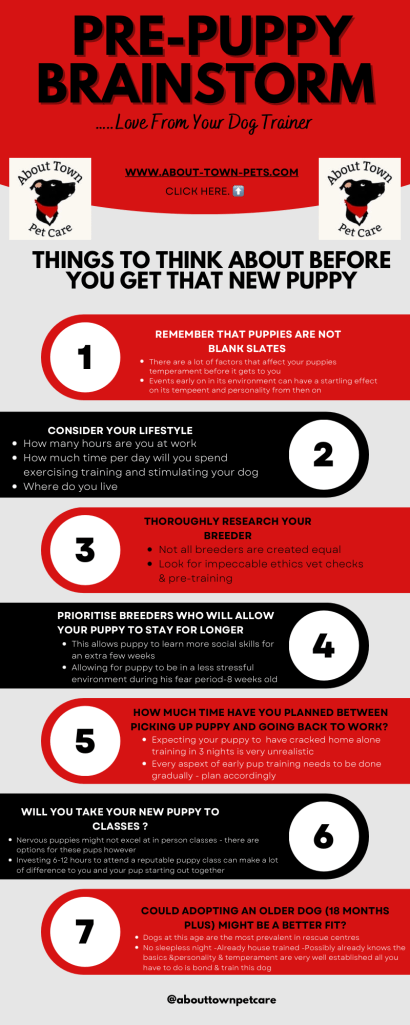
1- Consider Your Own Lifestyle………

I know I know you’ve promised yourself you will walk it twice a day rain or shine , play with it every day and take it on hikes at the weekends when it’s big enough – now just give me that husky already! But wait….. you work 10 hour shifts and live in an apartment and you don’t even own walking boots. Obviously I’m jesting but I see it so often that people either pick a dog because it’s beautiful or what they THINK they can cope with but reality kicks in the moment you struggle to house train a dog in an apartment or when the bull breed starts mouthing A LOT more than the average dog or simply can’t keep up with the athletic ability of a working breed. I also see what I call “being out dogged” for want of a better word especially amongst first time dog owners who pick the working version of the breed of dog and don’t realise the sheer variety even within a specific breed. There is no one size fits all for any breed but obviously don’t buy a Great Dane if you live in an apartment ,don’t buy a Malinois Shepherd even if you’ve owned big dogs all your life and definitely don’t underestimate the amount of difference between working cocker spaniels and show cocker spaniels – I say all of these things purely because I want you to enjoy being a team with your new pal and the best way for you both to get along from day one is to be REALLY honest with yourself with regards to how much effort you want to put in to training said puppy all the way through it’s life as well as the amount of space and time you have to keep him occupied when he becomes a teenager. EVERYONE struggles at least, a bit,during this phase. Ok, maybe you won’t pick the husky, perhaps a (insert breed here) would be better for my lifestyle, no-one is going to judge you for changing your mind if anything I’d respect you even more for being sensible so……….what next?

2. Thoroughly research your breeder……

I don’t just mean he’s KC registered that will do OR this person lives nearby that will do. Check that your breeder has a licence (in England you have one if you breed more than 3 litters per year) and if not that they are committed to get all the health checks and predisposed conditions for that breed checked. Make sure it’s not a backyard breeder who is breeding as many as they can or are dealing in European imported puppies (Red flags – will include not being able to see the mother with the puppies and or the fathers details, meeting at a motorway fuel station to collect the puppy , also the owner bringing the pup out to you to see it , all indicators that they don’t want you to see where the animals are kept). Don’t be afraid to ask to look around – ask if they will allow the puppy to stay longer with its siblings and mother – ask if the pup will start some training with them before you collect them (handling socialisation crate and toilet training can all start as early as 4 weeks old) any dog breeder worth their weight in gold, should now realise, that they have more of a responsibility to breed dogs which are healthy & have better temperaments not just the ones that are trendy & beautiful .Lastly make sure they have a breeders agreement/contract in place just in case something untoward happens and the puppy needs to rehomed ( I’ve personally rehomed 6 dogs (to prevent them from going in to kennels) and they are all free to come back to me if ANYTHING happens . Dog shelters are currently at capacity and receiving 40 percent more enquiries due to behaviour issues this is sadly becoming a one way street to behavioural euthanasia so please please please don’t add to the problem where it could have been avoided.

7 common things that are often over looked when considering buying a new puppy

3- Try finding a breeder who will allow your puppy to stay an extra two or three weeks….

Studies are now showing (I will link studies another day- it’s late and I’m typing with fury) that due to what is known as the “fear period” in puppies which occurs right at (depending on the breed) 8 weeks of age, just as puppies are typically encouraged to go to new homes. What is a fear period I hear you cry! Its period of heightened sensitivity to overtly stimulating or aversive experiences. The studies proved that if an aversive thing (as perceived by the puppy) happened at 8 weeks old (a scary hand coming in to touch or roughly handle the puppy- I believe) then the puppies were unable to show any signs of resilience and stayed fearful of people after the fact – the same thing happened to puppies at 10 weeks old and they bounced back and were more resilient to the perceived aversion and went on to be trained how to like people more easily (there is thought to be another period like this at 6 months old but that’s for another post). So by simply allowing the puppy to wean for longer and eat socially with siblings as well as have more social interactions in a safer environment this extra 2 weeks with the breeder could make all the difference between taking home a fearful puppy and a more confident one.

4- That puppies are not blank slates…….

Just because you buy a new puppy does not mean that it’s free from temperament or health issues from day 1. Stress can be inherited (again I will link studies another time) so if you buy a puppy from a stressed mother ie: puppy farm scenarios or a nervous first time mother , your puppy will likely feel the affect of that through genetically having these dispositions be passed on to them or through lack of maternal care by a naturally less confident dog (so ask as many questions as you can to the breeder- what’s mum like with other dogs? What’s dad like around children etc etc) Also I personally know of puppies bred and raised exactly the same yet yielding puppies with completely different personalities even within a litter. Mother was a slightly nervous girl and had a very typical Labrador male puppy (not phased gentle happy go lucky dog) and also a moderately nervous female who doesn’t like to be away from her owner and isn’t confident around new people and barks a lot (some might say not typical Labrador behaviour ) but is totally normal to find this variance even within a litter so choose your puppy wisely – Was the litter all females or all male (this is thought to have a hormonal difference on behaviour Or was it the puppy that has been returned? If so why was it returned (you get where I’m going with this?). As a rule look for Goldilocks dog – not too shy and staying away but not the one who’s trampling all over the others and being too rough- find the guy who’s happy to be handled and equally happy playing & not too boisterous – a red flag here is a puppy that is panicking a lot if gently tipped onto their backs – look out for the ones who panick or mouth increasingly in doing so.

5- How much time will there be between getting your puppy & you going back to work? ……

I don’t think that this is considered enough. I see all too often people asking on social media – how long does it take for a puppy to settle at night ….it’s been 3 nights now and I’m exhausted. These tend to be people with unrealistic expectations of a brand new baby animal that has just moved away from his previous cohabitating life (puppies are group sleepers) where he had access to his mother and siblings for comfort almost 24/7 to live in a home where everything is new and is expected to sleep alone in 3 days🙈 Alternatively they just haven’t given themselves and their puppy sufficient amount of time to practice everything I mention in my upcoming blog post & webinar – Surviving the first 7 days of puppy ownership- If I were to get another puppy, knowing what I know , I would use the 6 weeks school holidays to take full advantage of several people being home at this critical phase – we would crash course the first two weeks where we would hit the ground running with- settling at night gradually – toilet training- basic crate training gradually- getting ready for micro absences- working up to 15 minutes of home alone training – working through your puppy socialisation list & signing up for online puppy classes – so that my pup can be 2 weeks ahead of his class and we can be being proactive whilst waiting to finish his course of vaccinations (which In the UK is about 3 weeks now & the socialisation window for new experiences is roughly 18 weeks old 😅) But even if you don’t have 6 weeks to spare try to use your annual leave as much as you can and call in favours for puppy sitting at least until your pup can successfully go to the toilet without accidents and is big enough for a pet sitter to visit. Try to break up the puppies day every 2-3 hours so plan to come home on lunch breaks , get a pet sitter and ask the neighbour to come in because its difficult for your pup to hold it in when their bladder is the size of a walnut 😉🐕

Things to consider BEFORE you get your puppy – from your friendly neighbourhood dog trainer – About Town Pet Care

6- Going to puppy classes or not to go to puppy classes that is the question….

I have two points to make on going to puppy classes (disclaimer I offer in person puppy classes as of November 2022 in the Plymouth area) that being said I don’t think FORMAL puppy classes are for every dog but let me explain….. I wholehearted think that everyone with a confident puppy should go to some form of formal positive training sessions with their puppy – I mean its 6-12 hours of your life that can greatly benefit you as the owner (gives you the building blocks and advice to start training your own puppy quickly and kindly) to save you, hopefully, from having to come back to me in 6 months time with Separation Guarding or Reactivity related issues. I say this because the vast majority of my behaviour cases are currently resource guarding nipping or Separation Related distress based upon leaving it too late to train their dogs (none of them have had any early years training even if it was just online sessions with a reputable trainer) a lot of their issues could have been remedied earlier or noticed quickly by a trainer. The seven most commonly asked training issues are usually covered in the very first 6-12 sessions on offer for puppies under 12 months old (I shall do a post about those soon as well). If you have a naturally nervous shy or boisterous dog who loves to bark formal classes might not be the best idea for them and that’s really OK not all dogs need to physically be next to others to socialise. You could pick online classes to start with so that you can do a class with your mute button on so that your dog can learn the basics in a calm environment OR I recommend “Anti-Social” training in my puppy classes where, for example, the nervous nellies (daschunds I’m looking at you😅) can still be in class but kept at a distance where they are more comfortable and might settle better or cope better with the movement – just simply being in the same room can help your dog mimic the other behaviour and also it might just be that little Rover needed a few sessions to get to know that everyone else is ok before joining in 👍 Alternatively 1-2-1 puppy training sessions are another way to get the most out of your hour with the trainer and learn what your peers are learning without the crowds. Just a few ideas to think about…..

7- Lastly, seriously consider whether adopting an older dog might be a better fit…..

What? A puppy trainer just told me to not get a puppy and adopt one instead!! Hear me out…. As the owner of two “failed puppies” and having worked in a rescue centre myself in the past I know all too well what the puppy industry fallout looks like. Whilst I want to promote the absolute best pet guardianship possible in the most positive of ways I want to also make it clear that I would personally (unless an absolute emergency ) own a puppy ever again – It’s easier to take on dogs 18 months and older who have already done puppy classes can go to the toilet on their own and have lovely personalities already. I have also had 3 puppies over the years and it’s hard work- it’s called the Puppy Blues for a reason – you think your puppy isn’t normal and “why me” when it comes to relentless biting peeing and barking BUT I am an advocate for RESPONSIBLE dog ownership & want to reduce the like hood of any current puppies from needing to either be rehomed for behavioural issues that could easily be prevented or simply reducing the amount of “on a whim” puppy buyers to reduce the 40 percent increase in intakes in rescue centres of dogs aged 6-18 months old roughly about the same time the “fun period” ends for puppies and sh*t gets real. So please please please take notice of the points mentioned above and perhaps hold off another year from getting that puppy but by all means go and get yourself a puppy if you truly have the burning desire to do so because as with dogs not everyone is the same sort of owner I get that ❤️ Do try your very best,however, to avoid all of the pitfalls I see every week so that we can all live in a world where dogs are angels in real life – I just want you to enjoy your dogs in the best most kind way possible. Xx

Thanks Sara🐕❤️ Ps Check back every Tuesday for more training tips and advice and get your fix of daily doggies on my Instagram or more posts at My Facebook Page

http://www.about-town-pets.com

An In Depth Look At Animal Emotions

Recently I signed up for a free Coursera short course on dog emotion and cognition, Find course here, hosted by Duke University. It got me looking into the most recent research on the subject over the last few days. I thought I’d share what I found with you all, I want to be useful so I’m sure someone will benefit from this little finding.

One of the first articles listed in the journal of Neuroscience and Biobehavioral Reviews was this review article , (Kremer et al 2020) that took all of of 3 seconds to find on Science Direct. It is a not to be officially published until next month so it is hot off the press.

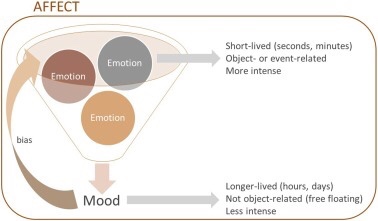
The study is from the Animal Science department at the Wageningen University in the Netherlands by authors Kremer, Klein-Hokenborg, Reimert, Bolhuis and Webb. It is a synopisis of the field of animal affect. Animal affect is a broad umbrella term for mood and emotion (see Figure 1 below).

Figure 1: the relationship between mood emotion and affect (Kremer et al, 2020)

The study asks – do existing animal science methods assess animal mood, happiness or personality?

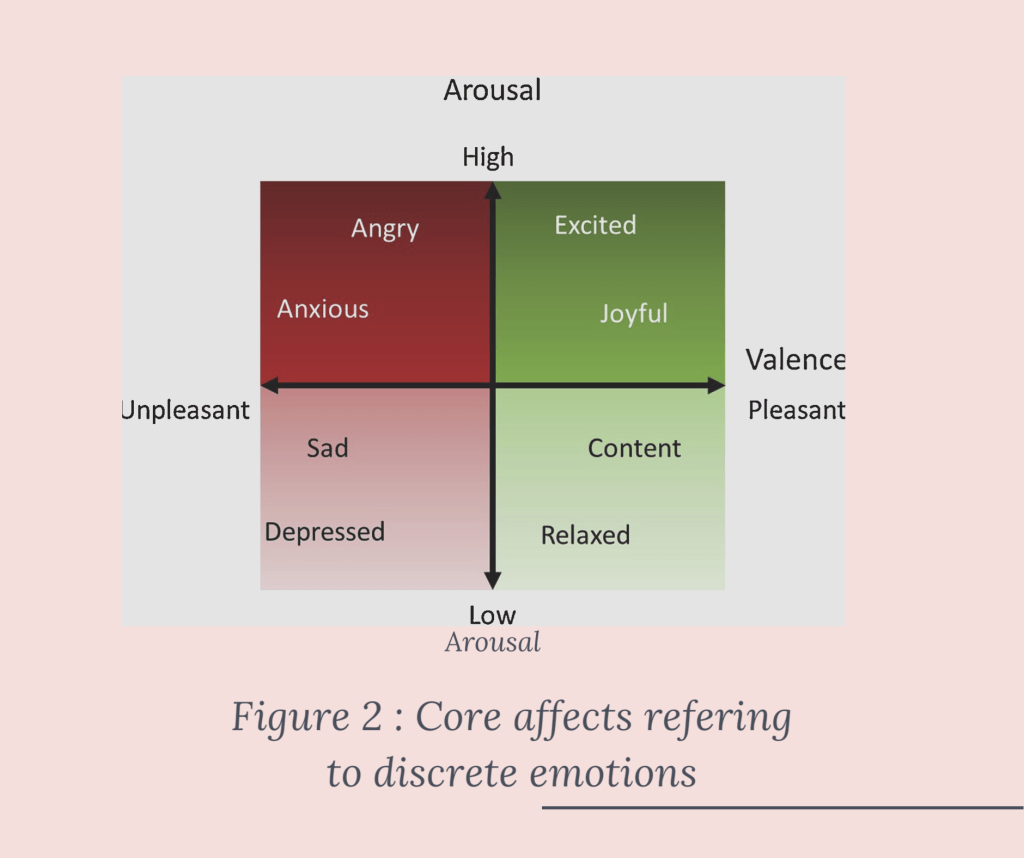
The multi process method (which brings together both of the current methodologies for these assessments) is the most promising. It suggests that low arousal positive affects (for example,contentment or relaxation) need further research as it is a lot more difficult to test for these sorts of behaviours without the animal getting too highly aroused. The researchers also believe that better defined methods are needed to unravel negative from positive affects of low arousal ( For example being able to safely differentiate between sad or depressed or content and relaxed) See figure 2 below.

(Adapted from this study)

The study of animal emotion can sometimes be confusing with each branch of study with its own variants on the definitions used for the terminology within the field. This study however tries to be a complete and up to date overview of the field of animal emotion with its functions and processes explained.

As the interest into emotional lives of non-human animals continues to grow so too does the growing concern for the welfare of captive and domesticated animals (Cornish eat al, 2016). Certain animals show characteristics that influence concern for their welfare, with those species considered more intelligent being afforded more concern. With regards to our food production animals almost being given an “out of sight out of mind” sort of mentality , there is compelling evidence that the general public have a very poor understanding of farm animal welfare.

By Roy Buri – Did you know pigs are thought the most intelligent of all of domesticated animals?

It is with further studies into animal emotion that we can, perhaps, change the public awareness surrounding an animals consciousness and emotional capabilities so that we may be able to further improve standards of welfare and ethics for the more overlooked species and therefore all animals both locally and internationally.

Animal emotions studies have emerged in various fields of science including zoology, neuroscience and even psychopharmacology. I am particularly interested in animal intelligence, emotions and personality.

There are already a multitude of reviews on animal emotions, many of which study researchers using neural, behavioural and physiological indicators to measure animal emotions, these measures are used to characterise how animals responded to situations that induce discrete emotional states as well as affective characteristics such as positivity Vs negativity and arousal (likened to being excited).

The review also includes thorough definitions of emotions, moods and affects, the function of these affects and the frameworks used to study these affects. It also delves into the cognitive components of emotions as well as the physiological affects.

In summary this article review, dated for next month, is very thorough and provides an in-depth incite so that you can gain a good working knowledge of the methods being used to determine animal emotions. It is also open access so everyone can benefit from it. It includes a wealth of cited current (I use data from the last 10 years only unless looking into historical methods etc) scientific papers and articles so that you can continue expanding your understanding of topic of animal cognition and emotion. It’s a lot of reading but highly worth it.

Happy weekend everyone

Sara

By Ivan Ovgood