Help My Dog Is Lead Reactive

How to start helping your lead reactive dog by changing his emotions
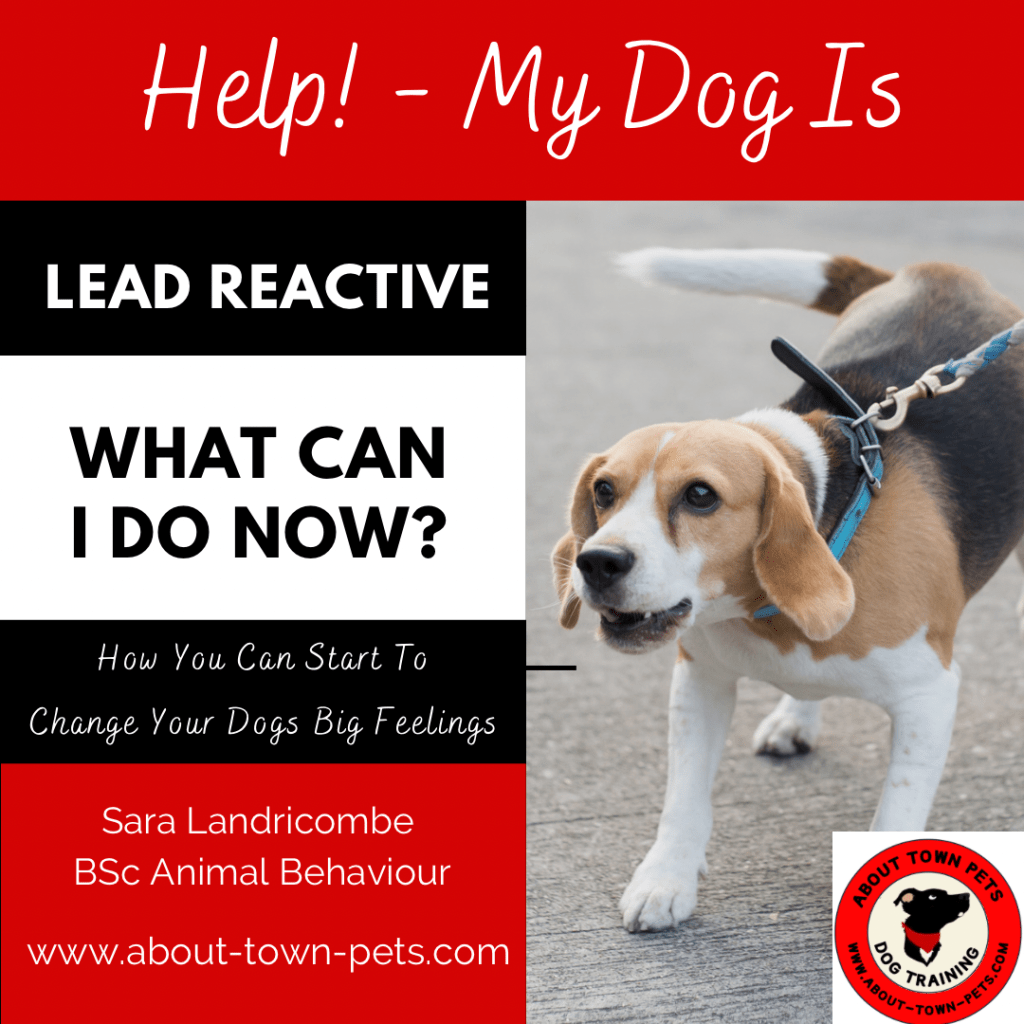
Beagle on a blue lead lunges to the right

You are not alone , this is a very common occurrence nowadays especially as we have to keep our dogs on a lead in order to keep them under control in public places.

If I want you to take three things away from this post today it’s that:

1- Reactive dogs are not bad dogs

2- Reactive dogs are likely having to resort to this form of communication because their more subtle attempts of appeasement or displacement have gone unnoticed

3- There is NOT a one size fits all approach to these behaviours (every dog is different has their own learned history of events / genetic background/ age / sexual status etc) all need to be taken into account

4- There IS however some underlying emotional state that is going unnoticed or being misinterpreted perhaps.

So let’s begin…..

So you’ve filled in a training and behaviour history questionnaire and we have assessed perhaps likely causes and rule outs and the reactions are not so severe that they require medical intervention and you are waiting to start some training with an experienced and ethical dog trainer or behaviourist. Whilst some simple changes to your dogs lifestyle including diet and enrichment might help – controlled training scenarios and possibly behaviour modification is likely what’s needed at this point.

I am assuming here that you know that letting people or dogs greet your dog for the first time on a taught lead is not ideal and that letting your dogs run up to other dogs in general, but especially ones on leads is actually making their behaviours worse as most do not care for rushed face to face greetings – it’s bad manners if you’re a dog and the reacting dog is sometimes angry about the intrusion into his space.
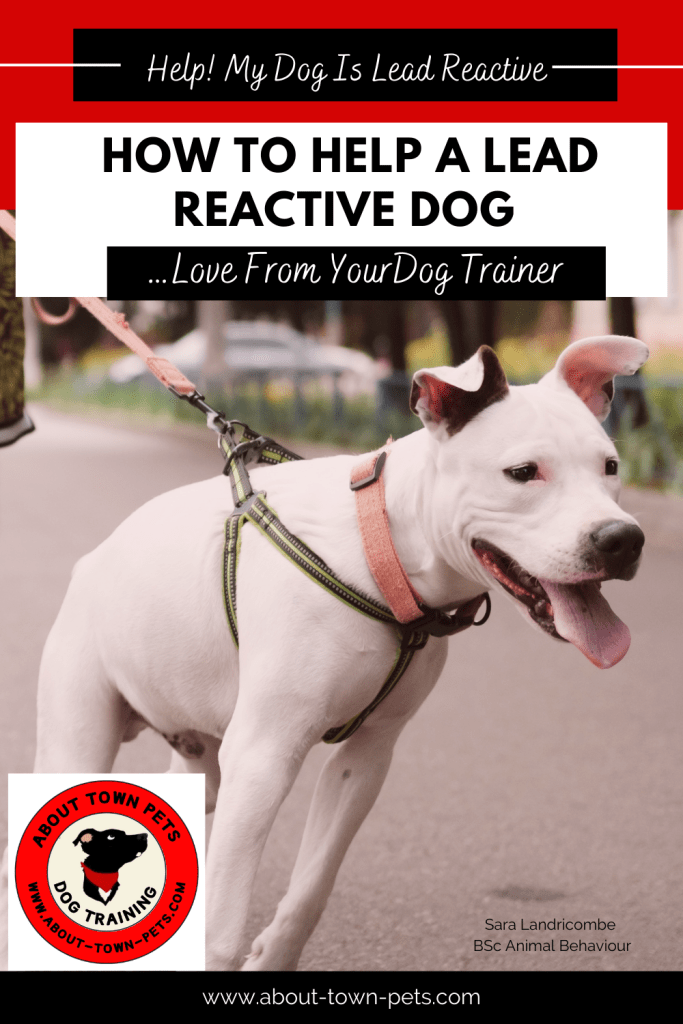
A white bull breed dog on a green harness looks happy and pulls forward to the left

What well adjusted social dogs actually prefer is a behaviour I’ve heard being called “Arcing” where they approach each other from the side whilst giving each other somewhat of a wide berth (this can be seen when you see two dogs go round and round in circle trying to sniff each others butts) and then when they sniffed a butt they quickly go on their merry way – now if we then add a lead we are preventing that free access to the bottom sniff and walking away (we’ve all seen this in the local park when dogs get tangled –

TIP – if safe to do so drop the lead and once they’ve finished their little butt sniffing circle quickly pick said lead back up, gather it up and move on- this is one of the copious reasons I do not like flexi/extendable leads- I digress – can you now see how by adding a taught lead to this scenario we would be taking away that dogs ability to choose a quick exit ? This will often lead to frustration in a dog that really wants to go and say Hi or anxiety in dogs that just want to move away – this spills over into a reaction because nobody’s making this rude obnoxious new comer get out of the way. How can you help your dog with this? I hear you cry -simply ask yourself a series of questions…..

Is your lead long enough? AND do you know how to handle a 6ft lead appropriately ? I ask you this because the lead creates tension if it’s too short – whilst keeping a dog on a short tight lead might feel to you like you have more control in a given situation (and in an emergency situation definitely do this to get past another dog for example) but it is not however , helping that dog feel like he has a choice or conveying calm in the face of something potentially exciting, frustrating or scary (from your dogs perspective).
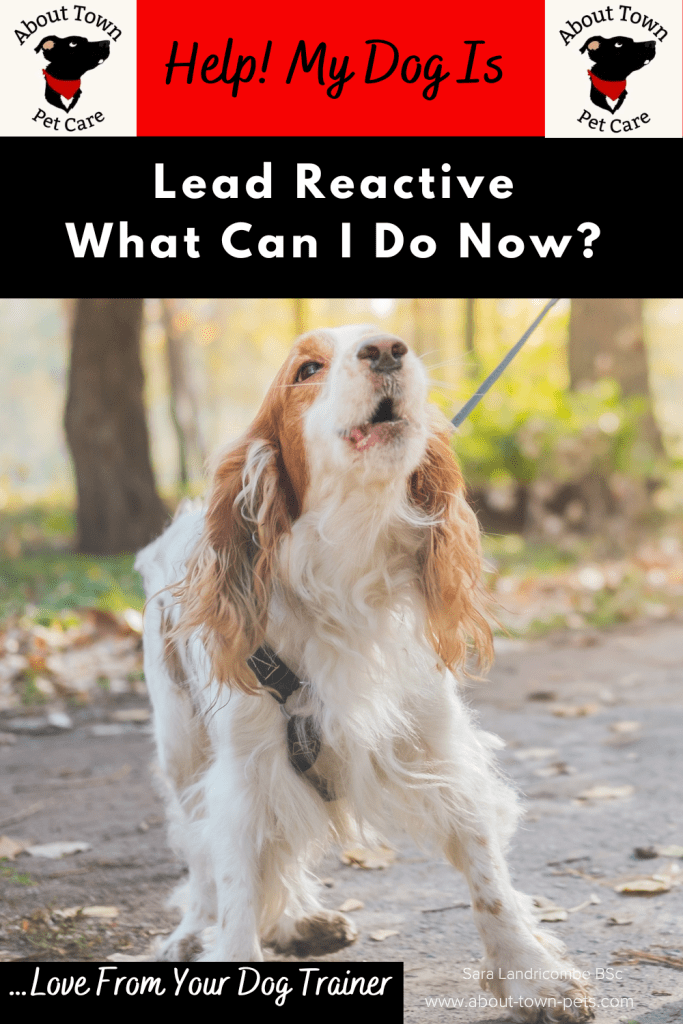
Red and white spaniel on a black harness lunges and howls

There is a definite way to handle a longer lead in relaxed manner but also having control of that lead should you need to move your dog forward or away from a scenario. You also should attempt to create enough distance so that your dog isn’t having to get to the point that he feels that he has to lunge and therefore make that lead tight- learning your dogs “safe zone” is critical to starting any training . Which leads (no pun intended😅) me to …..

Do you know the distance at which your dog does not react?

This could be the point at which your dog is comfortable enough to simply look over at another dog or person or thing WITHOUT showing signs of worry stress frustration or becoming excitable. This is likely to be the point at which you will be able to get your dog to think straight again by offering some responses to training or even more relaxed body language. It is here we would start our training process and build back up to these places that were previously stressful or too overwhelming for your dog AT THE MOMENT – all is it lost we just need to remember what we THINK our dogs want might not actually be what they WANT at that time.

This is where some of you will shout “my my dog is not food/toy/praise orientated” or insert whatever types of “reward” you have tried before and I’d say that’s ok – all dogs are food motivated at some point – they eat food to live don’t they? So try some of my counter points here

Go back to basics with reward / food based training we might not have been consistent enough, engaging enough with our treat delivery or our timing might be off – increase the VALUE of the reward so boring kibbles might not cut it – but salmon paste might – my dog goes mad for pieces of broccoli 😅try out different types of reward 👍

Is the environment we are in MORE rewarding than me on the lead at this moment – try a less distracting more barren environment to get the basics down (industrial estates on Sunday) are a good idea for practice 👍

Can you make treat delivery more exciting ? And think about the breed of dog you have ….. do you have a scent hound – treat delivery can be on the floor or scattered in long grass (remember to allow enough time for your dog to “find” the treat before doing another rep – don’t rush” Do you have a husky who likes to pretend they are hunting? Throw the treat in the air to find or catch (this is a great tip for Lurchers for example or collies) Do you have a spaniel that just has to keep moving ? Incorporate treat or reward delivery at pace and roll it away from you whilst they are on a long line. Can you see how these methods would make a reluctant dog more engaged in you ?

Young golden retriever pulls whilst walking in a Sandy path

Every dog is different and it’s up to us to make decisions for our dog to keep their best interests at heart- got a happy go lucky Labrador who wants to say hi to everyone ? Let’s set him up with lots of polite meeting and greeting BEFORE he goes bounding up to potential lead reactive dogs and setting them back and also earning him the title of “Billy No Mates” as the other older dogs will not want to hang out with this big overly friendly dude again and potentially give him a few unpleasant experiences where older dogs might nip at his face to get him to go away (FYI we shouldn’t be expecting other dogs to do our jobs for us) It’s our responsibility to not set anyone else’s dog back just because we haven’t taught our dog polite greetings or recall- they are our responsibility nobody else’s. If this does happen apologise profusely and keep training.

Perhaps you have a 6 year old pug who has a questionable background and lunges out of fear or under exposure when they were young to a variety of people and other dogs – those dogs will benefit from general confidence training and their “Safe Zone” might start from the moment you leave the house because going somewhere busy or overstimulating will cause reactions the minute you leave the home – in this case we would build up to going anywhere at all – this is because this dog has been exhibiting the behaviour for a long time they will have a very well trodden pathway which has created a habit that has gone unaddressed over time – but now we know how to look for the signs of stress and the distance at which it can handle short bursts of training. We can now start to prevent that dog from getting overwhelmed and begin the unlearning (is that a word?) that dog now doesn’t have to go towards the thinggs it doesn’t like – we can actually teach it to engage calmly and make a quick retreat- this dog can do more calming behaviours on walks at a distance from things and then start to work at distance again from the scary things as start to learn they now have a CHOICE and we can begin to build a NEW association with the previously scary things.

Frustration Fear Or Out Of Practice?

Lead reactions are not all created equally. A dog with tight stiff forward body language is different to a dog who barks and tries to run away. A dog that might look loose and happy might simply be barking out of excitement and not any malice but at the same time growling coupled with a bristling wagging tail is a courtesy which usually precedes a lead lunge and a snap because they are actually anxious- so by working with an experienced dog behaviourist you will be able to see if you have a shy nervous and potentially under confident nervous dog as opposed to a highly frustrated dog who doesn’t actually know how to greet properly and their reactions are manifestations of not being allowed to do the thing they want to do (there is lots more to this and I am generalising to a quicker post) but you can see how they are different things that might “look” like a aggressive reaction but there is more going on underneath.
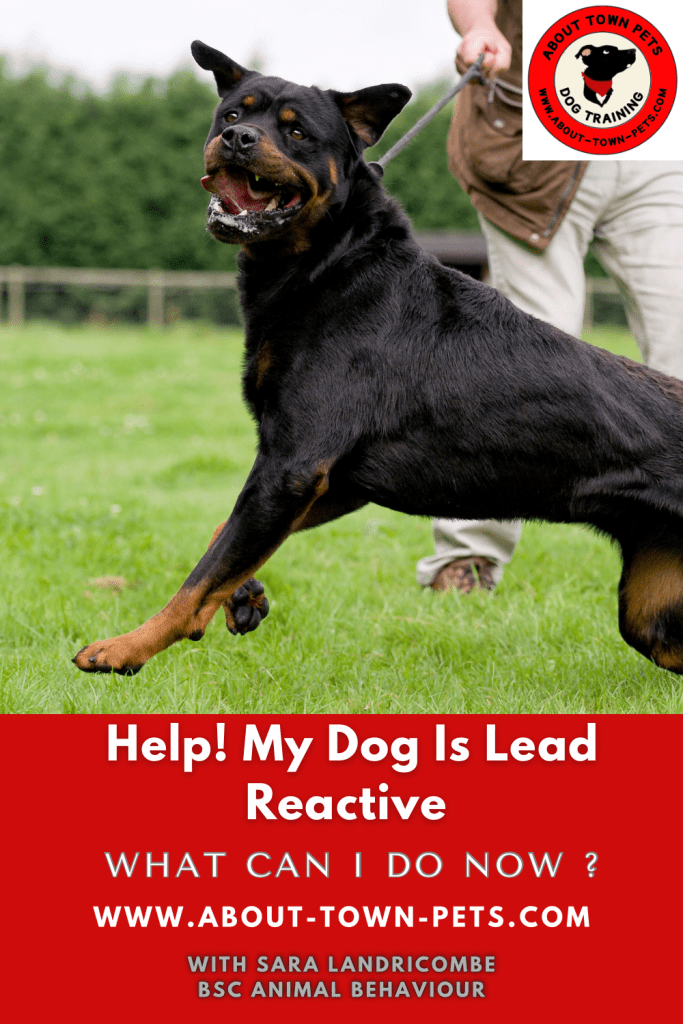
A Rottweiler pulls to the end of a lead with owner in the background

What can you do first and foremost to help your dog before you start working with an experienced dog trainer then?

Start to recognise dog body language and once you see it you won’t be able to unsee it again. Dogs do a lot of things before a growl or a lunge and a snap or a bite but are we really looking ? If your dog misses a few of these steps and goes straight to “explosive reactions” or constant reactions like constant barking for example then it’s likely the previous steps haven’t worked for them in the past so they now have a “default reaction” or habit, that looks like – see something I don’t want to be near me – get in there first with an explosive reaction – resulting in something moving away equals awesome it worked I’ll do that again next time👍 It can be tempting to then start to not react to the dog and ignore the behaviour and allow the dog to keep going until they stop but this can lead to further frustration sometimes with more and more explosive responses before “extinction “ takes place so our best bet is to make the dog more comfortable at a distance with someone who has take the time and effort to build up a secure relationship with the dog and work on changing their feelings and association with previously response inducing thing. There is also lots of hormone and neurotransmitter things going on behind the scenes here and a skilled behaviourist will know this about your dog but that’s for another day😅

What to look for – stiff forward “stuck” body language where there back feet stay planted but they move forward with their front paws – ears back – whale eyes (seeing the whites of their eyes) hackles up – lip licking – turning their head to the side to diffuse tension – odd displacement behaviours out of context eg: scratching or yawning – whacking off after an altercation – seeing something and going to wee on something nearby straight away – grabbing the lead – scanning and being hyper vigilant – if these things are happening – move your dog away to a safer distance and simply let them observe – reward dogs then checking with you and generally being attentive and focusing on you instead .

If your dogs reactions are quite severe and they have been reacting for a long time – please consider reducing walks in areas where they are likely to encounter the thing they are reactive to just so we can start to reduce the amount of time your dog spends “rehearsing” the behaviour – do this by planning your walks more appropriately.
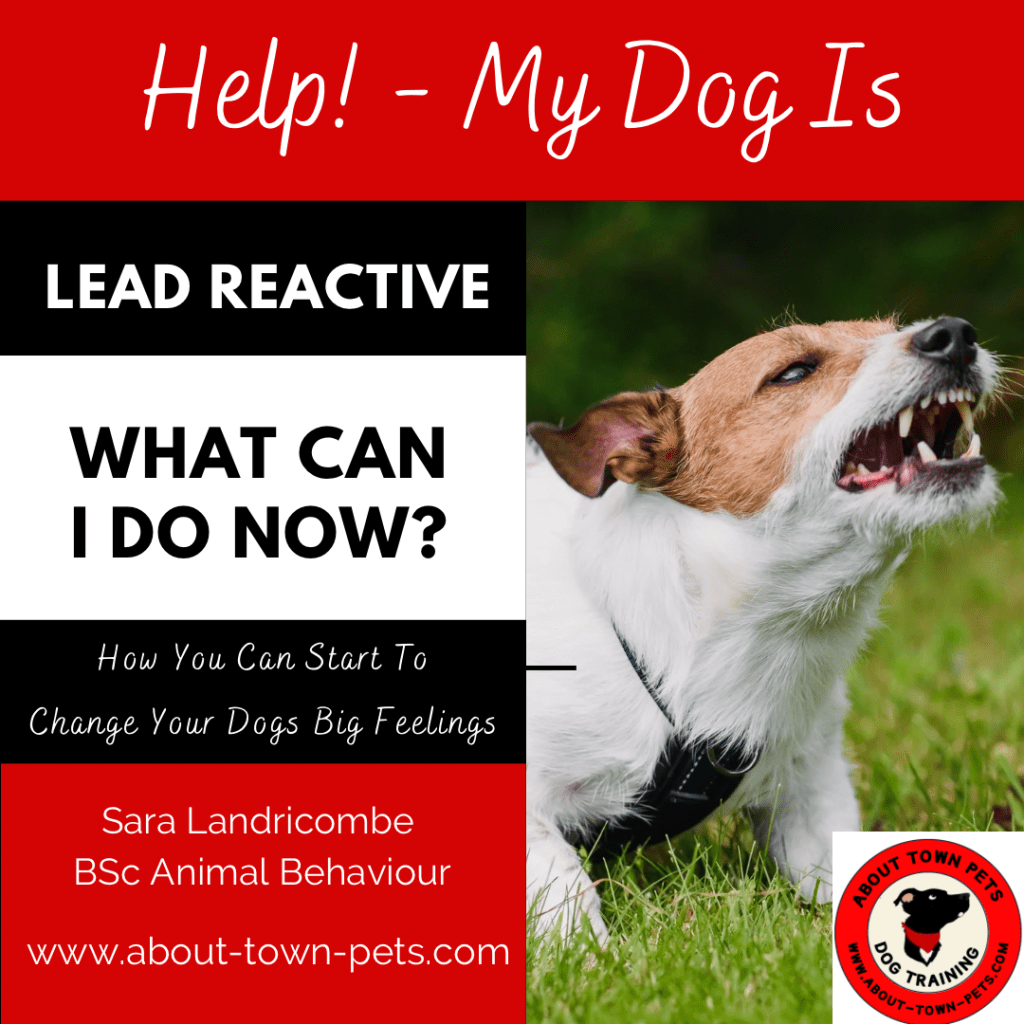
A jack Russel on a black harness pulls and barks at the end of the lead

– Do you really have to take your dogs to the shops? Could they go out again later when it’s quieter or earlier in the morning when less people are around ? Could you plan a couple of sessions in a secure field so your dog feels better and can be off lead letting off steam? Can we learn to manage our walks with turn arounds, crossing the street and using objects in the environment as a barrier to keep our dogs calmer whilst they begin to learn an alternative ? There are LOTS of techniques we can utilise and practice BEFORE a dog reacts.

Also worth noting is that it can be tempting to not want to walk your dog because it has become overwhelming or it is “embarrassing” to walk them when they are reactive- I would argue that reactive dogs cannot improve if we do not have a controlled plan in place – they need to work up to learning how to behave in public and they need gradual exposure to the things that they react to otherwise they will become out of practice and antisocial and then we cant blame them if their behaviour escalates due to under exposure. Caveat – this does not mean flooding the dog and hoping he gets over it ❌

Lot of things to think about – don’t worry about being judged – get help sooner rather than later – it has always baffles me that people only ask for help when the problem has become unmanageable instead of being proactive and preventative but is just be really happy if you simply started to get appropriate help and support now. Start as you mean to go on and no dog is too old to train to be more resilient so let’s get started 👍

…… love from your friendly neighbourhood dog trainer Sara ❤️

Ps if you enjoyed this post you might like my previous post on Behind The Scenes As A Dog Trainer & Behaviourist

If you would like to work with me please Contact Me Here Let’s Train Together

Just A Quick Question – A Behind The Scenes Look At What A Trainer Or Behaviourist’s Process Looks Like

When working with a behaviourist you are not just getting a dog trainer who can teach you how to do a new behaviour you should also be getting someone who can delve into their Rolodex type mind to come up with solutions for more complex issues as well as the more simple ones. Each scenario should be approached with the hierarchy of humane procedures.

This is a slightly simplified version of what goes on, but this is the general idea for why we ask you to fill in a list of very specific questions on our behaviour history question forms. A lot of information can be gleaned from the dogs breed age and sexual status (neutered or not) and medical history but we are also looking for the following things in every case:

1. Is the dog healthy? I’ve heard different numbers but over half of aggression cases are medical issues according to the experts. Get a general physical done and some tests. Seemingly average looking complaints (such as compacted anal glands, pain, intestinal issues or females in season) can cause obscure behaviours which may not need any behavioural intervention at all just management and veterinary intervention.

Is the dog being fed enough & a quality food? Just because we use food doesn’t mean we want them starving. Also is the dog eating everything and anything and still not putting on weight ? (This last one can be true for dogs with specific forms of diabetes so again not behavioural but medical rule outs are needed as standard). We are not in cohoots with the vet and we are not trying to get you to pay out for the vets when not needed , we ask because about fifty percent of the time there IS a medical underlying issue that has gone unnoticed and knowing these things can speed up your training experience if we need to do that as well.

Are they getting enough mental and physical exercise? More confidence training, more engagement with family members #BeMoreFun and more stimulating walks (dependent on the dogs age personality and ability) more enrichment activities will likely solve lesser problems in the first instance -solve those first, always.

If the dog is excitable how can we introduce more calming activities ? ( just as we need to be exciting to train a young dog recall we also have to note that that same method won’t help us when training calmer behaviours).

2. Can we change the environment so it’s not an issue? Management is always our next port of call so that whilst the dog is learning we manage them safely whilst they learn an alternative – this management can then be phased out over time when the dog has become more “trustworthy” For example we might phase out the use of a crate over time when toilet training or mouthing has subsided and upgrade the dog to having more space over time, not as a privilege but because growing dogs need more space and it’s up to us to train them or give them stimulation so they can be trusted in their new space.

Does this lead reactive dog need to be on lead or can he enjoy enrichment in other ways that doesnt involve being tied to a person or for safety reasons, a food resource guarding dog must ALWAYS be given space and left alone when eating to prevent escalation before we can start to train and educate owners on what the risks are and how to manage this scenario.

3. Next up- Positive reinforcement training. Pick something the dog already does that we like and reinforce it. Even better choose something simple that is incompatible with the issue (got a dog that jumps up? Train a default sit or settle on a mat and repeat repeat repeat- Dog isn’t eating food? Go back to step one. All dogs are motivated by food it’s usually the environment is too stimulating for them to WANT to take the food in that instance (be it negatively – anxiety or positively – excitable behaviours).

The dog normally eats but isn’t now? Change the environment. We are probably flooding them which means they are too over aroused to think clearly – reinforcing calmer behaviours regularly helps here or at a distance too. Going back to basics even if it’s for a refresher in an older dog who is out of practice will help everyone get on the same page.

4. Like mentioned above we would then look at reinforcing alternate behaviors. Jumping isn’t reinforced but standing is. Pulling isn’t reinforced but walking near handler is and this is done with good timing, clear hand signals (no need for man handling in any case) with good frequency (don’t be stingy with reinforcement) and with good mechanics (delivery of the treat matters, can the dog see its reinforcement , are you reinforcing after the dog does something ie: in the case of counter conditioning – don’t be tempted to put your hand in your pocket too soon😅) and all of this is done with lots of repetition – you get what you put in and the simpler the approach the better as it helps owners stick at the training too😉

Lastly If you have done these things and they aren’t working, it’s time to call in someone else because we missed something. It’s not time to use aversives. There is lots and lots of science to back up this claim (a simple google scholar or science direct search is all that is required) these days and the top behaviourists should be aiming to work collectively with knowledgeable vets who also hold a specialism in veterinary behaviour (unfortunately these are few and far between at the moment and their case loads have months and months waiting lists) – again another topic for another day.

Your trainer or behaviourist should not be trying to “muddle on” if they don’t know how to progress when a dogs behaviour has plateaued they should be asking for a second opinion or help with the task or if it’s a complicated case should be happy to refer on.

So as you can see there are no quick fixes even for relatively simple issues and when you ask for a response to your very unique or specific question you can start to see why it might be problematic for me to generalise to “every dog that does A needs to be trained to do B”

We can give you an educated guess based on what we’ve seen before and what science has proven the probability of it to be true but every dog is an individual with learned history and specific breeding and upbringing so they may have learned things even us as owners are unaware of.

So I hope the takeaway here is that your qualified experienced dog trainers and behaviourists are doing all of this puzzle solving in the background and trying to come up with a manageable, easily digestible plan that you can implement at home without lots of supervision .

When we hear “I’ve tried this XYZ and been to lots of different trainers” regardless of methods it’s not really a dog trainer issue at this point it’s the individuals ability to go at the dogs pace , not expect a quick fix and putting in the repetitions with GOOD technique to get a dog to the point it’s issues are “resolved” and whether a dogs issues are truly solved or rehabilitated is also a topic for another day.

Keep up the good work and keep training the best you can and stayed informed 👍

Love from your friendly neighbourhood dog trainer ❤️xx

Ps if you enjoyed this article feel free to check my previous article on The Puppy Blues & Why it’s Totally Normal

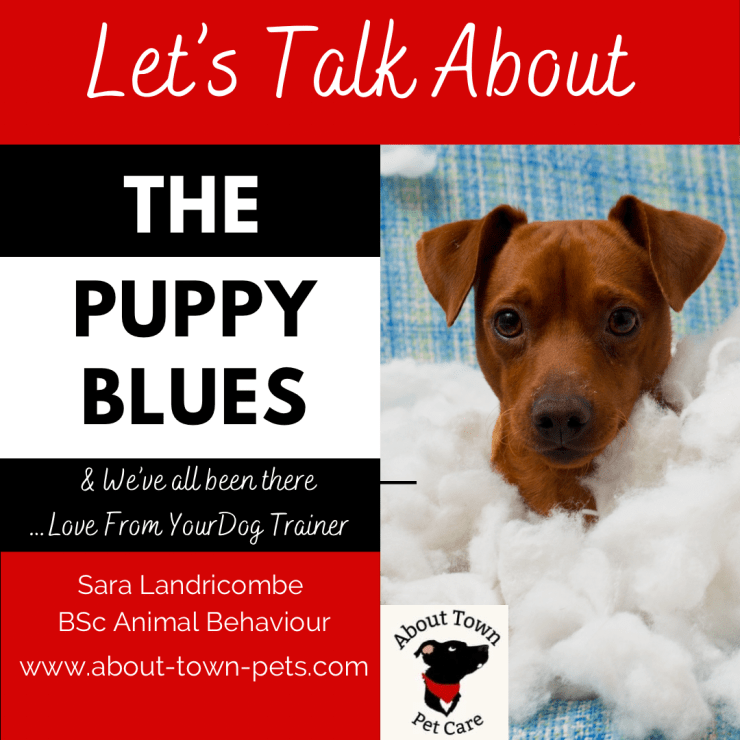
Let’s Talk About The Puppy Blues – It’s Exhausting & Totally Normal

Inspired by a recent post in a puppy group that I frequent on Facebook and by the looks on any of my puppy club members faces when they get to class – I thought it would worthwhile to mention that “The Puppy Blues” Phase of puppy ownership is completely normal and I guarantee that the majority of other small puppy owners are feeling the same way or have done over the past 6 months. I know this because it’s a constant topic online and amongst my own puppy class members who tend to bond over stories of their own puppy blues- it’s exhausting having a puppy but please remember this too shall pass- if you ever make it to a formal puppy class you will notice that it slightly resembles an AA meeting but for young puppy owners. They recall tales of hands that are beaten and bruised by puppy gnashers and bleary eyed first time owners recall how they haven’t really slept for the past three weeks whilst everyone else in the group nods and agrees it’s true in some form or another for them all.

Terrier puppy against a blue checkered background sits amongst fluff pulled from the inside of a cushion – presuming that this is “naughty” behaviour

It’s real “The Puppy Blues” they tend to set in when it dawns on you that this going to be harder and take longer than you thought but I’m here to tell you that its gets easier and we’ve all been there I promise.

Dogs transitions vary with age breed and their personality but as a rule I say stick to a 3 day protocol anything you implement please allow three days for your pup to get used to it – chopping and changing will not help you – don’t be afraid to pop your pup in a crate or play pen in your room so you are at arms length for the first few nights – I promise you are not going to ruin your dog – it’s just come from 8 weeks of mum and siblings on tap and physical comfort at all times so bare this in mind when we are in a hurry to get puppy into a routine

Cavapoo puppy sits amongst toilet roll which strewn around him

Being at arms length allows your puppy to feel safe if he cry’s but allows him to settle when he can- further tips and advice can found on my previous post- here

Then you can start to move the crate/pen etc every three days to the next spot (I assume here that you eventually want your puppy to sleep downstairs) so every 3 days move the crate/pen to the end of the room then just outside the door then downstairs then in the room that you want them in – be prepared to reassure puppy and go back a step if they are really getting very worked up – unfortunately with some dog s(breed and personality have a lot to say in this) letting your dog self soothe as a blanket piece of advice may mean 1/ your create a dog with separation anxiety or 2/ you ruin any crate training you are working on (crate training requires gradual exposure and all positive experiences happen in the crate with the door open and closed) this can’t happen if he starts to associate the crate with scary bedtimes

Also be prepared to go out (physically scoop up your pup if you have too to begin with) on the hour every hour until you have mastered toilet training because puppies cry not only for attention but because they often don’t want to soil their bedding

A good rule here is let them out/physically take them out after eating sleeping playing – they have tiny bodies and tiny bladders for the next 6 months

A beagle puppy stands on his back legs to greet someone on the other side of his playpen

If you prepared well you would be writing off the next 6 weeks a bit like new parents don’t see the light of day for about 6-12 months new puppy owners are likely going to need about 6 weeks minimum to get that pup into some sort of routine and so much training and visiting happens during this time not to mention that your pup is likely not going to be allowed out for the first 3 weeks that have them at home due to the gaps required between their first and second and potentially third vaccinations (unless your puppies breeder was an absolute gem and got your pup vaccinated whilst they were still with them)

⭐️Side Bar – Breeders you get extra superstar status if you – as standard- keep the puppies for an extra 2 weeks with mum and do some beginners handling socialisation and rudimentary toilet training in those first 4/5 weeks with mum – I would be grabbing your hand off for details to pass onto potential new puppy clients😍

I digress…. that happens here and even when pup is eventually allowed out your going to be working on toilet training socialisation and potentially going to puppy classes (I highly recommend that you do😍) even if you’ve had lots of dogs in the past – techniques have changed and there’s about a hundred different ways to train simple things so you are most definite going to pick up tricks and tips) even if it’s how to mark and rewards quickly and efficiently, how to use the three predominant ways of getting initial behaviours and how to look out for puppy body language you may not have noticed before) and SO MUCH more, I know that I want people to learn as much I can teach them with my limited 6 hours that I spend with them because I believe it’s a “hit the ground running” scenario and your window of opportunity is definitely slim – of course you can train older dogs there’s no time limit on training, but your puppy is small and manageable and like a sponge up until about 6 months old so I highly recommend training FOR a scenario rather than when you are IN a scenario.

Adorable tan coloured cavalier King Charles spaniel puppy lies down on a white bed

This means that there’s no point in panicking and hoping your puppy will recall away from another dog in the park instead you should anticipate things that might happen whilst you are out and stay vigilant knowing that you can distract and recall your pup for example BEFORE it’s too late and your puppies attention is lost and you have to scramble to go and get them back – you can manage and mitigate in a scenario but hopefully you’ve put in some solid foundations in the garden in the house or in low distractions whilst you build up and try the same training but in the real world scenarios, understanding that a puppy with lots of repetitions under his belt and a solid “What’s this” (what’s this gets attention and is followed by a high reward) encourages quick responses so you can put them back on areas or move them around or turn in a different direction until the distracting thing has moved on or you get an opportunity to greet the other dog whilst yours is under control (let’s practice polite quick greetings and move on) unfortunately I see too often owners scramble to recall or grab treats from pouches knowing full well that their dog should really be on a long line but that’s an inconvenience so I will just wing it and hope for the best – unfortunately hoping for the best and getting lucky isn’t best practice – train frequently and repeat is a better course of action – practicing at every opportunity is so much more fun for your dog anyway and you will end up with a dog that constantly keeps an eye on you instead of a wayward pup.

So really the point of the post is to persevere because everyone has to go through this phase albeit with a new puppy a teenage dog (see my post on this topic – which will ultimately end up being a secondary puppy blues phase for you) or a newly rescued dog – I will also note here that if it really doesn’t seem to be getting any better for you past the 6 – 8 week mark of puppy ownership I would highly recommend you get in contact with a professional training to help you work through potential training plateaus that might be occurring or something else that might need intervention for you or your pup- I’m not promoting that you struggle just that you allow enough time for your pup to cope before you get some intervention.

If you would like to work with me – please don’t hesitate to contact me HERE

Sara @ About Town Pets 🐶🐾

Ps If you appreciated this post you might also like my previous blog post on Tips & Training Advice For Dogs With Suspected Separation Anxiety

And Also This One- Learn About My Number One Training Tip

Leaving Your Anxious Dog Alone: Tips for Successful “Home Alone” Training

Ive had quite a few enquiries lately about suspected Separation Distress in young dogs these last few weeks so thought it best that I create something that might help those who are waiting to work with me in person 🐶👍

If you have a dog who is anxious or destructive when you leave the house, they may be experiencing some form of separation distress- to work out the extent of the issue I highly advise a through vet exam if this is something brand new (behaviour wise) for an older dog and would also like a full history before we work together – Work with me here but whilst you wait – find my tips below.
Fortunately, there are effective techniques you can use to help your dog cope with being alone. In this article, we’ll cover six helpful strategies for separation anxiety training.

Foundation Training: Encouraging Calm Behaviours

Before you start working on separation anxiety training, it’s important to establish a foundation of calm behaviors. This means teaching your dog to relax and settle down on cue. You can use positive reinforcement techniques, such as treats and praise, to encourage your dog to sit or lie down and stay calm. Practice this behavior frequently, gradually increasing the duration of the stay. My favourite technique is to use “The Magic Mat” where this behaviour can be transferred to different parts of the house to encourage settling on a mat and eventually (if required) it can be transferred to settling in a crate with the door open etc I briefly mention how to train this HERE👍

Ditch the Crate: Confinement May Be Hindering Your Results

Many dog owners assume that crating their pet is the best solution for separation anxiety. However, for some dogs, being confined to a small space can actually increase anxiety levels. If you suspect that your dog is not comfortable in their crate, consider trying other confinement methods, such as a gated area or a playpen. Be sure to provide plenty of toys and distractions to keep your pup occupied. These will help to create a space where you dog can learn to take themselves off for “micro absences “ even when you are in – they need to be ok with being away from you – this is great for those who this they dealing with a dog with a base line of around 5-10 seconds 😅Don’t panic it does get better. * A caviat to this I would say that toys can become a predictor of you leaving so only help keep them under threshold for the time it takes to complete the task – extended periods of home alone training will be required AS WELL provided toys and enrichment 👍 which leads me to the point below……
Work Out the Triggers That Are Predicting Your Departure to Your Dog

Dogs have been selectively bred for thousands to work cohesively with their guardians this also means they are experts in watching our body language and seemingly “know” when we are about to leave before we are even aware of what we are doing . They quickly learn to recognize the cues that signal that you’re about to leave the house. This can include putting on your shoes or picking up your keys. To help your dog feel less anxious, try to desensitize them to these triggers. For example, put on your shoes but don’t leave the house, or jingle your keys but don’t go anywhere- multiple times a day . Over time, your dog will learn that these cues don’t always mean you’re leaving for an extended period of time. You can also be a little bit more prepared I like going on about this topic here – and make sure you leave in a calm manner and have those triggering abject steady by the front door so you can make your “actual departure” as calm as possible.

Leave Frequently and Return While the Dog Is Calm

One effective way to help your dog get used to your departures is to practice leaving frequently for short periods of time. This can help your dog learn that you will always come back. Start by leaving for just a few minutes at a time, and gradually increase the duration of your absences. When you return, if you have a dog who frantically greets you on return (there’s a high chance you will because this comes as part of the by products of having Separation Anxiety)be sure to greet them a little (as we don’t want that frustration tipping over the edge ) and then walk all the way through your house and asking for a behaviour that might make their greeting calmer ie: Toss a treat a few times and ask them to “Find it” or get out the previously mentioned Magic Mat and ask them to simple wait on it – mark with the word “Yes” and reward this calmer version of your dog (praise with a soothing tone we are aiming for calmer reactions after all). This reinforces the idea that calmer behaviour is rewarded. I mention the basics of “Yes” training here

Training So Frequently That It Becomes “No Big Deal”

To help your dog feel more comfortable with your departures, you want to train in short yet frequent amounts so that they almost get “bored” of reacting. They get scared because being alone is unpredictable so try to make leaving the house a non-event. Don’t make a big fuss over saying goodbye, make sure that the new predictable keeping under their threshold of stress is the new norm and try not to make a big deal about departures and returns. This helps your dog understand that being alone is now a normal more predictable part of their routine.

Gradually Build Up the Time You Are Outside Out of View

Finally, as your dog becomes more comfortable with your departures, you can start gradually increasing the time you spend out of view. Again, start with short periods of time and gradually build up to longer absences. Be sure to continue rewarding calm behavior, and make sure your dog has plenty of toys and distractions to keep them occupied but make sure you you PLAN ahead give your dog plenty of time to use those toys – ideally half an hour after a walk or being fed they can do these activities (licking sniffing and chewing all promote calm behaviour) so if they are sufficiently calm before you leave instead of a rushed placement of toy and running out the door will make you look even more unpredictable than before. Everything needs to be well rehearsed and predictable because it’s the only training you have to rely on where you cannot be present to do it – this why whilst you work on gradually building these events up in small increments you MUST find ways to keep your dog from tipping over into severe stress – Get a dog walker , send your dog to doggy day care on the days you have to be out of the house, call in as many friends and family you can to take a day each WHATEVER it takes so that your training can take hold and the sacrifice of your time for perhaps 3-6 9 months is worth it so that your dog can have a lifetime of not being anxious.

With patience and persistence, you can help your furry friend overcome separation anxiety or at least increase the amount of time they can cope with being alone and feel more comfortable when you’re away. By following these strategies for separation anxiety training, you’ll be on your way to a happier, more relaxed pup. I know exactly what you are going through as the guardian of two dogs with Separation Anxiety myself – please remember that what they are experiencing is not your fault or their and it is a phobia just like I’m afraid of heights it’s a phobia it’s not rational but it’s still valid and it’s up to the learner (in this case your dog) how quickly or slowly we gradually expose them to the scary thing – in this case being home alone – sometimes younger dogs sail through the training – some need a title longer to realise everything is going to be ok – that’s ok whichever way we get there – If you would like more help with your anxious dog please don’t hesitate to contact me as I can offer this training online as well as in person within 30 miles of Plymouth UK – You can books 1-2-1 session here

Sara @ About Town Pets 🐶

Ps if you liked todays post please be sure to check this post on Training A Teenage Dog Who Has Forgotten Everything 👍

My Number One Tip For Any Training Scenario…

Be Prepared

If this conjures up thoughts of a very popular song from the original Lion King movie – then so be it 😅

It doesn’t matter if you’re training puppies to stop mouthing or setting up controlled scenarios to help practice something (ie: barking at the door or keeping calm for reactive dogs) if your not prepared, your dog is less likely to succeed at every given opportunity.

Husky mixed breed looks up at handler in the sit position – good training requires practice

I NEVER leave the house without at least some treats in my pockets – even when I’m not training, I am prepared to train if the need should arise. My dogs, for example have been learning to settle at cafes at least twice a week, as well as learning to settle in our new campervan. At 5 and 10 years old they still need reminders of what’s expected and practicing regularly is the best way to do this. They may need help in the form of food reward to keep them motivated and keeping their attentions , especially if said cafe gets quite loud and full of people – our dogs can do this well usually, because they’ve practiced a lot previously, but I can’t assume they will be perfect on the day, so I bring things I know will help them concentrate and mitigate against distractions. multiple greetings from people , constant movement of people backward and forward , food and drink coming and going – it’s a lot but that’s why we are here right? 😅-

These things used to be an issue for Ollie (settling with distractions) he thought all food was for him and would bark until someone gave him something, he has since practiced A LOT and knows that EVENTUALLY he gets something if he waits it out – the only time he might bark is if he needs to go out for a wee so I don’t really want to extinguish ALL barking ALL OF THE TIME, it is sometimes a good thing but it would be dog specific 👍

A Jack Russell Lies Down on a mat holding its own lead – practicing duration of a hold is what makes training this behaviour successful

I digress….. that happens here…… now imagine that I didn’t take any treats or poo bags and didn’t bring a mat for my lurcher to chill out on (he has bad arthritis these days) the visits would not be as relaxed or as well planned as they could be. Scout would constantly figet because he was uncomfortable -leading to him excessively using his arthritic knee more than he should and Ollie would get very frustrated with me very quickly because after waiting a long time for his reward (we’ve worked on duration and delayed rewards) he would stop offering this waiting behaviour and most likely start his frustrated barking in public again – it’s not really worth the hassle and all of this can be avoided by simply was being a little bit prepared with a sensible lead some treats in my pocket and piece of vet bed for Scout – it is the difference between a chilled out lunch on a Sunday afternoon and having to rush and get a quick takeaway coffee and a walk in the rain because they won’t settle 😅😅

By simply being more prepared you are both setting yourselves up for success. Success that you can train your dog efficiently (hands free with a Halti lead around your waist means your hands are free to deposit a treat or you reward at the exact right time – because timing is everything😉) or having treats or a toy stashed systematically at points (I’d advise you out these out of reach from your dog 😅) so that when you come through the door you are ready with a toy for your frustrated greeters or if you want to practice alone time you prep pre-made toys and frozen kong enrichment toys, for example, all ready to just take out of the fridge when you need to leave and place in a crate or safe space for your pup or dog.

Another example from my dogs perspective is that just before I leave everyday for work , to settle them down BEFORE I leave I make sure they have a small kong with peanut butter or a Whimzees chew toy so that the chewing licking and sniffing actions of using these toys is medicine of a calm and more chilled out dog before I leave – we do it so often that they waiting just after I put on my shoes and put on my walking belt. Now if I didn’t prep that they wouldn’t be sufficiently calm before I left the house . I’ve don’t this a lot too – if I rush out of the door because I’ve missed the post man or I have to pop out to the car – this unprepared rush is different and unrehearsed and the dogs will definitely bark and be up at the window because of it BUT if I RESET them and I give them the chews and toy 10 minutes later I put on my shoes and bag and leave calmly they won’t bark and won’t jump up at the window because we are rehearsing the calm exit strategy that they have done lots of times before and can settle a lot quicker 😅

A Cavapoo looks up at their handler for a reward after taking a picture

So it sounds likes a stupidly simple piece of advice but if you want to succeed with your dogs training goals it’s the most important one of all. If you’re prepared you’re more likely to train than if you were unprepared and that means more practice and more repetitions of any desirable behaviours and that’s what successful dog training is all about.

Sara @ About Town Pets 🐶

Ps : if you liked this article you may also like my previous blog post With Tips & Advice For Training Tennage Dogs – Here 🐕

Or you may also want to check out my most popular blog article about 8 Enrichment Ideas For Your Dog 🥎

Help My Teenage Dog Has Forgotten Everything!

Adolescent bulldog is running on the grass making a crazy face with mouth open

⭐️Tuesday Tips – The FAQ Series

Most dog owners with a pet aged 6 months or over will often say the same thing to me. That during the onset of your puppies adolescence phase (anywhere from 6-12 months old depending on the breed and their size) that their dog seems to have forgotten everything that they’ve ever taught them. Also there is usually mention of the fact that their dog seems to turn their ears off and needs extra persuasion during this time to follow through with behaviours that have been previously well practiced and trained😅

Fear Not – You Are Not Alone In This 🦮

This is so common that I offer follow on classes purely for this age range of puppy- It is often due to the fact that your dogs growth spurts will happen around 5 months old (perhaps earlier for smaller dogs) & during this period your dog may begin to start and stop in walks (especially if they walk on a harness). Which can look like “stubbornness” but is actually more likely to be that they are a bit more touch sensitive because of growing bodies. Their adolescent hormones will also start to kick in around 6-9 months old (again dependent on the rate at which that breed matures) This will mean that their focus and attention will be elsewhere as their environment , movement and sounds will be more distracting (more so than usual 😅)

Brown and white spaniel is running with ears flying and mouth open and tongue out

During this phase there is 50 percent more testosterone or Oestrogen in their little bodies as well as flooding into their brains making learning and memory very difficult during this time. This influx of hormones can contribute to concentration difficulties as well as bringing mood swings just like teenage humans- I am happy to report that these hormones do wain over the next 6 months or so, as does, the maturity of the dog – (smaller dogs mature earlier but goofy personalities will still prevail dependent on the breed) – if you can get over the 12-18 months hump, I can almost guarantee that their hormones levels will level out and you will get your “sensible” dog back but it is extra important to double down on training during this challenging period, making sure that you do so with very high value reward (I’m talking peanut butter, liver pate, baby food tubes, cooked chicken) these extra repetitions and refresher training sessions will help make training stick once they come out the other side of their “hormone rollercoaster”.

So KEEP GOING & DOUBLE UP on your reward frequency (how liberal you are being with the AMOUNT of reinforcement you are giving – because there’s no such thing as too much rewarding at this stage) PRACTICE in small increments and try to make a conscious effort to do double the amount of training you have already been doing (& by this I mean LITTLE BUT VERY OFTEN) be mindful of how long your dog can go before he needs a break in training – little tests help reset the “learning” part of their brains and look for frustrated behaviours such as fatigue in the form of panting , impatience ,getting overaroused by the activities you are asking your dog to do and really you will be onto a winner – the massive PLUS side to all the extra training means that you will have built up a great bond with your dog and your training habits will likely stay put , well in the dogs adult phase . You will be giving your dog a head start on the next phase of training which involves the 3 Ds (training through DISTRACTIONS over DISTANCE & for longer DURATIONS👍….But that’s a post for another day😅

Two young beagles that look related are running side by side with mouths open grabbing and playing with each other

Common Complaints During The Teenage Phase Include;

🐾Not listening when called (because girl/boy dogs can be smelt up to a mile away😅) -if recall is non existent (go back a step to recall on a long line with super duper high value rewards – think liver pate peanut butter tuna in a squeeze tube etc.

🐾Marking their “territory”, (did you know that simply smelling the ammonia of another dog’s pee will illicit the cocking or squatting behaviour/ dogs live in a world of scent that we have no way of knowing anything about.

* Not knowing when to calm down (double down on your “Settle” or “Magic Mat”) everything good happens in the May including calm sits or downs on the mat – again build up the duration over time making sure your dog is kept focused for short periods of time and given regular breaks between mini sessions of training – settle training is also best practices after your dog has had some exercise, tired from a play session , after eating or after all of these things I’ve mentioned.

🐾Overexcited mouthing or nipping – time to get that tug toy out and start to practice a drop or leave it so it becomes very reliable – if you have a dog that gets a bit frustrated at you taking the toy away make sure to roll a treat away from them as you pick up the toy and put it away OR have a second toy ready the moment they drop the first so the game continues – you can add up duration to combat frustration tolerance gradually over time……ETC ETC so many questions so little time 😅

A brown shaggy dog that looks like an Italian Spinone is looking up and to its right with a wet face and mouth open and tongue out in the grass

⭐️Let me know what you are currently finding challenging with your teenage dog?

Sara @About Town Pets 🐶

✅Want To Work With Me On A 1-2-1 Basis Tap Here To Work With Me Now

Ps if you enjoyed this quick FAQ post you may also enjoy my post about Help- My Dog Is A Fussy Eater 🐶

How To Help Nervous or Shy Puppies in Class

A common mistake I see being made by new puppy owners is that they think that their new little bundle of fluffiness will automatically love all dogs and all humans and be as enthusiastic as they are about life in general 😬❌

Unfortunately this couldn’t be further from the truth for some puppies. Dog guardians are often forgetting a vital piece in their puzzle – and that’s no matter how many times you unbeknowingly place your puppy into a new situation ,that it doesn’t want to be a part of , you won’t be automatically creating well socialised dog – what you might be doing instead is creating a pessimistic puppy not an optimistic one.

Tan & Black Puppy lies down with his head resting on a docking area

– Let me explain – whilst my advice IS to expose your puppy to new and novel situations in the first 6-8 weeks of ownership ,gradually, in a calm and positive way (gradual exposure) – my advice ISNT to begin exposing your puppy to everything as much as possible because your nervous pup will just get over it with time. Can you see the difference?

In the first instance I would like you to take your puppies personality (they are all different) into consideration – does he lip lick or turn his head away at the prospect of new things? Does he show instances of “Sticky feet” (wants to look or explore but keeps his back feet firmly on the floor for a quick getaway)? Does he hide under your legs or pull to get away from loud cars as they drive by? If yes then you have an under confident puppy or one who is potentially shy or nervous – I would expose these puppies even more calmly and gradually to things than your more forward puppy but the socialisation goals would be the same but timescale might take a little bit longer that’s all.

In the second instance mentioned above, we would be exposing our puppy for exposure sake- blindly not noticing the subtle body language cues puppies give off when they are nervous and what it can eventually lead to something called “flooding” – in this instance your dog becomes so overwhelmed by the scary things that they just shut down (which can “look” like they’ve “gotten over it”) but they actually don’t know what else to do for lack of escape routes or distance and reassurance from their handler. Chances are if we continue down this road with overly exposing puppies to things too quickly or too much your pup isnt going to want to interact again at the next opportunity – WHY? because they need GRADUAL EXPOSURE and SAFETY to figure out if the new anxiety inducing thing being presented is worth the risk.✅🐶

Cream coloured puppy with colourful harness lies down amongst the grass and leaves

This is where you come in -as the mammal with a large brain to body size ratio -you’d think we’d be able to work out our puppies likes and dislikes quite quickly. If your dog is a little nervous Nellie, then slow gradual confidence building is needed and regular rewards are required for activities that might have been quite hard work for them – Eg; your pup greets a new person they were otherwise shy of – EXTRA PRAISE & REINFORCEMENT PLEASE in the form of play or treats so that you make the puppy feel confident in their next choice to do so without pulling them towards the scary thing – with enough reward for making those sorts of choices, your pup will be more likely to choose to do that again and come back to their SAFE person (you) if you’ve built up a nice relationship at this point.

It’s a personality thing – not all puppies are happy go lucky and not all puppies are going to need the softly softly approach BUT let’s just assume all puppies aren’t confident until they are, just to be on the safe side- don’t pull them towards something they don’t want to interact with – instead create space and when they are at a SAFE distance just let them LOOK👀 and reward for looking and looking back at you- this simple act let’s them know we can move away from the thing but it doesn’t go away -they also get rewarded for simply looking – you can then move forward at the puppies pace or try again another day.

Bernese mountain dog type puppy is being held in the arms of his guardian

DONT be tempted to rush this part as it can take quite a long time to build confidence in a nervous dog – it only takes one big scary interaction for your dog to unravel all of your training and set you back a week or two to build back up to it again. This is why we ALL must be mindful of our adult dogs interactions with puppies AT ALL TIMES – ESPECIALLY ALREADY SHY OR NERVOUS DOGS- they’ve got lots of time to become friends but a very narrow window exists in which if a scary thing happens (and this means scary to the dog not you) you are unlikely to be able to unravel this learning without months of behaviour modification in the future 😅 Honestly, gradual confidence building at key moments is better than full exposure and potential behavioural issues that need ironing out at 18 months old .

DONT assume all puppies want to be your friend – I know it’s tempting – the tiny daschund puppy you met on your walk is so cute you could eat him – but imagine if everyone on that walk picked him up and snuggled his face when he was quite a nervous dog to start with? Not only are we not noticing his cues to leave him alone but you are creating one of the most common behavioural issues for small dogs – explosive reactions. If he continues to not be listened to because he is so small – his behaviours and reactions have to get bigger and bigger for people and other dogs to “notice” him and then we end up creating (and I hate this term) “little dog syndrome” the tiny dog who barks excessively or has “an attitude”it’s not a syndrome and almost always created by us and is just a by product of little dogs having to resort to big shows of emotions to get listened to and this stress response gets passed on to subsequent puppies and so on and so forth. Let’s just not start this in the first place – get good at being a dog detective – look for shying away and hiding – what he really wants is reassurance from the care giver and you to probably just need to ignore him until he’s READY to interact.

Cream coloured crossbreed puppy lies down on a driveway

The weirdest response to these dogs is the “offended bystander” you know those people who think they’re gods gift to dogs and they should “WANT” to interact with them at all costs and almost get argumentative about your dogs reactions – my response to this is – please step away from my dog please he doesn’t want to be your friend – he’s got enough of those at home 😉😅 …… I digress……

Next up DO consider taking your puppy to class even if you have a barky pup chances are he just needs the confidence to know that nothing bad is going to happen and that I can interact from a distance if I need to – provisions can be made to help a more nervous member of a group class – I like to create a barrier around them until they settle , pop them at the other end of the room at a safe distance and I keep sudden movement and personal interactions to an absolute minimum – he’s not my best friend yet so I’m not going to force him – purely by watching other dogs with positive outcomes that pup will interact at his own pace – dogs don’t need to be side by side or even off lead to interact the act of rewarding calm behaviours without reactions in that environment is enough work for that dog that day and that’s an achievement in my book – you can learn the techniques in class and take it all home to your safe space to learn. I won’t be offended and the other people and pups in the class learn a valuable lesson on how to interact and help their fellow nervous members.

Large black puppy lies with his head on the tile floor

I would AVOID classes with large numbers or outdoors classes where lots of other dogs can be seen and movement detected it’s likely to be a bit much for for nervous pal to begin with – you can definitely work up to this but start with an intimate class indoors or even try online training classes or 1-2-1 in home training – you can still be coached through all the techniques from puppy class but the distractions are minimised and you can gradually work up to training these things in the “Real World” with calmer puppies or adults dogs at a distance in the future – There’s always a way to adapt your learning for nervous dogs and people -your journey might take a little bit longer or need some provision to help you & your puppy learn at a different rate that’s all.

I hope this article was helpful and feel free to tag someone who might need to hear this advice or would benefit from learning how to help their nervous pup- I will never exclude a dog from class they may just need an alternative arrangement instead ♥️🐶

Sara @About Town Pets

Ps if you liked this article you might want to try my other articles such as 8 Super Simple Enrichment Ideas You Can Use Every Day

Or The Very First Things You Can Train Your New Puppy Before Class Starts

8 Super Simple Enrichment Ideas You Can Use Everyday Of The Week

Enrichment is simply activities that you can use to create a varied and different approach to mealtimes or even to simply give your best buddy a treat in a interesting way rather than ALWAYS popping their food in a bowl on the floor OR just giving them a treat stick from your hand….. go on let your dog live a little 😍

1- The number 1 freebie – “Find It” – encourage your dog to use use their eyes and their noses by scattering JUST ONE or TWO handfuls of their normal portion on the patio or in the kitchen or on a mat, granted you may have point out every kibble) to start with but once they get the hang of it (2 weeks tops) they will activate their little sniffers and enjoy “finding their food” more than just eating it straight from a bowl – I promise

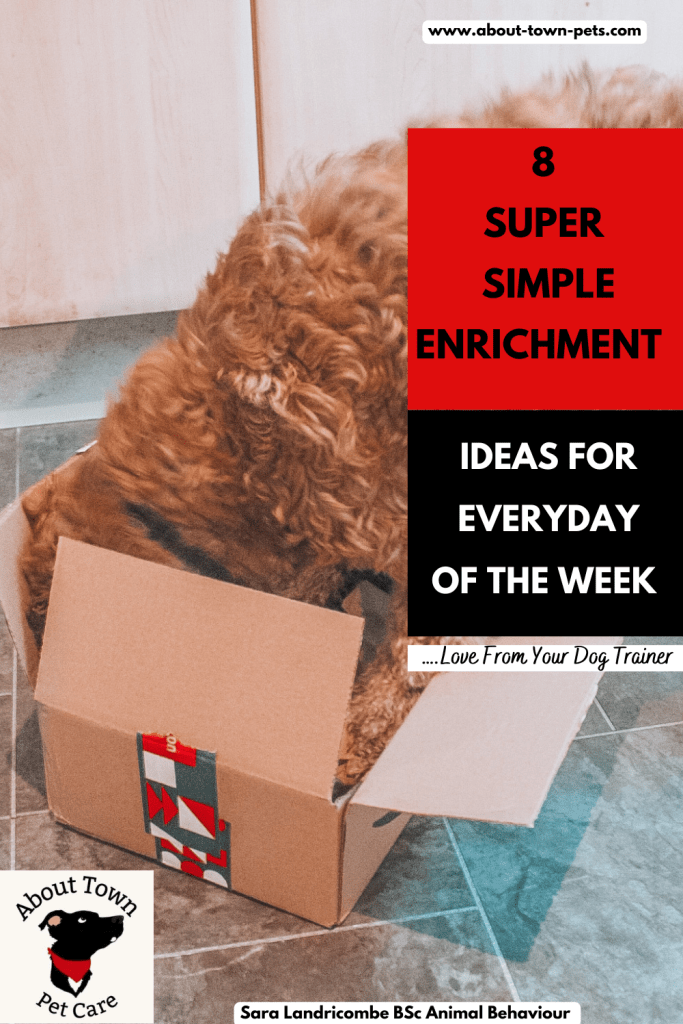
2- Second freebie on the list, “RECYCLE IT” keep your most recent Amazon box or cereal box and put some screwed up paper in it (make sure they don’t eat the paper) and again scatter a handle or two of their designated portion in the box (size appropriate of course) and encourage them to rummage around and “FIND IT”.

My own dog Ollie waits patiently for his treats to be placed in his box ❤️
Ollie is getting really stuck into his game of Find It in a recycled parcel box

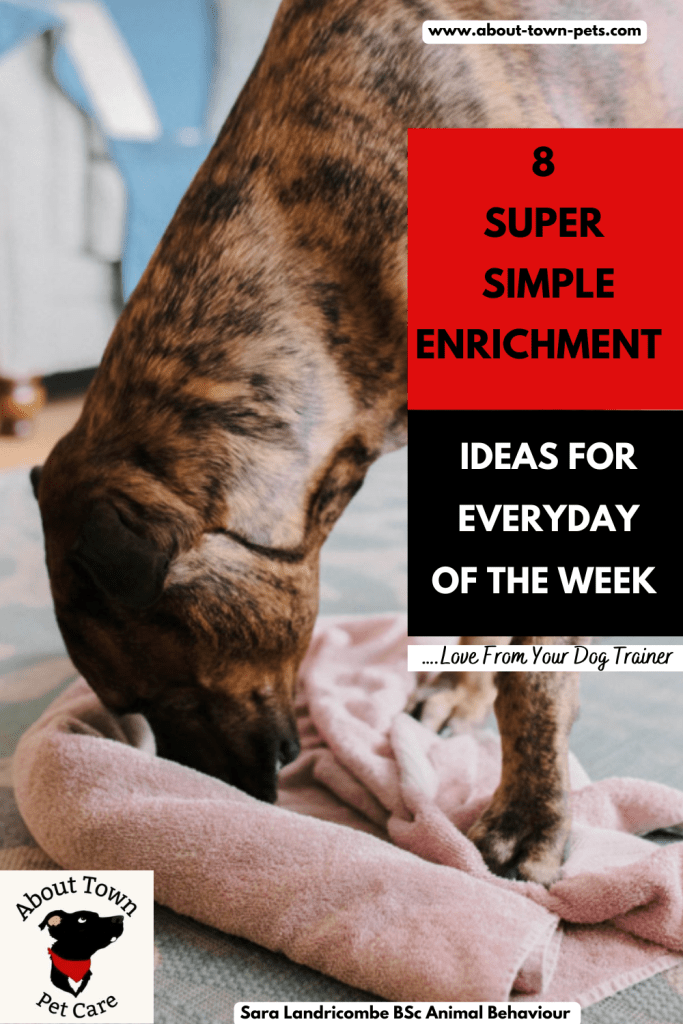
3- Last freebie on the list is “THE TEA TOWEL” trick – simply roll a couple of kibbles up inside a tea towel and allow your puppy to unravel it (this may or may not take a couple of seconds but you can keep doing it several times to keep the game up – what could be easier?

This image is from sparklesandsunshineblog.com and show a brindle crossbreed dog using a rolled up tea towel with treats rolled up inside to encourage sniffing.

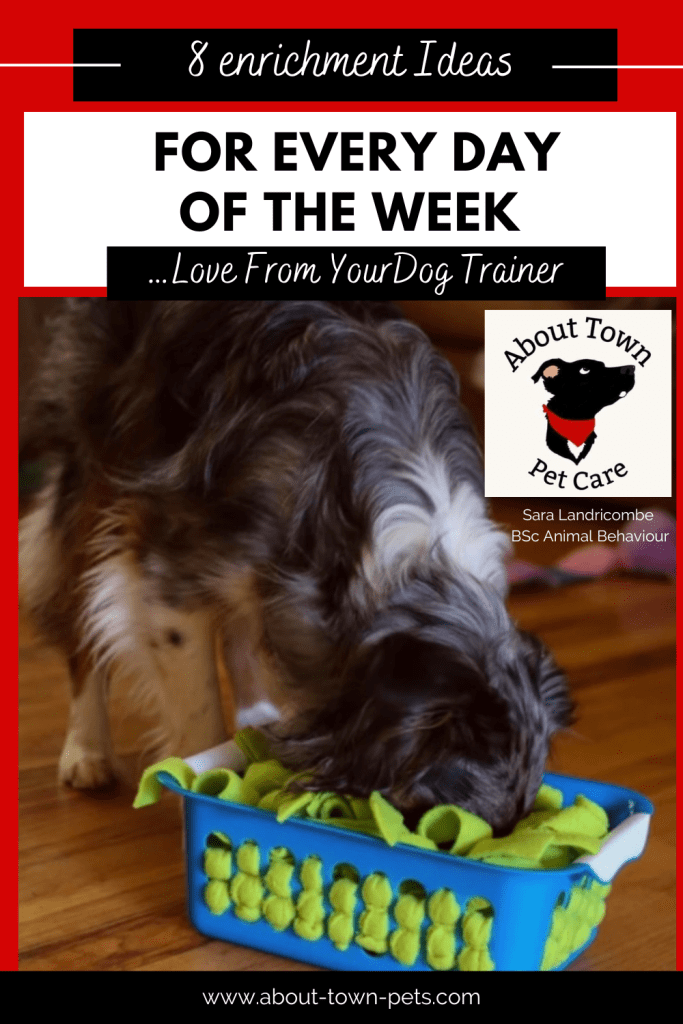
4- The next 2 are DIY projects potentially and requires some prep – THE SNUFFLE BOX Also known as the snuffle bin on Jolson Williams Website Here similar to the diy box except you get a plastic organising basket from your DIY/homeware store and some fleece material cut into strips then place those strips through the gaps to create a box that a little bit more of a challenge and place a few treats or a handful of kibbles in there and get them sniffing – obviously keep an eye on them for trying to chew up the fleece (supervision required for all of these activities- safety first).

This image is from joslinwilliams.com and shows a melee blue collie using a snuffle box/bin made with strips of fleece in a plastic basket

5- DIY SNUFFLE MAT- this is similar to the fancy snuffle mats you’ve all used or seen but you can make a cheaper version – get a holey bath mat (the non slip ones are good with the suckers on the bottom) and the fleece material from before but in shorter strips this time – tie each hole with 3/4 pieces of fleece (a simple crossover tie pulled tight will do no knots required) until you have a nice fleece surface to hide treats and again you’ve made your sniffing activity for your pup.

This image is from dreamalittlebigger.com and show a spaniel lying down on a snuffle mat made from fleece and tied through the gaps of a heavy duty plastic bath or door mat.

6- The next 3 are all brilliant products I recommend you invest in and make sure they don’t start to eat this first one when they are done (these are not affiliated links yet but they may become so in the future) – LICKI MATS- Place the wet portion of your dogs food or a small amount of pate or dog friendly peanut butter onto the mat (these come in heavy duty and with a non slip tray for heavy lickers😅) Find them here as the name suggests it slows down food scoffers and encourages licking which helps to settle your dog if they’ve been doing something else a bit more high energy or simply need to slow their eating habits down – I highly recommend you use Forthglade Puppy or Dog Food Grain Free as the nutrition rating is currently very high. Adult Dog Forthglade Here or the puppy version can be found Here

This image is from prouddogmom.com and shows a terrier chihuahua mixed breed using a Licki Mat.

7-The Kong – there are so many ways this can be utilised to help you out- distraction when in another room – encourages chewing and licking and movement all at the same time – you can put a little bit of dog pate or fat free yoghurt in there and it can take a while to get out – Find A Pack Of 2 Kongs Here -also you can put their own kibbles in there and plug the hole with wet dog food and let them get cracking for part of their breakfast OR if you need it to last longer you could soak the kibble before putting them in and plug the end and then put them in the freezer in a Jiffy bag for teething pups or simply to make them last longer, freezing has multiple advantages. I love them – I think they are one of the best toys ever invented for dogs and are so simple – I digress 😅😅I also love (bonus product) their wobbler Can be found here -for kibbles or small treats for older dogs or larger puppies to get the hang of too, just make sure you place them in a mat otherwise they go skidding all over shiny surfaces 😅

This image is from wearwagrepeat.com and shows2 Kongs and a Toppl product stuffed with lots of lovely dog food to be used as an enrichment activity

8- Lastly if you have a dog that pummels their food too fast -you could do all of the above (I do this for my dog and we’ve managed to get his 3 minute eating frenzy up to 15-20 minutes of active searching etc. Or you could invest in a Puzzle bowl to put their dry portion into. It is recommended you get a raised feeder also especially for taller dogs or deep chested dogs like whippets greyhounds or leggy gundogs (weimeraners and viszlas I’m looking at you) this simple act could be the difference between a dog that gets bloat (gulping too much air as they eat) or dogs that are too active after eating.

This image from an advert for PetDuro puzzle bowls on Amazon – other brands of puzzle/slow feeders are available 😅

I hope all of these ideas have given you some food for thought….. no pun intended 😅 so you can give something a go every day be it a free DIY or purchased activity. I’d love to see your enrichment ideas and you can tag me at About Town Pet Care On Instagram to show me. I can never see enough videos of dogs in my day👍👍 Check out some more tips below – this post is my very first TikTok Video with some tips on How To Make Your Dogs Mealtimes Fun 👇👇

A video with tips on How To Make Your Dogs Meal Times More Fun – this is how my dogs eat their meals most days ♥️ – copyright http://www.about-town-pets.com

Sara @ About Town Pets

Ps if you enjoyed this post perhaps check out my previous post on How Often Should I Be Training My Puppy 👍❤️