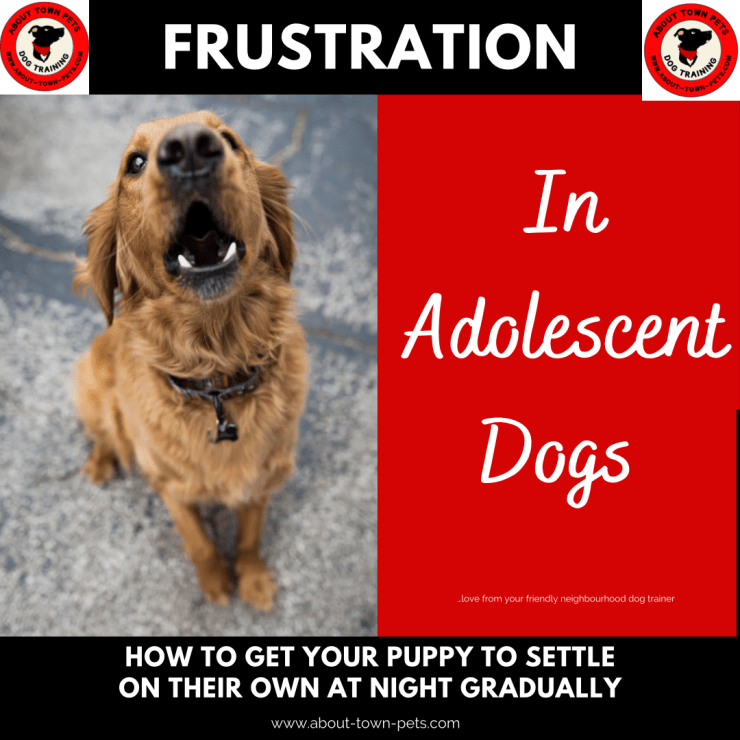
Frustration in adolescent dogs

Adolescence Isn’t Disobedience: Understanding the 7-Month-Old Spaniel Brain

I recently responded to a post about a 7-month-old Cocker Spaniel who was “pulling like a train” and they were asking for a harness that “stops pulling”. Other phrases that kept coming up were ones I hear all the time:

“He’s suddenly forgotten everything.”
“His attention span is like a gnat’s.”
“He’s pushing boundaries and meeting force with force.”

Welcome to canine adolescence.

This phase can feel like all your hard work has unravelled overnight, but what you’re seeing isn’t stubbornness, dominance, or your dog “being naughty”. It’s biology.


The Teenage Dog Brain (or: Why Your Dog Can’t Put the Brakes On)

A 7-month-old dog is roughly equivalent to a 14-year-old human teenager.

Their body is developing rapidly, hormones are surging, and crucially — their frontal cortex hasn’t caught up yet.

The frontal cortex is the part of the brain responsible for:

  • Impulse control
  • Emotional regulation
  • Decision-making
  • The ability to pause and think before acting

In dogs, this area doesn’t fully mature until around 18 months of age.

So when we expect a teenage dog to “just make better choices”, we’re asking them to use a part of the brain that quite literally isn’t finished yet.


Be the Swan 🦢 (Even When You’re Screaming Inside)

I often tell clients to be like a swan.

On the surface: calm, graceful, unbothered.
Underneath: paddling like mad, thinking “for goodness sake”, and feeling frustrated.

Feeling frustration is normal. It’s human. It’s part of our emotional repertoire.

But dogs don’t need us to win against them — they need us to be smarter than their nervous system.

Meeting force with force during adolescence often escalates behaviour, because the dog simply doesn’t have the neurological capacity to regulate themselves yet.


What Adolescent Stress Actually Looks Like

During this phase, dogs become more easily frustrated, and stress shows up in ways that often confuse owners.

You might see:

  • Scratching in the middle of play
  • Yawning when nothing seems tiring
  • Shaking off when they’re not wet
  • Avoiding things they were previously fine with
  • Lunging or barking at familiar sights
  • Sudden “out of context” behaviours

These are stress displacement behaviours — signs that the dog’s nervous system is struggling to cope.

When pressure continues, dogs may opt for space-increasing behaviours, such as:

  • Pawing at you to make you stop
  • Mouthing or grabbing clothing
  • Snapping to create distance

This isn’t aggression — it’s communication.


Redirect, Don’t Confront

Instead of challenging the behaviour head-on, I prefer redirection using cues the dog already understands well.

One of my favourites is:

“What’s this?”

It taps into curiosity and makes the dog come towards you to see what they’re missing out on.

If you can teach:

  • “Up up” → you can teach “Off”
  • “Come and see” → instead of pushing away

Always ask yourself:

What is the opposite of the behaviour I don’t want?

Examples:

  • Jumping up → a solid sit on a mat
  • Mouthing → stopping and picking up a toy
  • Recall issues → working very close for a long time to build value in staying with you

Distance is earned. Adolescents need to relearn proximity.


Puberty = Instincts Switching On

Puberty typically hits between 7–9 months, and this is when a dog’s breed-specific behaviours really start to emerge.

Under pressure or frustration, dogs revert to what they were selectively bred to do.

For example:

  • Spaniels like to hold and possess
  • Retrievers like to carry things in their mouths
  • Guardian breeds may grab and pull down

These behaviours often increase when:

  • The dog is frustrated
  • The dog doesn’t know what’s being asked
  • Training lacks clarity
  • Tasks change too quickly

Dogs don’t default to calm thinking under stress — they default to instinct.


Why Frustration Tips Over So Fast (Especially on Lead)

Frustration builds pressure in the nervous system, and pressure needs an outlet.

This is why:

  • Dogs are often more reactive on lead than off
  • Tension on the lead escalates behaviour
  • Lack of movement increases emotional overflow

Under pressure, behaviour can escalate quickly into:

  • Barking
  • Lunging
  • Snapping

Not because the dog is “bad”, but because their coping capacity has been exceeded.


A Note on Harness Battles

If getting equipment on and off has become a battle, you have two options:

1. Change the Equipment

Some dogs struggle with harnesses that go over the head.
step-in or Velcro harness can remove that stress entirely.

2. Go Back a Step

Slow the whole process down.

  • Break it into smaller steps
  • Reinforce calm behaviour
  • Reduce the “faff”

Sometimes removing the equipment altogether for a short reset helps, because the dog has learned to predict:

“Something uncomfortable or stressful is about to happen.”

If in doubt:

  • Change the cue
  • Change the equipment
  • Start again from scratch

There is no failure in resetting — only information.


The Takeaway

Adolescence isn’t a training problem.
It’s a developmental phase.

Your dog isn’t giving you a hard time — they’re having a hard time.

With clarity, patience, and an understanding of what’s happening inside that teenage brain, this phase doesn’t have to be something you “get through”.

It can be something you guide them through — calmly, consistently, and with empathy.

And yes… sometimes while paddling furiously under the surface 🦢

If you appreciated this post feel free to check out my previous post Help My Puppy Won’t Settle At Night here👈

Before you go you might want to check out my 12 Days Of Woofmas by adding your email to my newsletter sign up page Here to get access to 12 days of canine science right into your inbox there will also be 12 videos to accompany those emails on a private section of this website as well as daily tasks to complete via email – so if you want to keep yourself busy over the Christmas period feel free to sign up now 👍

Love from your friendly neighbourhood dog trainer and behaviourist.

S x

https://about-town-pets.com/newsletter-sign-up/

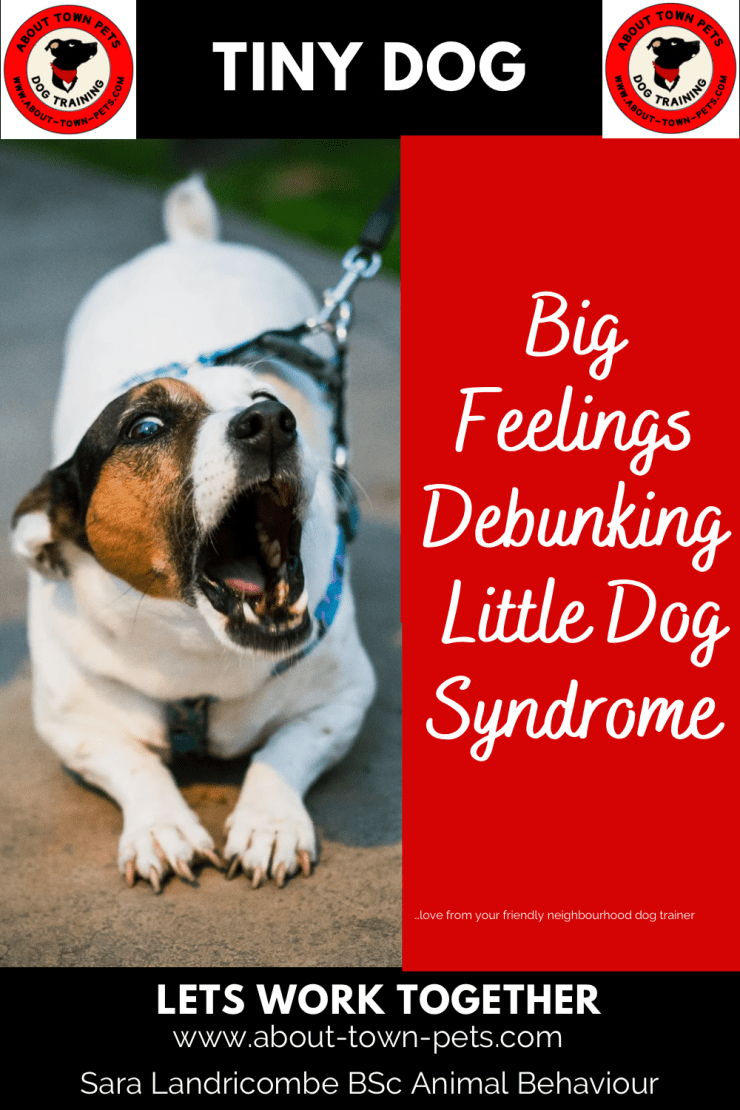
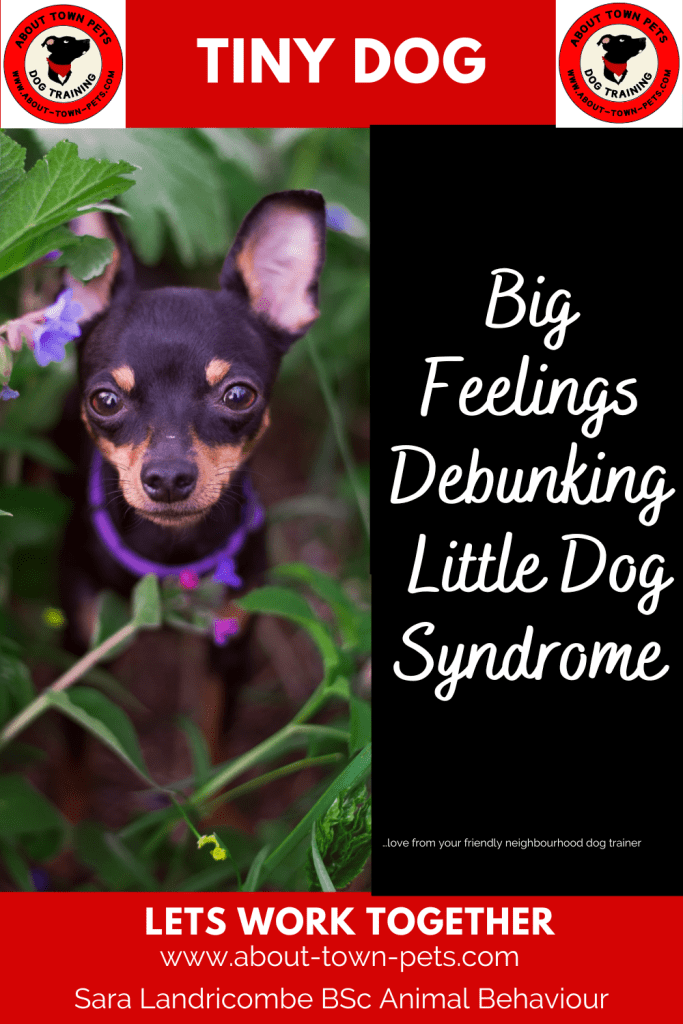
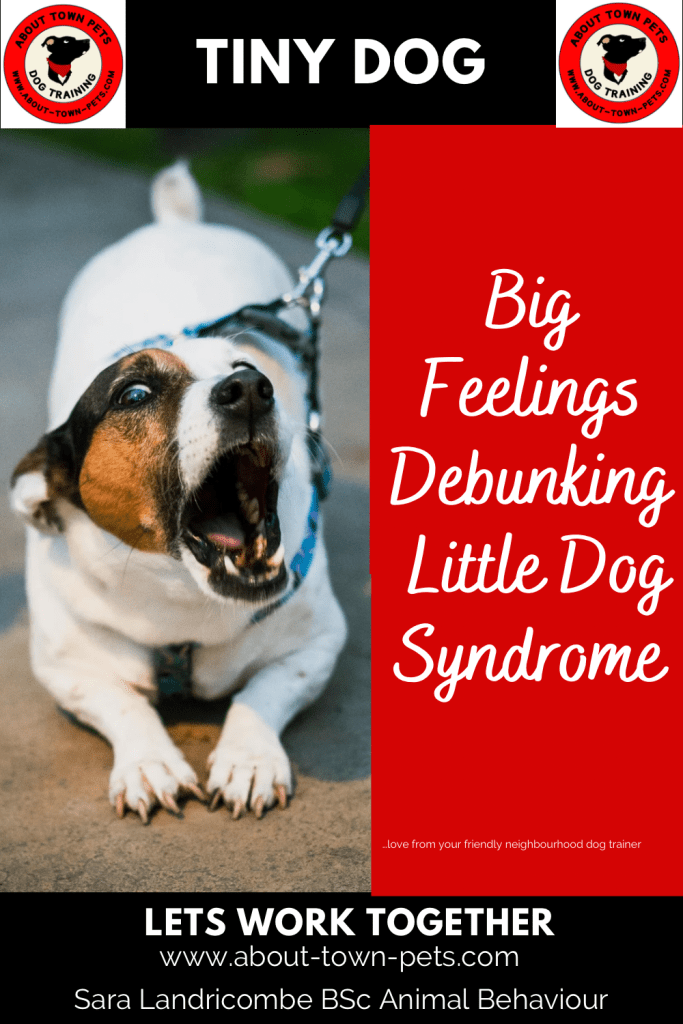
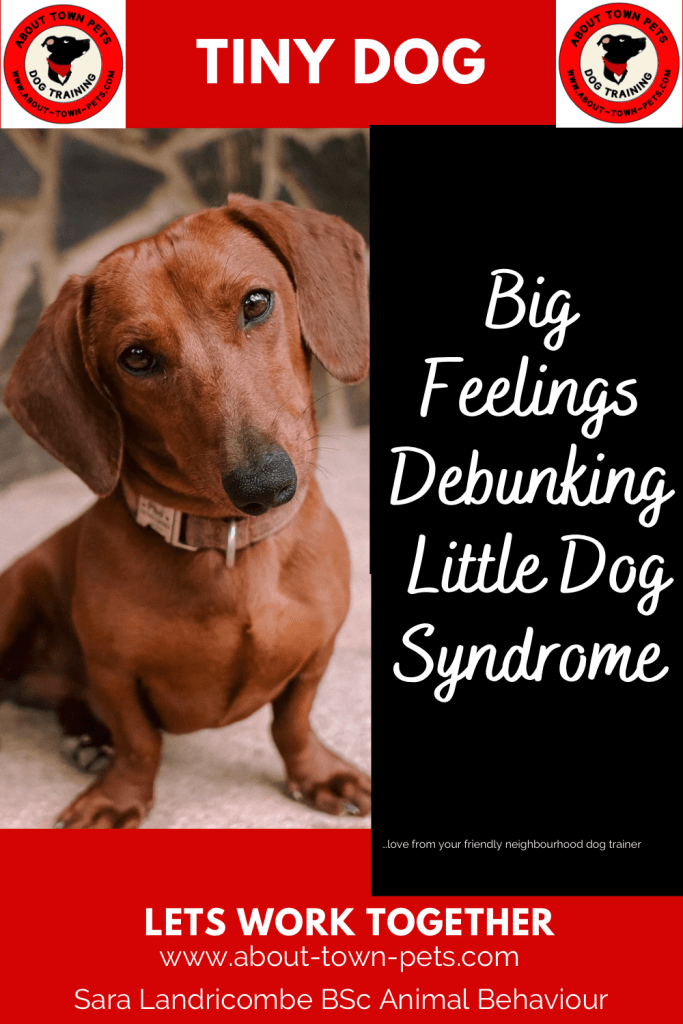
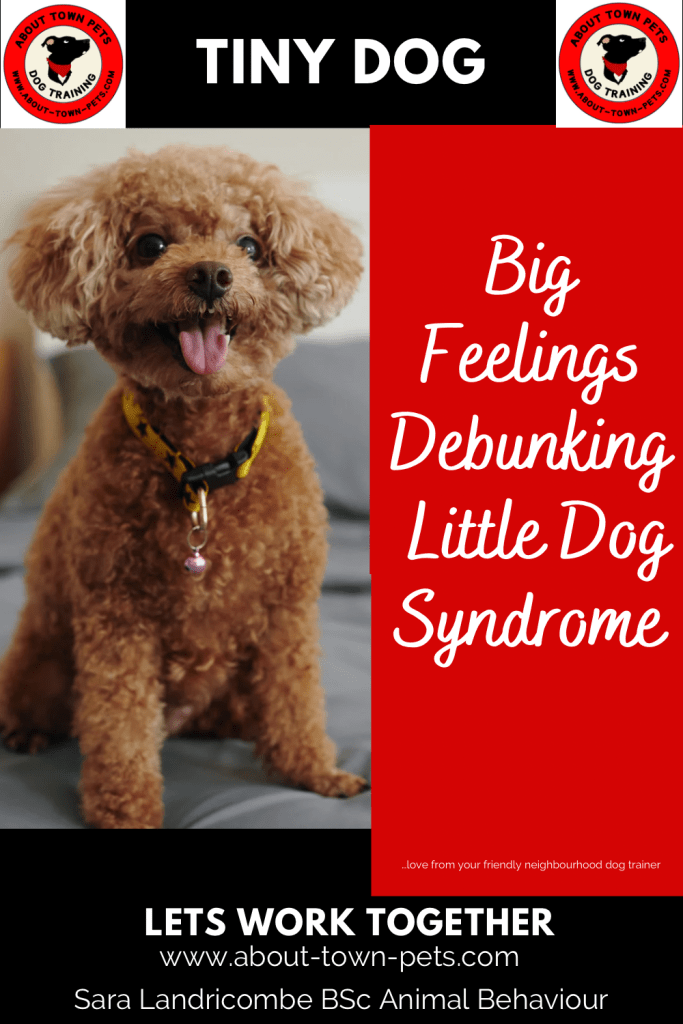
Little Dog Syndrome- What Small Breeds Really Need

Small dogs need big personalities for you to “listen” to them.

If you’ve ever heard the phrase “little dog syndrome”, you might picture a tiny dog with big attitude—yapping, bossing other dogs around, maybe even snappy or reactive. It’s a phrase many people toss around with a wink. But as with many catchy sayings, the reality is far more nuanced than it seems.

What the phrase implies

The term suggests that small-breed dogs are inherently more problematic: more yappy, more aggressive, more spoiled. It frames size as the root cause of behaviour problems. But the truth: size alone doesn’t determine behaviour. What does matter is why behaviour issues arise — and how we support small dogs (and their owners) differently.

What the science reveals

  • Research shows that smaller dogs do have higher odds of owner-reported fearfulness and aggression than larger dogs — but size is just one of many factors. For example, one large-scale study found that smaller body size correlated with higher risk of fear and aggression, but the authors emphasised that this is a broad, population-level trend, not a destiny for any individual dog.
  • Another key piece: early life and maternal care matter a lot. Puppies whose dams were less stressed, who gave more consistent licking/nursing and contact, develop into calmer, more resilient adults.
  • Behaviour issues in small dogs are frequently driven by pain or medical issues (for example dental disease, joint problems, airway or spine issues) rather than “just being a small dog with attitude.” When pain is relieved, behaviour often improves.
  • Nutrition and training style matter too: diet can support behaviour improvement (though it isn’t a silver bullet) and training methods that rely on rewards, respect and clear communication outperform punitive methods — especially for smaller dogs.

So what’s really at play?

Here are the bigger drivers behind what gets labelled “small dog syndrome”:

  • Higher vigilance: Many small breeds were bred to alert or watch (rather than herd or guard). That means a lower threshold to respond to stimuli (doorbell, stranger, passer-by).
  • Owner handling biases: Small dogs are easier to pick up, more likely to be carried, less likely to be handled like larger dogs (walked as much, trained as much). This can reduce their confidence and increase fear.
  • Overlooking health issues: Because they’re small, pain or discomfort in the joints, spine, teeth or airway may be overlooked — and an irritable, anxious dog often looks like a behaviour problem.
  • Inadequate training/enrichment: Smaller dogs still need outlets for their breed-instincts, socialisation, movement and mental challenges — these get missed if we think “small = easy.”
  • Environment and management: Running into strangers, dogs or stimuli at high speed without a plan creates stress; small dogs are more vulnerable to feeling “trapped” (less body mass, fewer escape options) so reading early signals matters.

What you can do to advocate for your small dog

1. Read the body language early

Look for the subtle-before-the-problem: lip licks, head turn, freezing, shifting weight, crouching or making the body smaller. These aren’t “cute” — they’re stress signals. Intervene early: give space, create a barrier (your body, a bench), redirect to a positive behaviour (scatter a few treats, hand-target, escort to safe zone).

2. Check health/pain before punishing behaviour

Especially in small breeds, do a “vet audit” when you see a new or changed behaviour: dental examination (crowded jaws are common); joint check (patella, spine/neck, hips); airway/trachea or breathing issues; signs of neuropathic pain (especially in certain breeds). Pain-driven behaviour is teachable — but only after treating the cause.

3. Tailor training to small-dog size & needs

  • Use a well-fitted Y-front or front-clip harness instead of a tight collar (especially for toy or brachycephalic breeds)
  • Teach “station” (mat on the floor or low bench) so your small dog has a safe base
  • Practice “hand-target,” “middle” (dog between your legs), “scatter-sniff” breaks during walks
  • Use short sessions frequently (2–3 mins several times a day) to suit small body/attention spans
  • Build “consent handling” (dog comes to you for grooming/touch rather than you always picking it up) to build resilience and trust

4. Provide enrichment & mental outlets

Small breed owners often think “less space = less need.” But with little dogs especially, enrichment helps reduce reactivity and fear: puzzle feeders, snuffle mats, short high-value walks, nosework, training games, “Look at that” with new people/dogs at distance.

5. Change the narrative: dismissing “small dog = easy”

Educate your network: small dogs can do a lot — we just need to support them right. They deserve the same structured socialisation, and predictable training, and patience. The phrase “small dog syndrome” stops being an excuse and becomes a stepping-stone to doing better.

6. Create safe walks & encounters

Because small dogs are physically closer to obstacles, less body-mass to buffer stress, teach your clients / owners to anticipate:

  • Use visual scanning: what’s ahead? Could another dog/child move towards us quickly?
  • If yes: U-turn early or cross the road, give space.
  • If in doubt keep moving – lead reactivity is often an attempt to create space if we take on the role of manager we can always help the dog out and keep moving- knowing your dogs initial safe distance is important.
  • Practice a “go-to” cue like find it” then drop a handful of treats behind a parked car or something else in the environment to help to block the oncoming trigger just until the moment has passed.
  • Use a “safe space” or magic mat at dog-friendly cafés or venues so your dog can climb up, feel elevated and choose to stay. Being sure that everyone understands to “ignore” your dog where needed.

Final word

Your little dog isn’t “just small.” It’s a fully capable, complex individual with specific needs. Yes—size adds a few extra risk parameters (fear threshold, vulnerability to pain, owner biases) but it never dictates the future. By understanding the science (maternal care, early life, genetics, health, training), reading the signals early, and advocating smartly, you turn “small dog syndrome” from a myth into an opportunity: a chance to say “small dogs count too—and actually, they hold the key to some of the best, most fun, most rewarding dog-human partnerships.”

Let’s shift the conversation: small dogs deserve big support.

And if you found this blog helpful you might also like my previous blog post on 👇

How To Tackle Jumping Up

BOOK ZOOM WEBINARS HERE

… love from your friendly neighbourhood dog trainer – S 

If you want to work with me 1-2-1 please check out my Training & Behaviour Questionnaire Link To Get Started HERE 🐶

Please consider signing up to my Weekly Newsletter to find out about all upcoming online session and in person sessions available over the next few weeks.

Sign Up Using This Link

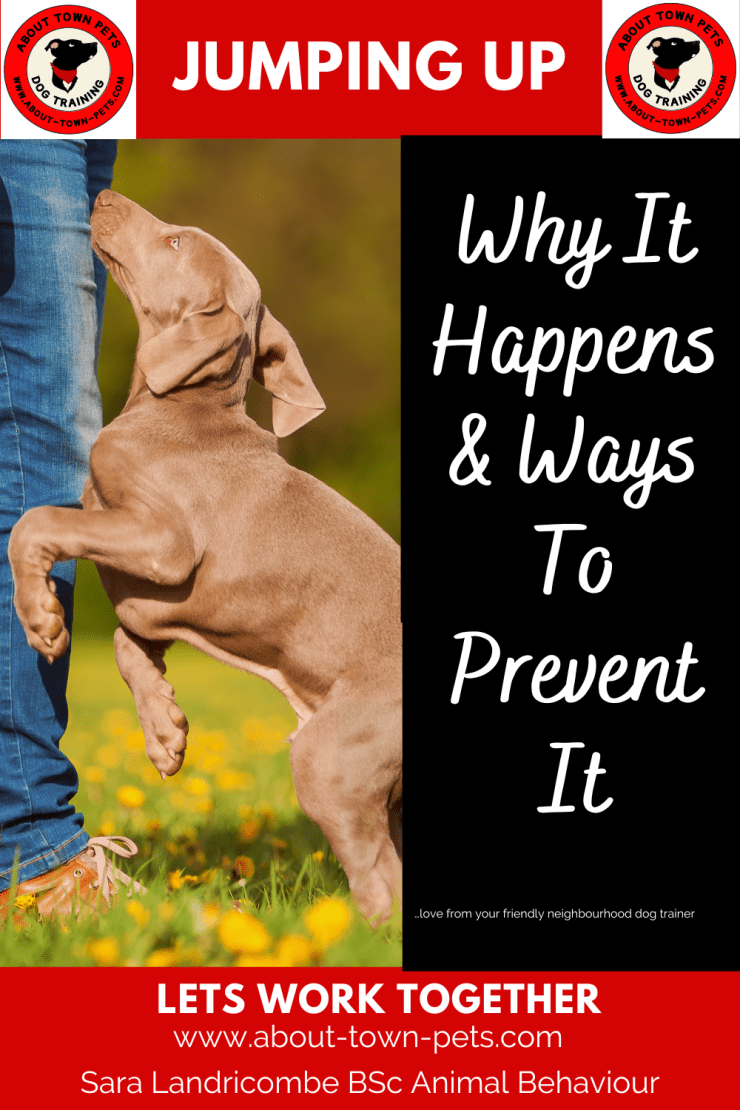
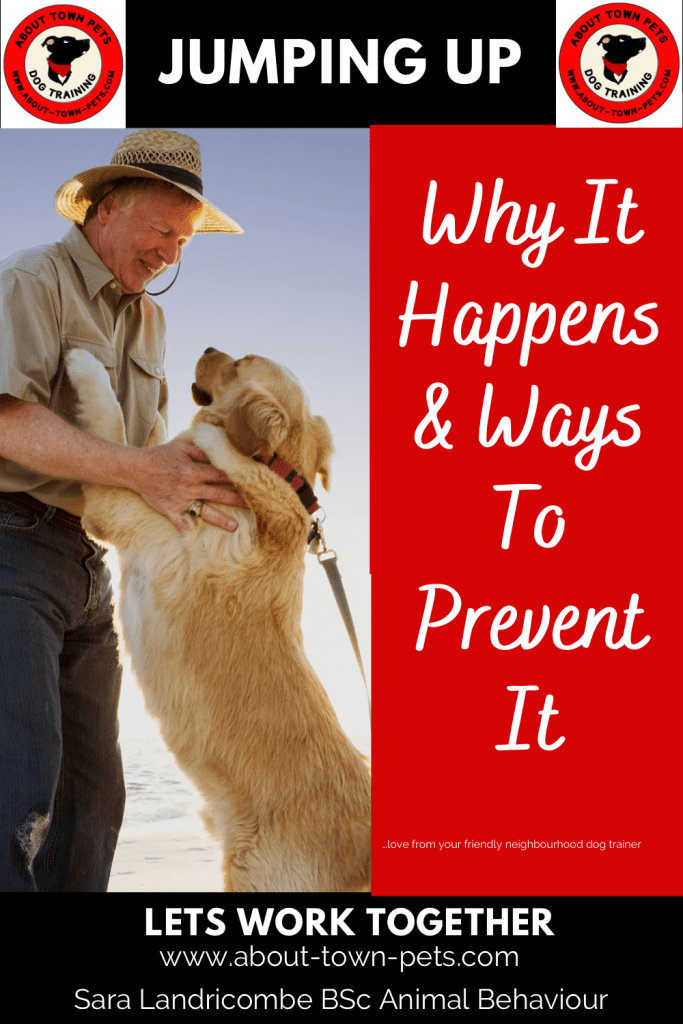
Jumping Up -Why It Happens and How To Tackle A Common Issue

If your once well-behaved puppy suddenly seems to forget everything they’ve learned, you’re not alone. The adolescent phase — usually between 6 to 18 months — can bring a wave of new challenges as your dog’s brain and body mature. Think of it as the teenage phase of their development: hormones, distractions, and big feelings all at once!

One of the most common issues owners face during this stage is jumping up — especially around people. The good news? With management, consistency, and a well-practised alternative behaviour, your dog can absolutely learn better ways to greet.


Why Does It Happen?

Jumping up is natural for dogs. They do it to get attention, greet face-to-face, or release excitement. During adolescence, impulse control dips while energy and social motivation soar — not the best combo! Add in the fact that new people, places, and smells are super stimulating, and it’s easy to see why polite manners can vanish overnight.


Step 1: Manage Before You Train

Use management to prevent unwanted rehearsals of the behaviour. Keep greetings calm and controlled — use a lead or long line, create space, and avoid letting the dog practise jumping.
This isn’t forever! It’s just until your teen pup is emotionally mature enough to handle more stimulation without losing focus.


Step 2: Train an Alternative Behaviour

Start at a distance where your dog can succeed. Practice a calm, incompatible behaviour such as:

  • An automatic sit
  • A “go to mat” or “place” cue
  • A relaxed settle on a bed

Reinforce these generously so they feel just as rewarding as saying hello by jumping.


Step 3: Keep Rewards Low

Always deliver rewards on the floor. This prevents your dog from anticipating treats coming from above — which can encourage more jumping. It is inevitable if everything fun happens at waist height then the dog is much more likely to want to get to the exciting thing more quickly by jumping up as excitement builds so get into the habit of asking your dog to “Find It” on the floor initially.


Step 4: Repetition Builds Reliability

Consistency is everything. It takes around 3–4 weeks for old habits to fade and new ones to stick.
And remember: one excitable jump can set you back a few practice sessions — so think long-term, not instant results.

A great rule of thumb: train 100 reps for the time you’ll need that 101st in real life. Build the muscle memory before you need it.


Step 5: Check the Motivation

Ask yourself:

  • Is my dog overstimulated by people or the environment?
  • Do they know how to switch off?

Try visiting public places to practise simply watching and settling. Start with 5–10 minutes at a distance, then gradually work closer as your dog learns to stay calm.


Final Thoughts

A well-timed “sit” or “what’s this?” is always more effective than shouting “no.” When dogs understand what’s expected, they feel secure — and calm dogs make better choices.

Adolescence can be challenging, but it’s also an opportunity to deepen your bond through patience, practice, and clear communication.

If you’d like to learn more about why adolescent dogs behave this way and how to support them through it, join my Teen Dog Behaviour Webinar on Wednesday nights — dates for the next rotation of webinar topics can be found below👇 🐾

And if you found this blog helpful you might also like my previous blog post on 👇

7 Tips To Help With Loose Lead Training

… love from your friendly neighbourhood dog trainer – S

If you want to work with me 1-2-1 please check out my Training & Behaviour Questionnaire Link To Get Started HERE 🐶

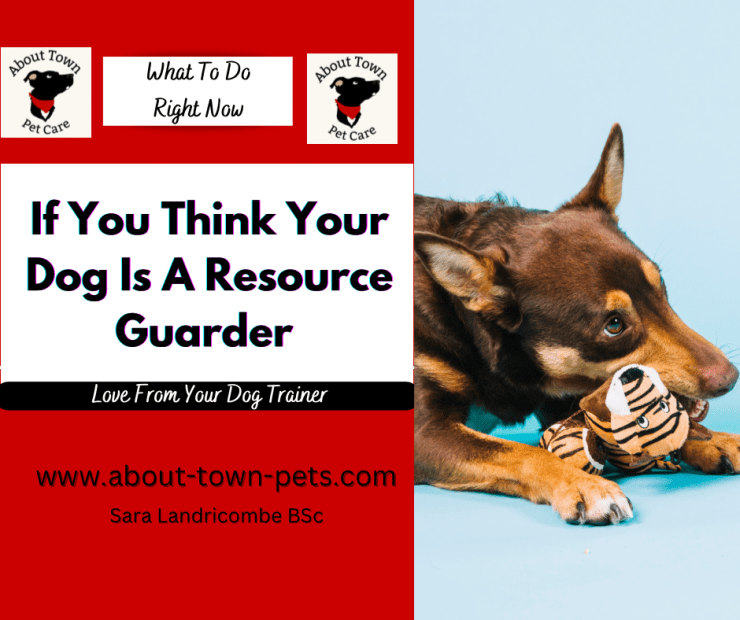
Help I Think My Dog Is Resource Guarding

👉Does your dog show signs of guarding sometimes known as Resource Guarding (anything of high value clothes toys food sofa people or space)- it could just be play OR it could be a slippery slope into defensive growling and eventually a bite (the fear of having its coveted thing taken away at all costs)

👉So here’s my “QUICK ADVICE” for someone who’s worried enough to ask for help but hasn’t been assessed by a dog behaviourist yet – Disclaimer – your scenario might not be as bad as you think but always er on the side of caution especially where growling & biting & CHILDREN are concerned

This is my online response so I’m trying to generalise massively for someone I don’t know but can make SOME assumptions based upon my own experience …….here goes👇👇(this was for a 8 month old goldendoodle pup)

⭐️Potential Resource Guarding⭐️

🛑First port of call is to manage your dogs triggers – ie: make every attempt to prevent him from practicing the unwanted behaviour so if you know he grabs socks and books and anything that rolls on the floor (my dog guarded a piece of pasta once 😅) you need to make the things inaccessible – I don’t have anything loose downstairs and those things are upstairs behind a baby gate

🛑You need to set your puppy up to not fail as this breed of dog is highly sensitive to guarding behaviour as they enjoy having things in their mouth (golden retrievers actually have a high incendence of guarding behaviour issues) and it’s OUR response to the guarding that starts to create the problem
If we quickly go to grab and manhandle a puppy with something in its mouth it will probably do one of two things:

1- Get defensive because he always gets manhandled or scolded therefore growling and running away will become the default- if this happens too much and pressure is constantly put on the pup and growls are not listened too it will become a bite and then habitually after many repetitions biting = normal for this dog

2- Or it becomes a game of “keep away” depending on the behaviour presented – to your dog it’s much more fun to get so and so to chase them around so he’s much more likely to steal that thing again next time because ANY attention is good attention for puppies sometimes

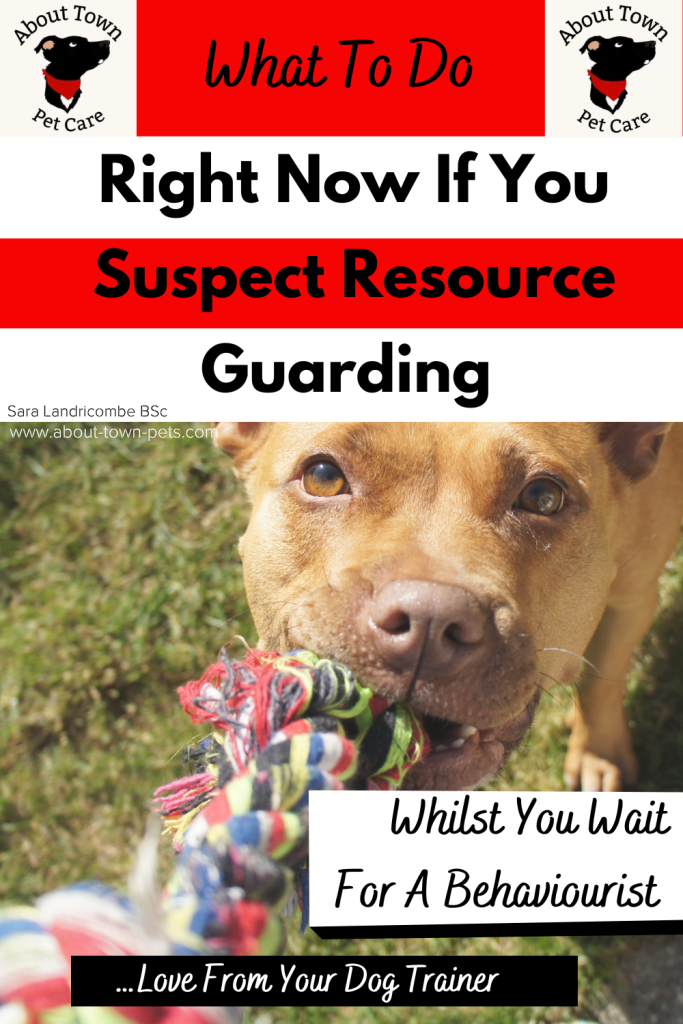
Tan coloured Staffordshire bull terrier plays tug

🛑So after management of the environment start “Yes” training – think of this as the first building block to create a new behaviour chain for your dog -do something completely different in a different room and if your dog knows “What’s This” you are already onto a winner too.


💚What you are trying to do is create distance between yourself and the guarded item – it’s the close proximity that’s is causing true resource guarding – there will be a distance at which you see the body language of your dog go stiff and growling starts – this is your boundary when you see it move away quickly to diffuse the situation- keep your body language light and airy even if you don’t feel it & reassure them by actually following through each time and moving away.

👉Say puppy “ What’s this” and go into another room and start putting HIGH value treats on the floor or scatter feed in the garden and say “Yes” every time they “find” a treat but make sure “What’s this” and following you into the other room is ALWAYS followed by this high value game to begin with as your pup is learning something very difficult (undoing the previous learned behaviours) whilst in the other room a secondary person can retrieve the guarded item and once it’s picked up have a puppy party so that coming to you = treats on the floor and eventually a game of tug for example – you can start to train a solid – DROP once you’ve established this first thing (getting two of the same high value things like two squeaky balls for example) and timing your “Yes” = treat the moment the first item leaves their mouth – This is Step 2 in your new behaviour chain.

👉Step 3 is training a solid “Drop”- To encourage the drop don’t put your hand in their mouth or grab (this triggers resource guarders) WAIT for the moment THEY drop and mark “Yes” and treat after
You can make a massive fuss of the second item as puppies get FOMO and will drop to play with whatever you have – keep it up until the DROP (you don’t even need to say drop to begin with just pairing the word “YES” with a treat becomes the predictor.

👉Yes Training is basically clicker training with your voice – a consistent word in the place where you would “Click” this is what I mean by start “Yes” training- I mention how to do this in the link below to my previous blog post👇

My Blog Post Mentions Yes Training Here

‼️Notes: On Food Bowl Guarding ‼️

🔴If you are finding that your dog has begun guarding snarling showing stiff body language and eating faster in the presence of other people or your other pets – PLEASE DO NOT ATTEMPT to force your dog to give you their bowl mid meal (I know SOME uneducated dog trainers on the internet will tell you that you NEED to do this) but you DONT need to do this AT ALL – it’s usually BECAUSE there is this forced bowl retrieval mid meal that resource guarding has started. to occur.

🔴What your dog actually needs is to feel SAFE & SECURE so he doesn’t have to resort to getting tense and fearful every time someone comes close so in the first instance 👉 create a separate place where only the dog is allowed to eat (this could be behind a baby gate or in a separate room and do not bother your dog until they have finished – just this for several days to give your dog more confidence – then do the steps previously mentioned above to create a willing response to coming away from the food bowl naturally.

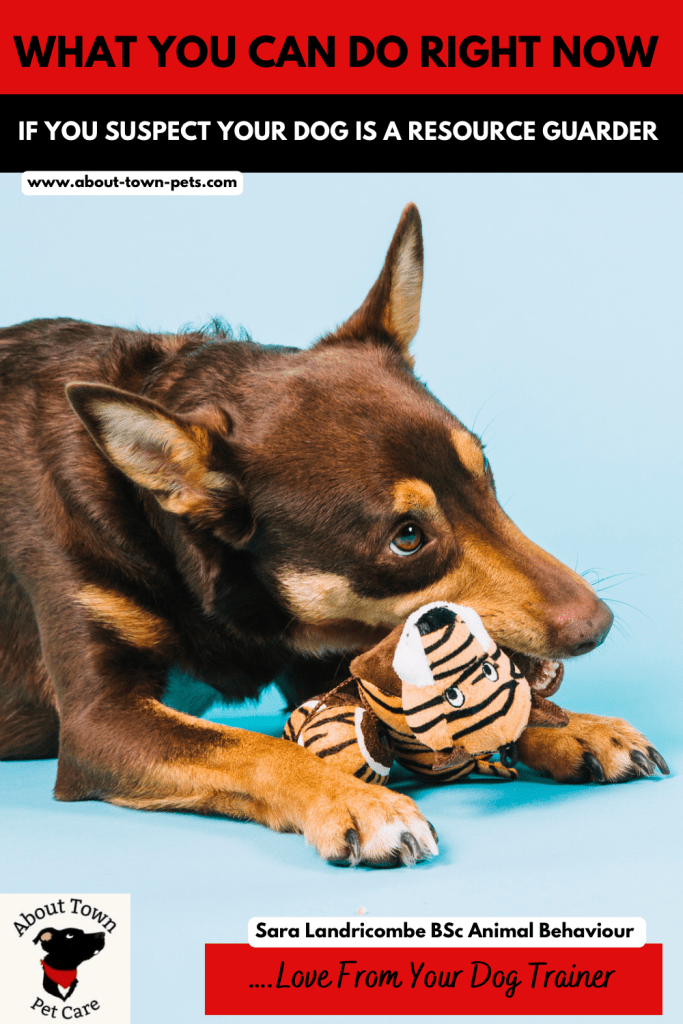
Brown & Tan Kelpie chews a soft toy

👉Then you can get a second person to pick up the bowl whilst your dog is being rewarded for an alternative thing in a separate room

👉This step might be easier said than done as I had a very smart spaniel who would only come away from the bowl for a VERY HIGH reward (I used chorizo and also I found he was only doing this behaviour INSIDE the house in confined spaces) so I found it useful to train an “outside” straight after eating to encourage a game outside in the garden to create natural distance from the bowl with a game of catch ALWAYS after his meal (nothing to strenuous I didn’t want him getting bloat) but he loved catching or “counting kibbles” or “finding chorizo” in the garden – these were all little tricks I could use if I ever failed at previous management steps and he got a tea towel for example – I could get him to at least come outside and swap for a game of ball instead of the object or “Swap” for the “catching kibble” 😅

❤️All of these things then become your toolkit for dealing with and managing a resource guarder humanely and without fear of escalation whilst you wait for behaviourist to assess the severity of your dogs guarding behaviour

👍My dog lived a happy 7 years in a home with three other dogs as quite a severe food & toy guarder because we managed him well helped him become more confident with his choices by doing fun confidence building training games. By having these little training protocols up our sleeves whenever the proverbial s**t got real made us much less nervous about managing him & made us realise it was our fault for not managing him properly or it was us who needed to dial down our response to the “stealing or guarding behaviour” as it’s was this overreaction that was fuelling the “ANY attention is good attention aspect of his behaviour. You learn quickly when you have a dog steal your mobile phone or the remote because you left it unattended on the sofa🙈🙈)

I hope this article helps someone with pointers and tips on how to be a more confident owner of a dog with resource guarding behaviour- because this is just a small aspect of their personality the other 75 percent is a loving happy active smart fun dog who just needs to be understood to thrive ❤️🐕❤️🐕

For an in depth look at the issues and training protocol I recommend this book 📕

Sara @ About Town Pet Care🐶

Ps – if this has helped you and you would like further help please contact me here👇