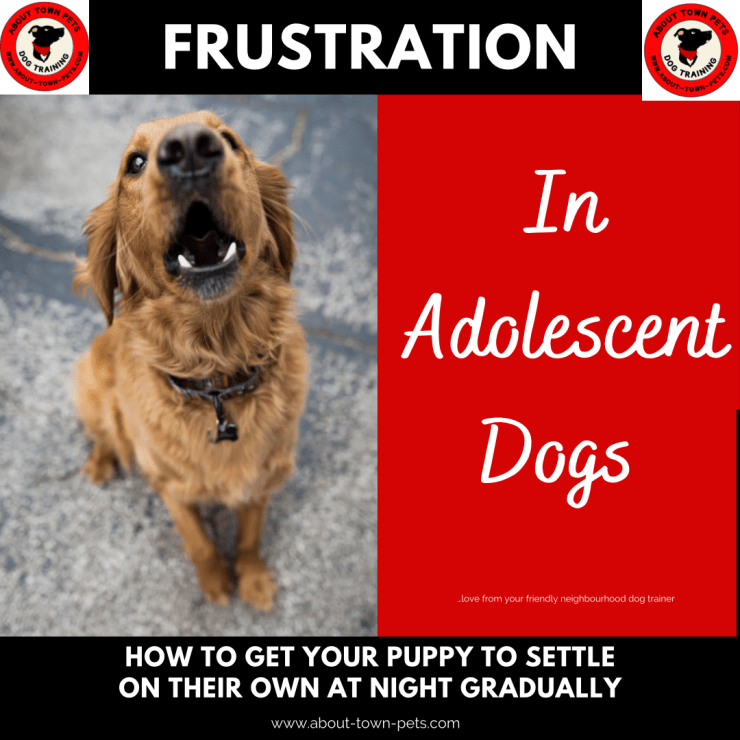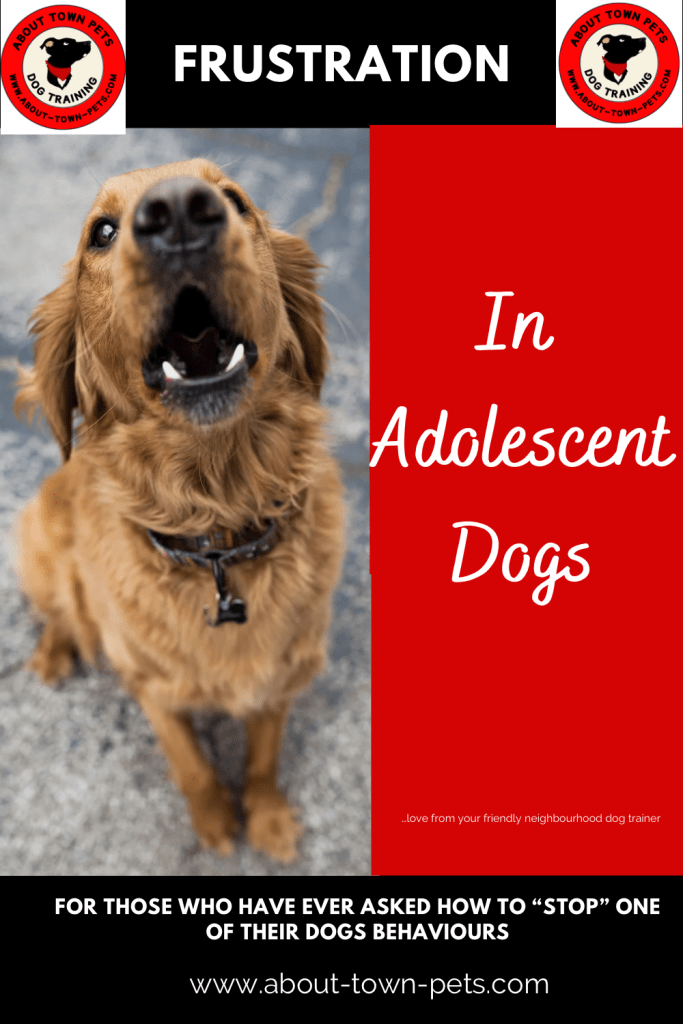
Frustration in adolescent dogs

Adolescence Isn’t Disobedience: Understanding the 7-Month-Old Spaniel Brain

I recently responded to a post about a 7-month-old Cocker Spaniel who was “pulling like a train” and they were asking for a harness that “stops pulling”. Other phrases that kept coming up were ones I hear all the time:

“He’s suddenly forgotten everything.”
“His attention span is like a gnat’s.”
“He’s pushing boundaries and meeting force with force.”

Welcome to canine adolescence.

This phase can feel like all your hard work has unravelled overnight, but what you’re seeing isn’t stubbornness, dominance, or your dog “being naughty”. It’s biology.


The Teenage Dog Brain (or: Why Your Dog Can’t Put the Brakes On)

A 7-month-old dog is roughly equivalent to a 14-year-old human teenager.

Their body is developing rapidly, hormones are surging, and crucially — their frontal cortex hasn’t caught up yet.

The frontal cortex is the part of the brain responsible for:

  • Impulse control
  • Emotional regulation
  • Decision-making
  • The ability to pause and think before acting

In dogs, this area doesn’t fully mature until around 18 months of age.

So when we expect a teenage dog to “just make better choices”, we’re asking them to use a part of the brain that quite literally isn’t finished yet.


Be the Swan 🦢 (Even When You’re Screaming Inside)

I often tell clients to be like a swan.

On the surface: calm, graceful, unbothered.
Underneath: paddling like mad, thinking “for goodness sake”, and feeling frustrated.

Feeling frustration is normal. It’s human. It’s part of our emotional repertoire.

But dogs don’t need us to win against them — they need us to be smarter than their nervous system.

Meeting force with force during adolescence often escalates behaviour, because the dog simply doesn’t have the neurological capacity to regulate themselves yet.


What Adolescent Stress Actually Looks Like

During this phase, dogs become more easily frustrated, and stress shows up in ways that often confuse owners.

You might see:

  • Scratching in the middle of play
  • Yawning when nothing seems tiring
  • Shaking off when they’re not wet
  • Avoiding things they were previously fine with
  • Lunging or barking at familiar sights
  • Sudden “out of context” behaviours

These are stress displacement behaviours — signs that the dog’s nervous system is struggling to cope.

When pressure continues, dogs may opt for space-increasing behaviours, such as:

  • Pawing at you to make you stop
  • Mouthing or grabbing clothing
  • Snapping to create distance

This isn’t aggression — it’s communication.


Redirect, Don’t Confront

Instead of challenging the behaviour head-on, I prefer redirection using cues the dog already understands well.

One of my favourites is:

“What’s this?”

It taps into curiosity and makes the dog come towards you to see what they’re missing out on.

If you can teach:

  • “Up up” → you can teach “Off”
  • “Come and see” → instead of pushing away

Always ask yourself:

What is the opposite of the behaviour I don’t want?

Examples:

  • Jumping up → a solid sit on a mat
  • Mouthing → stopping and picking up a toy
  • Recall issues → working very close for a long time to build value in staying with you

Distance is earned. Adolescents need to relearn proximity.


Puberty = Instincts Switching On

Puberty typically hits between 7–9 months, and this is when a dog’s breed-specific behaviours really start to emerge.

Under pressure or frustration, dogs revert to what they were selectively bred to do.

For example:

  • Spaniels like to hold and possess
  • Retrievers like to carry things in their mouths
  • Guardian breeds may grab and pull down

These behaviours often increase when:

  • The dog is frustrated
  • The dog doesn’t know what’s being asked
  • Training lacks clarity
  • Tasks change too quickly

Dogs don’t default to calm thinking under stress — they default to instinct.


Why Frustration Tips Over So Fast (Especially on Lead)

Frustration builds pressure in the nervous system, and pressure needs an outlet.

This is why:

  • Dogs are often more reactive on lead than off
  • Tension on the lead escalates behaviour
  • Lack of movement increases emotional overflow

Under pressure, behaviour can escalate quickly into:

  • Barking
  • Lunging
  • Snapping

Not because the dog is “bad”, but because their coping capacity has been exceeded.


A Note on Harness Battles

If getting equipment on and off has become a battle, you have two options:

1. Change the Equipment

Some dogs struggle with harnesses that go over the head.
step-in or Velcro harness can remove that stress entirely.

2. Go Back a Step

Slow the whole process down.

  • Break it into smaller steps
  • Reinforce calm behaviour
  • Reduce the “faff”

Sometimes removing the equipment altogether for a short reset helps, because the dog has learned to predict:

“Something uncomfortable or stressful is about to happen.”

If in doubt:

  • Change the cue
  • Change the equipment
  • Start again from scratch

There is no failure in resetting — only information.


The Takeaway

Adolescence isn’t a training problem.
It’s a developmental phase.

Your dog isn’t giving you a hard time — they’re having a hard time.

With clarity, patience, and an understanding of what’s happening inside that teenage brain, this phase doesn’t have to be something you “get through”.

It can be something you guide them through — calmly, consistently, and with empathy.

And yes… sometimes while paddling furiously under the surface 🦢

If you appreciated this post feel free to check out my previous post Help My Puppy Won’t Settle At Night here👈

Before you go you might want to check out my 12 Days Of Woofmas by adding your email to my newsletter sign up page Here to get access to 12 days of canine science right into your inbox there will also be 12 videos to accompany those emails on a private section of this website as well as daily tasks to complete via email – so if you want to keep yourself busy over the Christmas period feel free to sign up now 👍

Love from your friendly neighbourhood dog trainer and behaviourist.

S x

https://about-town-pets.com/newsletter-sign-up/

How Long Is Too Long? Understanding Your Dog’s Alone Time Needs

A Dog Owner’s Guide to Balancing Alone Time and Welfare

Let’s talk about something we’ve all probably mused over at one time or another as a dog guardian: how long can you really leave your dog home alone?

Technically, the Animal Welfare Act 2006 suggests that after 4 hours assuming that your dog has also just partaken in some form of enforced crating (think overnight in a crate for an average of 8 hours), it would be time to consider your dog’s welfare. Dogs are social creatures, after all, and leaving them for long stretches without interaction isn’t ideal.

In fact, the PDSA is pushing for an additional welfare guideline to consider dogs’ rights to companionship beyond that 4-hour mark. The science is simple: dogs thrive on interaction, and too much alone time can lead to boredom, anxiety, and even stress-related behaviors.

But how long is too long?

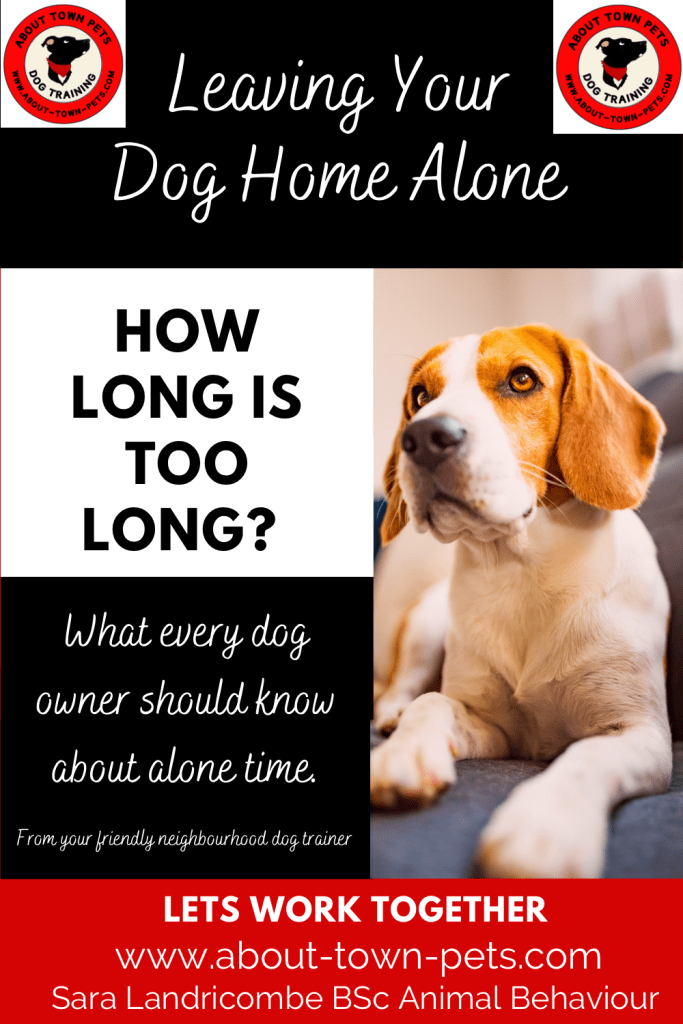
A tan faced beagle is lying down on a grey couch

Context Is Key: A Quick Reality Check

For a little perspective, animals in transit on their way to slaughter (yes, grim but relevant) can’t travel for more than 8 hours without a break for food, water, and in some cases, a quick hose down. So if even livestock in transit get regulated breaks, it makes sense to extend similar consideration to our household pets too doesn’t it?

While some dogs—like seniors, puppies, or those with medical conditions—may need more tailored routines, the general rule of thumb is to limit alone time to 4-6 hours, with 8 hours being the absolute maximum in most cases.


What Can You Do?

Here’s where your creativity and resourcefulness come into play. It’s all about breaking up your dog’s day:

  • Enlist Help: Think family, neighbours, friends, or even a professional dog walker.
  • Pop-In Visits: A quick visit to let them out, give them some love, and maybe toss a frisbee can make all the difference.
  • Gradual Training: If your dog isn’t used to being alone, work up to it gradually with the help of a specialist dog trainer/ behaviourist.

Gradual Alone-Time Training: Step-by-Step

If you’re planning on leaving your dog alone while you’re at work, it’s worth setting them up for success:

  1. Start Small: Begin with short periods out of the house, like 2 hours or even less if your dog has ZERO practice (thirty seconds is all I’m asking to begin with).
  2. Use a Camera: Set up a pet cam and see what your dog does when you’re gone. (Spoiler: the camera doesn’t lie.)
  3. Extend Slowly: Once your dog is comfortable, try 3 hours, then 4. Adjust based on what you observe. Even 1 minute / 2 minutes in micro bursts might be where you start.

It’s worth noting that adjusting to a new routine can take time—sometimes up to 6 weeks. So please be patient!

A shirt faces pug lies down in front of a glass door looking out

Setting Your Dog Up for Success

Here’s a handy checklist to help your dog settle into their alone time:

  1. Get Them Moving: Make sure your dog gets a good walk before you leave, but avoid high-energy activities like frisbee or fetch, which can leave them tired but overstimulated.
    • Instead, try scent-based activities like scatter feeding or search games to help them decompress on the way home.
  2. Feed Them: A well-fed dog is much more likely to nap afterwards. I often do this AFTER their walk due to issues regarding bloat (I have two deep chested dogs).
  3. Provide a Cozy Space: Create a comfortable “hotel spot” where they can snooze undisturbed whilst you are out. The more appealing and luxury the better.
  4. Offer Enrichment: Puzzle toys, Kongs, or chew toys can keep them entertained—but introduce these while you’re still home so they don’t associate them with you leaving. Give yourself plenty of time to leave. I use the rule that enrichment for the day goes down 30 minutes before I leave.
  5. Keep the Goodbye Drama-Free: No long farewells. Just calmly set them up and go. By planning these morning routines well we can set our dogs up well.
  6. Lastly – make sure you are actually out of sight and out of their scent range because dogs will settle sooner if they can smell you upstairs or out on the doorstep for example. We need to make it as true to life as possible.

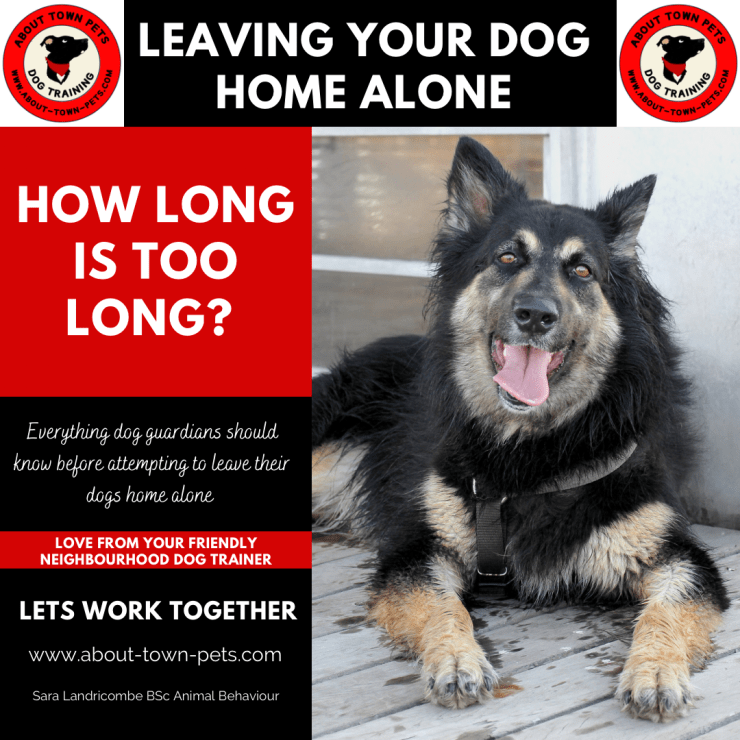
A large Black and Tan shepherd mix breed lies down on the decking with his mouth open whilst wearing a black harness on

The Bottom Line

Your dog doesn’t need 24/7 supervision, but they do deserve thoughtful planning to ensure their welfare. With a mix of routine, training, and enrichment, you can strike a balance that keeps your dog happy and healthy—while giving you peace of mind.

So, whether it’s calling on a neighbour, investing in a pet camera, or adjusting your dog’s routine, small changes can make a big difference and remeber it’s never too late to start home alone training.

Love from your friendly neighbourhood dog trainer Sara.

If you enjoyed this post feel free to check out my previous Home Alone Posts Here 👉 How to start home alone training & Five myths about separation anxiety

If you want to work with me then you can email me here Contact Sara at About Town Pets as I now offer online 1-2-1 dog training in person in an 8 miles radius of Plymouth Uk or online for the rest of the UK USA Canada Europe New Zealand and Australia specialising in the following topics;

Separation Related Distress

Lead Reactivity

Adolescent Dogs (6-18 months old)

Tiny Dog Behaviour (dogs under 7kgs)

City Dogs (adapting training for urban environments)

Or BOOK NOW 👉Home Alone Heroes Package

Please be sure to check out my Facebook page for upcoming webinar topics coming soon About Town Pets On Facebook

Tap on the image above to book now

Let’s Talk About The Puppy Blues – It’s Exhausting & Totally Normal

Inspired by a recent post in a puppy group that I frequent on Facebook and by the looks on any of my puppy club members faces when they get to class – I thought it would worthwhile to mention that “The Puppy Blues” Phase of puppy ownership is completely normal and I guarantee that the majority of other small puppy owners are feeling the same way or have done over the past 6 months. I know this because it’s a constant topic online and amongst my own puppy class members who tend to bond over stories of their own puppy blues- it’s exhausting having a puppy but please remember this too shall pass- if you ever make it to a formal puppy class you will notice that it slightly resembles an AA meeting but for young puppy owners. They recall tales of hands that are beaten and bruised by puppy gnashers and bleary eyed first time owners recall how they haven’t really slept for the past three weeks whilst everyone else in the group nods and agrees it’s true in some form or another for them all.

Terrier puppy against a blue checkered background sits amongst fluff pulled from the inside of a cushion – presuming that this is “naughty” behaviour

It’s real “The Puppy Blues” they tend to set in when it dawns on you that this going to be harder and take longer than you thought but I’m here to tell you that its gets easier and we’ve all been there I promise.

Dogs transitions vary with age breed and their personality but as a rule I say stick to a 3 day protocol anything you implement please allow three days for your pup to get used to it – chopping and changing will not help you – don’t be afraid to pop your pup in a crate or play pen in your room so you are at arms length for the first few nights – I promise you are not going to ruin your dog – it’s just come from 8 weeks of mum and siblings on tap and physical comfort at all times so bare this in mind when we are in a hurry to get puppy into a routine

Cavapoo puppy sits amongst toilet roll which strewn around him

Being at arms length allows your puppy to feel safe if he cry’s but allows him to settle when he can- further tips and advice can found on my previous post- here

Then you can start to move the crate/pen etc every three days to the next spot (I assume here that you eventually want your puppy to sleep downstairs) so every 3 days move the crate/pen to the end of the room then just outside the door then downstairs then in the room that you want them in – be prepared to reassure puppy and go back a step if they are really getting very worked up – unfortunately with some dog s(breed and personality have a lot to say in this) letting your dog self soothe as a blanket piece of advice may mean 1/ your create a dog with separation anxiety or 2/ you ruin any crate training you are working on (crate training requires gradual exposure and all positive experiences happen in the crate with the door open and closed) this can’t happen if he starts to associate the crate with scary bedtimes

Also be prepared to go out (physically scoop up your pup if you have too to begin with) on the hour every hour until you have mastered toilet training because puppies cry not only for attention but because they often don’t want to soil their bedding

A good rule here is let them out/physically take them out after eating sleeping playing – they have tiny bodies and tiny bladders for the next 6 months

A beagle puppy stands on his back legs to greet someone on the other side of his playpen

If you prepared well you would be writing off the next 6 weeks a bit like new parents don’t see the light of day for about 6-12 months new puppy owners are likely going to need about 6 weeks minimum to get that pup into some sort of routine and so much training and visiting happens during this time not to mention that your pup is likely not going to be allowed out for the first 3 weeks that have them at home due to the gaps required between their first and second and potentially third vaccinations (unless your puppies breeder was an absolute gem and got your pup vaccinated whilst they were still with them)

⭐️Side Bar – Breeders you get extra superstar status if you – as standard- keep the puppies for an extra 2 weeks with mum and do some beginners handling socialisation and rudimentary toilet training in those first 4/5 weeks with mum – I would be grabbing your hand off for details to pass onto potential new puppy clients😍

I digress…. that happens here and even when pup is eventually allowed out your going to be working on toilet training socialisation and potentially going to puppy classes (I highly recommend that you do😍) even if you’ve had lots of dogs in the past – techniques have changed and there’s about a hundred different ways to train simple things so you are most definite going to pick up tricks and tips) even if it’s how to mark and rewards quickly and efficiently, how to use the three predominant ways of getting initial behaviours and how to look out for puppy body language you may not have noticed before) and SO MUCH more, I know that I want people to learn as much I can teach them with my limited 6 hours that I spend with them because I believe it’s a “hit the ground running” scenario and your window of opportunity is definitely slim – of course you can train older dogs there’s no time limit on training, but your puppy is small and manageable and like a sponge up until about 6 months old so I highly recommend training FOR a scenario rather than when you are IN a scenario.

Adorable tan coloured cavalier King Charles spaniel puppy lies down on a white bed

This means that there’s no point in panicking and hoping your puppy will recall away from another dog in the park instead you should anticipate things that might happen whilst you are out and stay vigilant knowing that you can distract and recall your pup for example BEFORE it’s too late and your puppies attention is lost and you have to scramble to go and get them back – you can manage and mitigate in a scenario but hopefully you’ve put in some solid foundations in the garden in the house or in low distractions whilst you build up and try the same training but in the real world scenarios, understanding that a puppy with lots of repetitions under his belt and a solid “What’s this” (what’s this gets attention and is followed by a high reward) encourages quick responses so you can put them back on areas or move them around or turn in a different direction until the distracting thing has moved on or you get an opportunity to greet the other dog whilst yours is under control (let’s practice polite quick greetings and move on) unfortunately I see too often owners scramble to recall or grab treats from pouches knowing full well that their dog should really be on a long line but that’s an inconvenience so I will just wing it and hope for the best – unfortunately hoping for the best and getting lucky isn’t best practice – train frequently and repeat is a better course of action – practicing at every opportunity is so much more fun for your dog anyway and you will end up with a dog that constantly keeps an eye on you instead of a wayward pup.

So really the point of the post is to persevere because everyone has to go through this phase albeit with a new puppy a teenage dog (see my post on this topic – which will ultimately end up being a secondary puppy blues phase for you) or a newly rescued dog – I will also note here that if it really doesn’t seem to be getting any better for you past the 6 – 8 week mark of puppy ownership I would highly recommend you get in contact with a professional training to help you work through potential training plateaus that might be occurring or something else that might need intervention for you or your pup- I’m not promoting that you struggle just that you allow enough time for your pup to cope before you get some intervention.

If you would like to work with me – please don’t hesitate to contact me HERE

Sara @ About Town Pets 🐶🐾

Ps If you appreciated this post you might also like my previous blog post on Tips & Training Advice For Dogs With Suspected Separation Anxiety

And Also This One- Learn About My Number One Training Tip