
The thought of getting a puppy leaves the majority of us ecstatic and mostly feeling like a child waiting to go to Disney world (that last part might just be me) but have you REALLY considered everything before taking the plunge? 🐶
You’ve seen THE ONE and you’ve simply got to have him- now take the next 10 minutes to step back into reality and please consider the following 7 things before you make one of the biggest commitments of your life.

1- Consider Your Own Lifestyle………
I know I know you’ve promised yourself you will walk it twice a day rain or shine , play with it every day and take it on hikes at the weekends when it’s big enough – now just give me that husky already! But wait….. you work 10 hour shifts and live in an apartment and you don’t even own walking boots. Obviously I’m jesting but I see it so often that people either pick a dog because it’s beautiful or what they THINK they can cope with but reality kicks in the moment you struggle to house train a dog in an apartment or when the bull breed starts mouthing A LOT more than the average dog or simply can’t keep up with the athletic ability of a working breed. I also see what I call “being out dogged” for want of a better word especially amongst first time dog owners who pick the working version of the breed of dog and don’t realise the sheer variety even within a specific breed. There is no one size fits all for any breed but obviously don’t buy a Great Dane if you live in an apartment ,don’t buy a Malinois Shepherd even if you’ve owned big dogs all your life and definitely don’t underestimate the amount of difference between working cocker spaniels and show cocker spaniels – I say all of these things purely because I want you to enjoy being a team with your new pal and the best way for you both to get along from day one is to be REALLY honest with yourself with regards to how much effort you want to put in to training said puppy all the way through it’s life as well as the amount of space and time you have to keep him occupied when he becomes a teenager. EVERYONE struggles at least, a bit,during this phase. Ok, maybe you won’t pick the husky, perhaps a (insert breed here) would be better for my lifestyle, no-one is going to judge you for changing your mind if anything I’d respect you even more for being sensible so……….what next?
2. Thoroughly research your breeder……
I don’t just mean he’s KC registered that will do OR this person lives nearby that will do. Check that your breeder has a licence (in England you have one if you breed more than 3 litters per year) and if not that they are committed to get all the health checks and predisposed conditions for that breed checked. Make sure it’s not a backyard breeder who is breeding as many as they can or are dealing in European imported puppies (Red flags – will include not being able to see the mother with the puppies and or the fathers details, meeting at a motorway fuel station to collect the puppy , also the owner bringing the pup out to you to see it , all indicators that they don’t want you to see where the animals are kept). Don’t be afraid to ask to look around – ask if they will allow the puppy to stay longer with its siblings and mother – ask if the pup will start some training with them before you collect them (handling socialisation crate and toilet training can all start as early as 4 weeks old) any dog breeder worth their weight in gold, should now realise, that they have more of a responsibility to breed dogs which are healthy & have better temperaments not just the ones that are trendy & beautiful .Lastly make sure they have a breeders agreement/contract in place just in case something untoward happens and the puppy needs to rehomed ( I’ve personally rehomed 6 dogs (to prevent them from going in to kennels) and they are all free to come back to me if ANYTHING happens . Dog shelters are currently at capacity and receiving 40 percent more enquiries due to behaviour issues this is sadly becoming a one way street to behavioural euthanasia so please please please don’t add to the problem where it could have been avoided.

3- Try finding a breeder who will allow your puppy to stay an extra two or three weeks…….
Studies are now showing (I will link studies another day- it’s late and I’m typing with fury) that due to what is known as the “fear period” in puppies which occurs right at (depending on the breed) 8 weeks of age, just as puppies are typically encouraged to go to new homes. What is a fear period I hear you cry! Its period of heightened sensitivity to overtly stimulating or aversive experiences. The studies proved that if an aversive thing (as perceived by the puppy) happened at 8 weeks old (a scary hand coming in to touch or roughly handle the puppy- I believe) then the puppies were unable to show any signs of resilience and stayed fearful of people after the fact – the same thing happened to puppies at 10 weeks old and they bounced back and were more resilient to the perceived aversion and went on to be trained how to like people more easily (there is thought to be another period like this at 6 months old but that’s for another post). So by simply allowing the puppy to wean for longer and eat socially with siblings as well as have more social interactions in a safer environment this extra 2 weeks with the breeder could make all the difference between taking home a fearful puppy and a more confident one.
4- That puppies are not blank slates…….
Just because you buy a new puppy does not mean that it’s free from temperament or health issues from day 1. Stress can be inherited (again I will link studies another time) so if you buy a puppy from a stressed mother ie: puppy farm scenarios or a nervous first time mother , your puppy will likely feel the affect of that through genetically having these dispositions be passed on to them or through lack of maternal care by a naturally less confident dog (so ask as many questions as you can to the breeder- what’s mum like with other dogs? What’s dad like around children etc etc) Also I personally know of puppies bred and raised exactly the same yet yielding puppies with completely different personalities even within a litter. Mother was a slightly nervous girl and had a very typical Labrador male puppy (not phased gentle happy go lucky dog) and also a moderately nervous female who doesn’t like to be away from her owner and isn’t confident around new people and barks a lot (some might say not typical Labrador behaviour ) but is totally normal to find this variance even within a litter so choose your puppy wisely – Was the litter all females or all male (this is thought to have a hormonal difference on behaviour Or was it the puppy that has been returned? If so why was it returned (you get where I’m going with this?). As a rule look for Goldilocks dog – not too shy and staying away but not the one who’s trampling all over the others and being too rough- find the guy who’s happy to be handled and equally happy playing & not too boisterous – a red flag here is a puppy that is panicking a lot if gently tipped onto their backs – look out for the ones who panick or mouth increasingly in doing so.
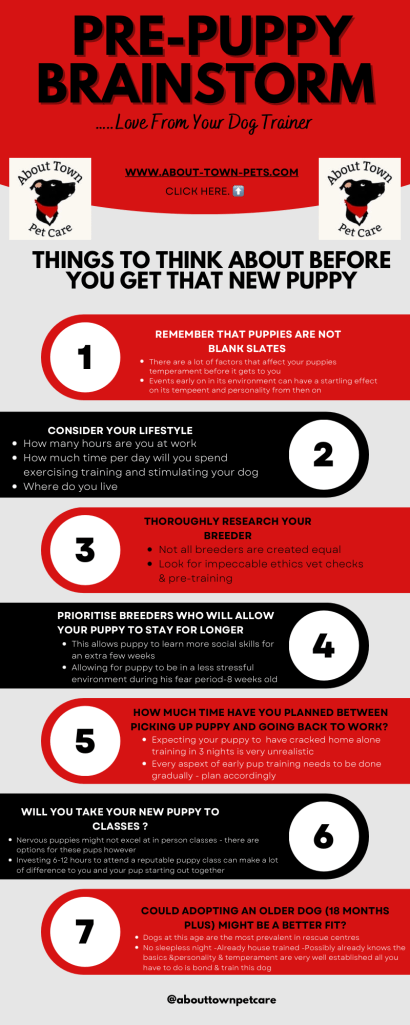
5- How much time will there be between getting your puppy & you going back to work? ……
I don’t think that this is considered enough. I see all too often people asking on social media – how long does it take for a puppy to settle at night ….it’s been 3 nights now and I’m exhausted. These tend to be people with unrealistic expectations of a brand new baby animal that has just moved away from his previous cohabitating life (puppies are group sleepers) where he had access to his mother and siblings for comfort almost 24/7 to live in a home where everything is new and is expected to sleep alone in 3 days🙈 Alternatively they just haven’t given themselves and their puppy sufficient amount of time to practice everything I mention in my upcoming blog post & webinar – Surviving the first 7 days of puppy ownership- If I were to get another puppy, knowing what I know , I would use the 6 weeks school holidays to take full advantage of several people being home at this critical phase – we would crash course the first two weeks where we would hit the ground running with- settling at night gradually – toilet training- basic crate training gradually- getting ready for micro absences- working up to 15 minutes of home alone training – working through your puppy socialisation list & signing up for online puppy classes – so that my pup can be 2 weeks ahead of his class and we can be being proactive whilst waiting to finish his course of vaccinations (which In the UK is about 3 weeks now & the socialisation window for new experiences is roughly 18 weeks old 😅) But even if you don’t have 6 weeks to spare try to use your annual leave as much as you can and call in favours for puppy sitting at least until your pup can successfully go to the toilet without accidents and is big enough for a pet sitter to visit. Try to break up the puppies day every 2-3 hours so plan to come home on lunch breaks , get a pet sitter and ask the neighbour to come in because its difficult for your pup to hold it in when their bladder is the size of a walnut 😉🐕

6- Going to puppy classes or not to go to puppy classes that is the question….
I have two points to make on going to puppy classes (disclaimer I offer in person puppy classes as of November 2022 in the Plymouth area) that being said I don’t think FORMAL puppy classes are for every dog but let me explain….. I wholehearted think that everyone with a confident puppy should go to some form of formal positive training sessions with their puppy – I mean its 6-12 hours of your life that can greatly benefit you as the owner (gives you the building blocks and advice to start training your own puppy quickly and kindly) to save you, hopefully, from having to come back to me in 6 months time with Separation Guarding or Reactivity related issues. I say this because the vast majority of my behaviour cases are currently resource guarding nipping or Separation Related distress based upon leaving it too late to train their dogs (none of them have had any early years training even if it was just online sessions with a reputable trainer) a lot of their issues could have been remedied earlier or noticed quickly by a trainer. The seven most commonly asked training issues are usually covered in the very first 6-12 sessions on offer for puppies under 12 months old (I shall do a post about those soon as well). If you have a naturally nervous shy or boisterous dog who loves to bark formal classes might not be the best idea for them and that’s really OK not all dogs need to physically be next to others to socialise. You could pick online classes to start with so that you can do a class with your mute button on so that your dog can learn the basics in a calm environment OR I recommend “Anti-Social” training in my puppy classes where, for example, the nervous nellies (daschunds I’m looking at you😅) can still be in class but kept at a distance where they are more comfortable and might settle better or cope better with the movement – just simply being in the same room can help your dog mimic the other behaviour and also it might just be that little Rover needed a few sessions to get to know that everyone else is ok before joining in 👍 Alternatively 1-2-1 puppy training sessions are another way to get the most out of your hour with the trainer and learn what your peers are learning without the crowds. Just a few ideas to think about…..
7- Lastly, seriously consider whether adopting an older dog might be a better fit…..
What? A puppy trainer just told me to not get a puppy and adopt one instead!! Hear me out…. As the owner of two “failed puppies” and having worked in a rescue centre myself in the past I know all too well what the puppy industry fallout looks like. Whilst I want to promote the absolute best pet guardianship possible in the most positive of ways I want to also make it clear that I would personally (unless an absolute emergency ) own a puppy ever again – It’s easier to take on dogs 18 months and older who have already done puppy classes can go to the toilet on their own and have lovely personalities already. I have also had 3 puppies over the years and it’s hard work- it’s called the Puppy Blues for a reason – you think your puppy isn’t normal and “why me” when it comes to relentless biting peeing and barking BUT I am an advocate for RESPONSIBLE dog ownership & want to reduce the like hood of any current puppies from needing to either be rehomed for behavioural issues that could easily be prevented or simply reducing the amount of “on a whim” puppy buyers to reduce the 40 percent increase in intakes in rescue centres of dogs aged 6-18 months old roughly about the same time the “fun period” ends for puppies and sh*t gets real. So please please please take notice of the points mentioned above and perhaps hold off another year from getting that puppy but by all means go and get yourself a puppy if you truly have the burning desire to do so because as with dogs not everyone is the same sort of owner I get that ❤️ Do try your very best,however, to avoid all of the pitfalls I see every week so that we can all live in a world where dogs are angels in real life – I just want you to enjoy your dogs in the best most kind way possible. Xx
Thanks Sara🐕❤️ Ps Check back every Tuesday for more training tips and advice and get your fix of daily doggies on my Instagram or more posts at My Facebook Page



 About Town Pets
[…] https://about-town-pets.com/2022/10/18/7-things-you-should-consider-before-getting-a-puppy/ […]
LikeLike