How to Create a Dog That Loves Learning: By Becoming A Well Prepared Owner
Training your dog doesn’t have to be a chore. With a little patience, consistency, and a whole lot of positivity, you can turn learning into a fun and rewarding experience for both you and your canine companion. Here’s 9 ways in which you can create a dog that loves learning, in a relaxed and enjoyable way.
1. Start with Easy Wins
Begin with simple commands even before you start to train the obvious stuff like “sit” or “down” in a quiet environment. You can begin to reward your dog for looking up at the sound of his name OR for “Checking In” doing it so often that it becomes a reflex is a great starting point which. These early successes build your dog’s confidence and set the stage for more complex training. A great example of an easy win is when we try and get our dogs to engage with enrichment activities – shy nervous or easily frustrated dogs and puppies might not actually know what to do to begin with so you can start by point or showing the dog how to do something and mark and reward the moment their nose touches a treat (a simple rolled up tea towel with treats inside is a wonderful easy win). See my previous post about Every Day Enrichment Ideas Here.
2. Embrace Imperfection
Perfection isn’t the goal—progress is. Celebrate small victories and understand that mistakes are part of the learning process. Your dog’s journey is about improvement, not flawlessness. The aim of the game is to get the behaviours you want loosely then you have plenty of time to polish anything up over time and as the dog matures or becomes more engaged with the whole process of training. Even if that means getting a little creative with how you train something (because there are a plethora of ways to train one thing) it’s mostly about confidence building for you both as a team and whether or not you can go away and actually get a little bit done often because imperfect consistency is better than no training at all.
If you really find yourself hitting a brick wall with a certain behaviour don’t hesitate to get in contact or at the very least send your trainer a video of you doing the behaviour and we can tell you what aspect of your training mechanics or reward delivery might need a little more practice.Contact me here 😅
3. Train Frequently, Seize Every Opportunity
Incorporate training into daily routines. Whether it’s during walks, meal times, or play sessions, use these moments to reinforce commands and behaviors. A great example of this is to get into the habit of naming everything that is significant on your walk- because if you always say a certain word or give a specific hand gesture at the same points on your walk the dog will get into the habit of predicting your behaviour and over time start to look as though “they trained themselves” when actually what is more likely is that you were predictable with your body language and words when out and about with your dog.
For example ; I talk in sound bites to my dogs and give slightly over exaggerated arm signals so that I can see they’ve seen them – it’s all communication after.
Need to cross the road – always say “Wait” at every curb then “Cross” with an outstretched arm signal that acts not only as the “release cue” as it were it also tells my dog what direction we are going.
Need the dog to get up into a crate in the car? I get into the habit of getting dogs to jump “up up” onto and into things on my way as well as “off” in the opposite direction for when I need them to then generalise that to getting “up up” into the car with a tossed treat luring them into the crate to begin with and again when they need to get out a flat palm to ask to “wait” and then “off” when they need to get themselves out.
Remember to think about does this behaviour look like something they already know? If so adapt a previous behaviour so you don’t have to work so hard.
Got a dog that loves to sit as a default behaviour ? use this as the cue to prevent jumping up instead of creating a new cue work with the one you already have 👍
4. Use Hand Signals First
We are verbal creatures and live to add words to everything (see previous point😅) yet dogs however, are highly visual learners. Start with hand signals before adding verbal cues. This approach helps your dog associate actions with commands more easily. This way we don’t even need to worry so much about what words we are using half of the time but I’d my body language looks similar to something they’ve done before it is likely I can tell a Spanish dog to sit by simply asking what hand signal they use instead. I mean let’s be honest it must all sound like gobbledygook to our dogs in the beginning anyway.
5. Shape Behavior Gradually
Instead of expecting your dog to perform a complex behavior immediately, break it down into smaller steps. Reward each step toward the desired behavior to encourage progress. For example maybe your dog is struggling with retrieving something or they drop the toy to early. Start with the end result train a dog
1- a chin rest (get the dog used to having your hand under their shin for longer and longer amounts of time)
2- get the dog to hold a toy with a chin rest
3- get the dog to pick up the toy and then release it like previously mentioned
4- start to toss that toy slightly further away
5- add distance to the tossed toy etc etc
And voila you have back chained (reverse engineered as it were) a behaviour by breaking it down into 5 steps instead of wondering why your dog goes to get the toy but drops it before they come all the way back – start closer and work out.
6. Introduce a Marker Cue
A marker cue like “good,” “yep,” or a clicker helps your dog understand exactly what behavior is being rewarded. This clarity speeds up the learning process. But the caveats I want to add here is that you must classically condition your cues to begin with. There’s no pint in saying yep good or click if they have no perceived meaning yet – much like telling your dog “no” if there is no association with it yet. This just means they must hear the word and a reward appears for many many repetitions much like your dog starts to associate their name with your attention or a treat for example. You do it so much that it becomes a reflex. Go and call your dog – if they don’t immediately price their ears up or look up chances are you haven’t done enough classical conditioning yet. Then with good timing your dog can hear your cue “yep” or “good” “click” and know that that means a reward is coming.
7. Add Verbal Cues Later
I know I just told you to make everything because ….why not but you actually NEED to worry about the exact words you use initially. If it’s a new behaviour you might have noticed that there are a couple of steps you need to do first anyway to be sure the dog knows what you’re asking and then when they start to pre-empt a kite or a hand signal you can start to add a word. Focus on the behavior, and introduce verbal cues once your dog consistently performs the action is actually the most efficient way to train. But for the smarty pants dogs who have a learned history with training then I speed it up and do hand signals and naming at almost the same time- but that’s just me.
8. Practice the Mechanics of Training
Don’t run before you can walk. A lot of mishaps or odd foibles that your dog does are usually because your training “mechanics” are a bit clunky. So taking a little time to master the foundations of your own muscle memory / how you lure your dog into behaviours/ what your own body language looks like to your dog/ how will I deliver the reward all effects whether or not your dog gets what you are asking. So for example if you’ve never taught loose lead behaviours before definitely don’t start with the lead attached- go home and practiced the techniques shown to you in the garden with the lead OFF before you add in a layer of complexity with the lead inevitably brings, then you need to add in your marker word and treat delivery in the go – all things that need to be practiced individually BEFORE you take it out into the real world where you then have to navigate – other people, distractions, terrains. Etc etc, practicing in this way builds your confidence and ensures you’re prepared for various situations when you need to be in full control of your dog as well.
9. Phase Out Lures Gradually
If you’re using treats or toys to guide your dog’s behavior, slowly reduce their use over time. This helps your dog learn to respond to cues without relying on external rewards. That again comes with a BIG CAVEAT I am never in a massive hurry to phase out lures for young shy or nervous dogs because they need as much repetition and confidence building as possible but as that confidence and reliability grows or in some cases matures, we can start to phase out treats for less valuable reward such as touch, play or praise- eg; quickly go from rewarding every successful attempt of a behaviour to every other / to every third to just once or twice a walk. But I’m never without some form of reward regardless of how long a dog has learned something for because the world is unpredictable and I cant expect my dog to be perfect in all scenarios so having some “emergency rewards” never goes a miss.
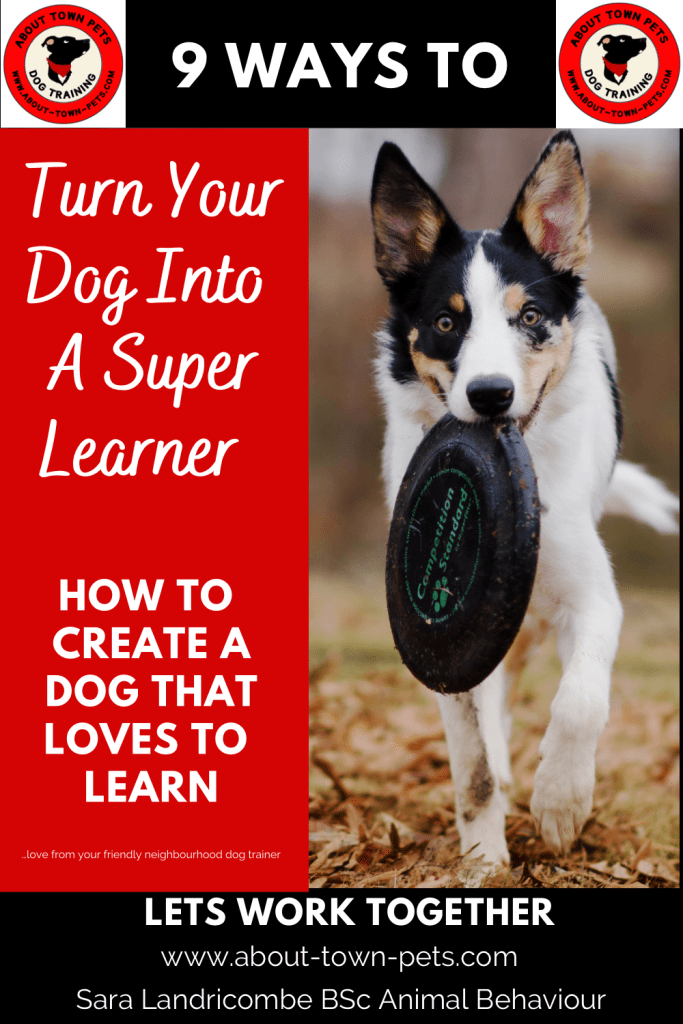
By following these steps, you can foster a positive learning environment that strengthens the bond between you and your dog. Remember, the key is consistency, patience, and making learning enjoyable for both of you. Love from your friendly neighbourhood dog trainer 🐶👍 S
I’d you enjoyed this post please check out my previous post on Knowing how long to leave your dog home alone x


 About Town Pets
[…] 💡 Related reading: 9 Ways to Turn You & Your Dog into Super Learners […]
LikeLike